
Artículo: How to Verify Ethical Coffee: A 2026 Shopper's Guide
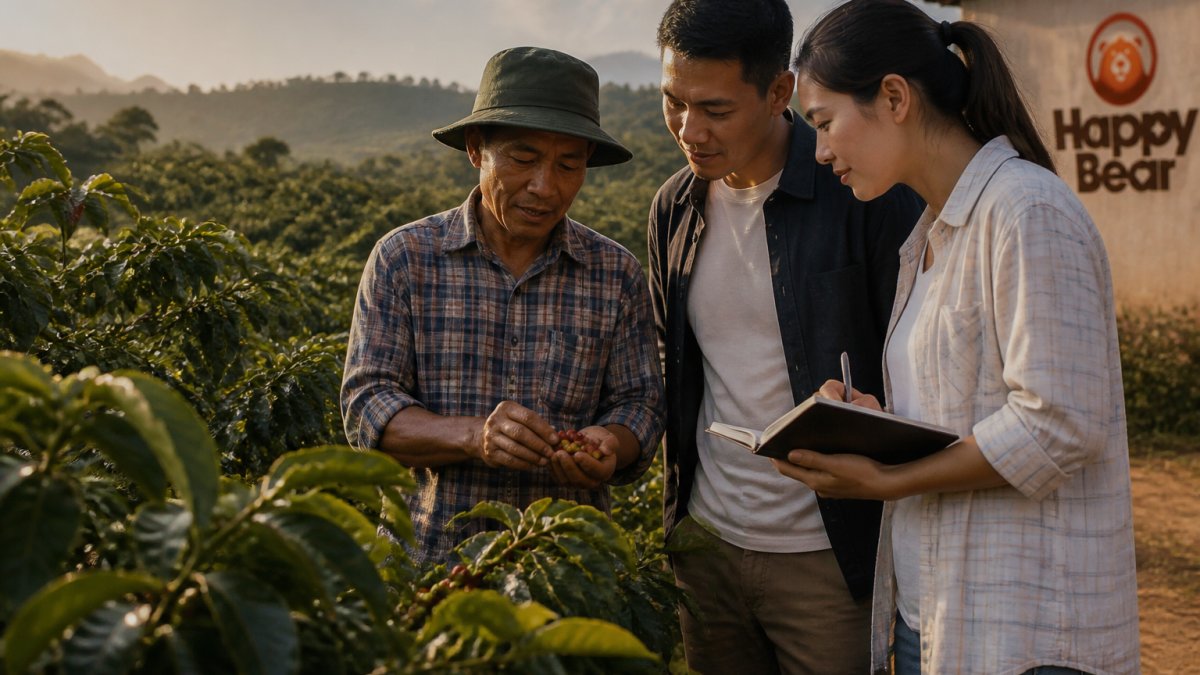
How to Verify Ethical Coffee: A 2026 Shopper's Guide
Table of Contents
- Why Verifying Ethical Coffee Claims Matters in 2026
- Step 1: Read the Label Like a Detective
- Fair Trade vs Direct Trade Coffee Explained
- How to Spot Coffee Greenwashing
- B Corp Certified Coffee Brands: What the Label Tells You
- Using QR Codes and Blockchain to Verify Ethical Coffee
- How to Verify Direct Trade Claims
-
Regional Risks in Ethical Coffee Sourcing
- Brazil: Labor Contracting and Mechanized Harvests
- Colombia: Smallholder Economics and Price Volatility
- Ethiopia: Cooperative Governance and Cherry Pricing
- Central America: Harvest Labor and Water Use
- Southeast Asia: Deforestation and Land Tenure
- East Africa Beyond Ethiopia: Kenya, Rwanda, Uganda
- How to Use This When You're Standing in the Store
- Budget-Friendly Ethical Coffee: You Don't Have to Pay More
- Conclusion: Your Role in Ethical Coffee Verification
- Frequently Asked Questions
Last Updated: September 30, 2026
Why Verifying Ethical Coffee Claims Matters in 2026
Walk down any grocery aisle and you'll see bags shouting "sustainable," "direct trade," and "farmer-friendly." Many of those claims are hard to check, so learning how to verify ethical coffee has become a real skill. This guide breaks the process into simple steps.
Ethical coffee is coffee produced and sold in a way that supports fair pay for farmers, safe working conditions, and farming methods that protect the land. That definition sounds clean. The reality behind most packaging is messier.
The words on a bag are marketing, but the proof lives in documents, audits, and long-term relationships, a side most shoppers never see.
Below, we'll show you how to check a bag before you buy: which logos carry weight, which phrases mean nothing, and how to trace a bean back to a farm.
Step 1: Read the Label Like a Detective
Start with the front of the bag, but don't stop there. The front is designed to sell. The back and the fine print tell you more.
Flip the bag over. Look for a roaster name, a country of origin, and a harvest date. Then check the bottom seam or side panel for certification marks.
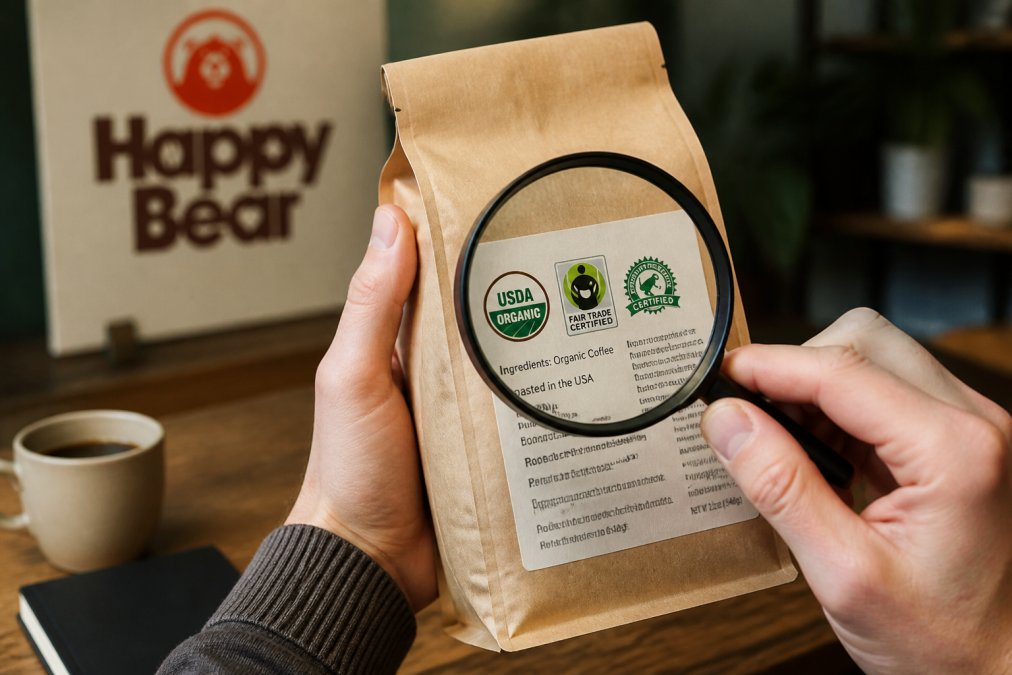
Most people scan for one logo and move on. That's the mistake. A single stamp rarely tells the whole story.
Certification Logos That Actually Mean Something
Third-party certification means an outside group, not the roaster, checked the supply chain. The ones worth knowing:
- Fairtrade sets a minimum price and a social premium paid to farming cooperatives.
- USDA Organic covers growing methods, not worker pay.
- Rainforest Alliance focuses on farming practices and some labor standards.
- Bird Friendly requires shade-grown farms that protect habitat (Smithsonian Bird Friendly®).
Each logo covers a different promise. None covers everything.
Red Flags on Coffee Packaging
- No roaster name or address anywhere on the bag
- A vague "ethically sourced" claim with no logo or explanation
- No country of origin listed
- A "direct trade" stamp that's the roaster's own design, not a third party's
If a bag hides basic facts, that's your answer.
Fair Trade vs Direct Trade Coffee Explained
The difference comes down to who sets the rules. Fair Trade relies on a certification system with set prices and audits. Direct Trade means a roaster buys straight from a farm or cooperative, often with no outside certifier.
Fair Trade gives you a paper trail. Direct Trade can pay farmers better, but only if the roaster is honest.
Here's how the two compare:
| Feature | Fair Trade | Direct Trade |
|---|---|---|
| Who verifies it | Outside certifier | The roaster |
| Price floor | Yes, set minimum | Negotiated case by case |
| Audit trail | Public and standard | Varies widely |
| Farmer premium | Built into the model | Depends on the deal |
| Risk to shopper | Low | Higher without proof |
Fair Trade is the safer bet for a shopper who wants a clear standard. Direct Trade can be better for farmers, but you have to trust the roaster.
How to Spot Coffee Greenwashing
Greenwashing is when a company markets a product as ethical without real proof. It's common in coffee because the supply chain is long and most buyers never see it.
A roaster can print "sustainable" on a bag with zero certification and zero documentation, the label is not a legal promise in most cases.
Common Greenwashing Tactics
- Earthy colors and leaf imagery with no certification
- Words like "natural," "pure," or "conscious" that have no defined meaning
- A single vague claim like "we care about farmers" with no details
- Burying the origin country in tiny text, or leaving it out
Questions to Ask Before You Buy
- Which third party certified this?
- What country and region did these beans come from?
- Does the roaster publish a transparency report?
If a brand can't answer these, treat the claim as unproven.
B Corp Certified Coffee Brands: What the Label Tells You
A B Corp certification means the whole company, not just one product, met standards for social and environmental performance. B Lab reviews the business and re-checks it every few years.
This differs from a coffee-specific logo: Fair Trade checks the beans, B Corp checks the company running the show.
What it tells you:
- The business passed a full review of its practices
- It must keep meeting standards to stay certified
- It covers labor, environment, and governance
What it doesn't tell you:
- Whether every bean in the bag is ethically sourced
- How much farmers were paid for that specific lot
So B Corp is a strong signal about the company. It's not a guarantee about the bag in your hand. Use it alongside other checks, not instead of them.
Using QR Codes and Blockchain to Verify Ethical Coffee
Some roasters now print a QR code on the bag. Scan it and you may see the farm name, harvest date, and price paid to the grower.
This is traceability in action. It's the fastest way to check a claim without emailing anyone.
Blockchain technology takes it further: a few companies log each supply chain step in a record that can't be quietly changed, creating an audit trail from farm to cup.
The catch: not every QR code leads somewhere useful. Test it in the store, real farm data is a good sign; a brand video means keep walking.
How to Verify Direct Trade Claims
Direct Trade has no official certifier, no shared definition, and no regulator. Two roasters can both print "Direct Trade" and mean completely different things, one might pay double the commodity price and visit the farm twice a year; the other might have wired money to an exporter once and never met the grower. The label alone tells you nothing.
So you do the checking yourself. The good news: roasters running real programs almost always publish the proof, because it's their main competitive advantage. The ones using the phrase as decoration stay vague.
The Four Things a Real Direct Trade Claim Discloses
Ask for these, in this order. A serious roaster answers all four without hesitation.
- The farm or cooperative name. Not "smallholders in Colombia", an actual name like a cooperative, a mill, or a family farm. If they buy through an exporter, they should still be able to name the producer group.
- The price paid, per pound, at origin. This is the number that matters. A common benchmark is the Fairtrade Minimum Price plus the social premium, if a roaster can't tell you whether they cleared that bar, they don't know their own supply chain.
- The length of the relationship. One harvest is a transaction. Five harvests is a partnership. Ten is a supply chain.
- Who physically visited the farm, and when. A roaster who has stood on the farm can describe the wet mill, the drying beds, the altitude. A roaster who hasn't will describe the flavor notes instead.
How to Score the Answers
You don't need a spreadsheet. A simple pattern works:
- All four answered with specifics: treat the claim as credible. This is a roaster doing real work.
- Farm named, price vague, relationship recent: plausible but unproven. Ask a follow-up.
- "We work directly with farmers" with no names: marketing. The phrase "work directly" is used by companies that buy through importers and never meet a grower.
- No response, or a response that redirects to a values page: treat the claim as unverified.
Where the Proof Usually Lives
Most roasters with genuine Direct Trade programs publish the details in one of four places:
- A transparency report or sourcing report, often updated annually, listing farms, regions, and prices paid
- A farm page on their website with photos, harvest dates, and producer names
- Origin trip write-ups, blog posts or social posts from a visit, with dates
- Bag-level detail, the roast date, the lot name, the farm, and the altitude printed on the back panel
If none of those exist, the claim is a vibe, not a practice.
The Relationship Test
Long-term producer relationships are the strongest single signal you can find. A roaster who has bought from the same cooperative for years has money, reputation, and logistics tied to that farm's success, and has absorbed bad harvests with the growers instead of walking away. A roaster who bought one lot as a limited release has none of that.
Ask one question to cut through it: "How many harvests have you bought from this producer?" The answer tells you more than any logo on the bag.
When Direct Trade Beats Certification, and When It Doesn't
Direct Trade can outperform certification on price paid to farmers, because there's no certification fee skimmed off the top and no minimum-price ceiling. A roaster paying well above the Fairtrade floor can move more money to the farm than a certified chain does.
But it can also underperform badly. Certification at least guarantees an audit; Direct Trade guarantees nothing except what the roaster chooses to disclose. That's why the verification burden sits with you.
Regional Risks in Ethical Coffee Sourcing
Ethical risk is not distributed evenly across the coffee belt. The problem a shopper should watch for changes by country, yet most buying guides flatten it into one vague "sustainability" conversation. Knowing what to look for in a given origin tells you which claims to pressure-test.
Below are the major producing regions, the ethical risks that actually show up there, and what a credible roaster discloses for each.
Brazil: Labor Contracting and Mechanized Harvests
Brazil is the largest coffee producer in the world and the most mechanized. Large estates use mechanical harvesters, which changes the labor picture, fewer pickers, but the workers who remain are often hired through labor contractors rather than directly by the farm. That contracting layer is where compliance problems concentrate, because responsibility gets diffused between the contractor, the estate, and the exporter.
What to look for: A roaster sourcing Brazilian coffee should be able to say whether the beans come from a large estate, a cooperative of smallholders, or a certified operation. Brazil has a large smallholder sector too, and the ethical profile of a family farm in Minas Gerais is very different from a mechanized estate in São Paulo state. If the bag just says "Brazil," ask which.
Colombia: Smallholder Economics and Price Volatility
The Colombian coffee sector is dominated by smallholder farms, many under a few hectares, organized into cooperatives and tied into the national growers' federation. The core ethical risk here isn't labor abuse, it's whether the farm family earns enough to stay in coffee at all. When the commodity price drops, smallholders in Colombia are the first to abandon their farms, migrate to cities, or switch to illicit crops.
What to look for: Certification matters more here than almost anywhere, because the Fairtrade minimum price and the social premium are designed exactly for this problem. A roaster buying Colombian coffee without certification should be able to name the cooperative and the price paid.
Ethiopia: Cooperative Governance and Cherry Pricing
Ethiopia is the birthplace of coffee and one of the most complex supply chains in the industry. Most coffee moves through a network of smallholder farmers, washing stations, and cooperatives, with a government-run exchange historically sitting in the middle. The ethical risk is not usually farm-level abuse, it's whether the money that leaves the roaster actually reaches the farmer after passing through the washing station, the cooperative, the exporter, and the exchange.
What to look for: Ethiopian coffees are often sold as single-origin lots with a washing station name. That's a good sign, it means the roaster knows the specific point in the chain where the coffee was processed. If the bag says only "Ethiopia" with no washing station or cooperative, the traceability stops at the border.
Central America: Harvest Labor and Water Use
Guatemala, Honduras, El Salvador, Nicaragua, and Costa Rica share a pattern: labor shortages during harvest, reliance on migrant pickers from neighboring countries, and wet-milling processes that consume large volumes of water. The labor risk is real, pickers are often paid by weight, which creates pressure to strip unripe cherries, and housing and sanitation conditions on remote farms vary widely.
What to look for: Bird Friendly certification is unusually relevant in this region, because it requires shade-grown farms that preserve habitat and tend to be smaller, more diversified operations. Rainforest Alliance also has a meaningful footprint here. A roaster sourcing Central American coffee should be able to speak to harvest labor, not just flavor.
Southeast Asia: Deforestation and Land Tenure
Vietnam is the second-largest coffee producer in the world, and Indonesia and Thailand both have significant sectors. The dominant ethical risk in this region is deforestation, coffee expansion into forested land, particularly in Vietnam's Central Highlands and parts of Indonesia. Land tenure is also contested in some areas, with smallholders farming land they don't formally hold title to.
What to look for: Deforestation risk is hard to verify from a bag. Certification helps, Rainforest Alliance and USDA Organic both include land-use standards, but the strongest signal is a roaster who can name the province and describe the farm's shade and canopy situation. Robusta from this region is common, so if the bag is a blend, ask which component is Southeast Asian.
East Africa Beyond Ethiopia: Kenya, Rwanda, Uganda
Kenya's auction system and Rwanda's cooperative washing stations both produce excellent coffee, and both carry a version of the same risk: smallholder farmers who depend on a single harvest and a single buyer. Kenya's auction historically favored large estates over smallholders; Rwanda's post-conflict cooperative rebuilding made farmer ownership a central goal.
What to look for: Cooperative names and washing station names. In Rwanda especially, a roaster who can name the cooperative is a roaster who is buying at the cooperative level, not through a bulk exporter.
How to Use This When You're Standing in the Store
You don't need to memorize the whole map. Use origin as a filter for which question to ask:
- Brazil or Vietnam: ask about labor contracting and land use.
- Colombia or Ethiopia: ask about cooperative names and prices paid.
- Central America: ask about harvest labor and shade.
- Kenya or Rwanda: ask about the washing station or cooperative.
A roaster who can answer the question for their specific origin is a roaster who knows their supply chain. A roaster who answers every origin with the same generic "we care about farmers" line is telling you something too.
Budget-Friendly Ethical Coffee: You Don't Have to Pay More
Here's the myth worth killing: ethical coffee has to cost a fortune. It doesn't.
Prices vary by roast, origin, and how the beans are flavored or processed. You can find certified beans at many price points. The trick is knowing where to look.
- Buy whole bean in larger bags to lower the per-cup cost
- Choose a certified blend over a rare single-origin lot
- Skip the flavored syrups and brew at home
- Try a subscription so you're not paying café markups
A subscription can also cut waste. You get fresh beans on a schedule instead of buying bags that go stale. That's money saved and less coffee thrown out.
Happy Bear Coffee offers customizable bundle subscriptions, so you can mix regular and decaf, or try small-batch roasts without committing to a full bag of each. For shoppers who want to test a few origins before settling in, that flexibility matters.
Conclusion: Your Role in Ethical Coffee Verification
The hard part of ethical coffee isn't finding it. It's proving it. Labels sell a feeling, but only a few give you something you can check: a certification, a farm name, a published price, a working QR code.
That's the shift worth making. Stop trusting the front of the bag. Start reading the back, scanning the code, and asking the roaster direct questions. Consumer advocacy works when shoppers demand proof.
At Happy Bear Coffee, we build our sourcing around the same checks we just walked you through.
Frequently Asked Questions
What certifications should I look for to verify ethical coffee?
Look for third-party certifications like Fair Trade Certified, Rainforest Alliance, and B Corp. Fair Trade guarantees minimum prices and premiums for farmers. Rainforest Alliance focuses on environmental and social standards. B Corp measures a company's overall social and environmental performance. Also check for USDA Organic, which prohibits synthetic pesticides. These logos are verified through independent audits, not self-claims.
What is the difference between Fair Trade and direct trade coffee?
Fair Trade uses third-party certification to ensure minimum prices, fair wages, and community development premiums. Direct trade means roasters buy directly from farmers, often paying above Fair Trade prices, but without standardized certification. Direct trade can offer more transparency and higher quality, but claims are harder to verify. Ask roasters for import documentation or farm-level traceability to confirm direct trade relationships.
How can I tell if a coffee brand is truly sustainable or just greenwashing?
Watch for vague terms like 'eco-friendly' or 'naturally sourced' without proof. Check for specific certifications, published transparency reports, and named farm partners. Look for harvest dates and import documentation. Brands that practice greenwashing often avoid third-party audits. If a company claims sustainability but has no certification logos or verifiable supply chain data, treat those claims with skepticism.
Do QR codes on coffee bags actually prove ethical sourcing?
QR codes can provide traceability if they link to farm-level data, audit trails, or blockchain records. However, a QR code alone doesn't guarantee ethics. Some brands use them for marketing without meaningful verification. Scan the code and see what information appears. If it shows specific farm names, harvest dates, and certification details, that's a good sign. If it only leads to a generic brand page, it's not proof.

Dejar un comentario
Este sitio está protegido por hCaptcha y se aplican la Política de privacidad de hCaptcha y los Términos del servicio.