
Artículo: Guide to Specialty Coffee Flavor Profiles
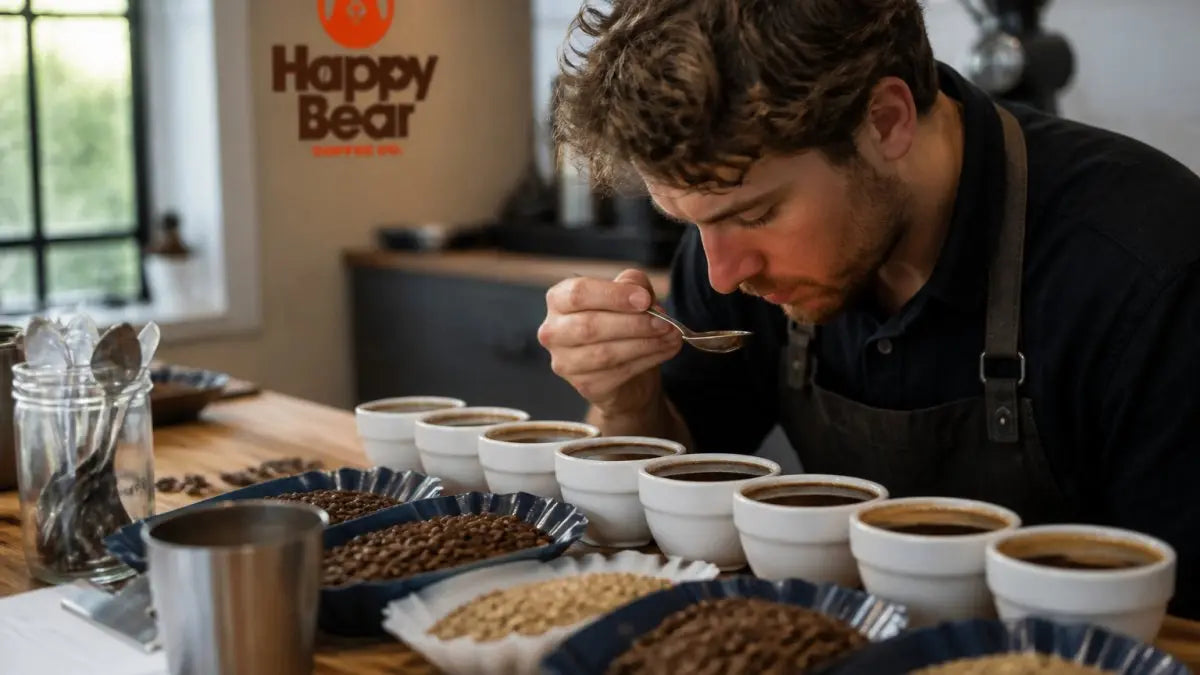
Guide to Specialty Coffee Flavor Profiles
Table of Contents
- What Are Coffee Flavor Profiles?
- The Origins and Terroir Behind Flavor
- Impact of Roast Level on Coffee Flavor
- Common Flavor Categories Explained
- How to Identify Coffee Tasting Notes
- How to Conduct a Coffee Cupping at Home
- Key Sensory Elements: Acidity, Body, and Mouthfeel
- How Brewing Methods Influence Flavor Expression
- Food Pairing Guide for Specialty Coffee
- Troubleshooting Off-Flavors and Extraction Issues
- Building Your Specialty Coffee Tasting Library
- Frequently Asked Questions
Last Updated: October 4, 2026
What Are Coffee Flavor Profiles?
A specialty coffee flavor profile is the unique combination of tastes, aromas, and sensory characteristics that define how a coffee tastes from the first sip to the finish.
At Happy Bear Coffee, we've spent years sourcing single-origin beans and small-batch roasts specifically because their flavor profiles tell a story.

The language of specialty coffee flavor profiles might feel intimidating at first.
The Origins and Terroir Behind Flavor
Where coffee grows matters more than almost any other factor in determining its final flavor. Terroir is the French term coffee professionals use to describe how a specific geographic location, its climate, soil, altitude, and rainfall patterns, shapes the taste of the beans grown there.
The terroir concept explains why two coffees processed identically can taste completely different. A bean grown at sea level in one region will have a different flavor profile than the same variety grown at 6,000 feet elevation somewhere else.
Altitude and Growing Conditions
Altitude is one of the most powerful influences on coffee flavor. Higher elevations mean slower bean development, which allows more complex sugars and acids to accumulate.
The relationship between elevation and flavor isn't random. Cooler temperatures at higher altitudes slow the ripening process.
Temperature fluctuations matter too. Regions with significant differences between daytime warmth and nighttime cool, common in mountainous areas, produce beans with more balanced flavor development.
Processing Methods Shape the Cup
How coffee cherries are processed after harvest has an enormous impact on the final flavor.
Washed Process: The cherry is removed, the bean is fermented in water, then dried.
Natural Process: The entire cherry dries intact around the bean before removal.
Honey Process: The cherry is removed but some of the sticky fruit mucilage remains during drying.
Happy Bear Coffee's Tanzania Peaberry Punch, a medium roast, has notes of rich cocoa, tropical fruit, and lemongrass.

Impact of Roast Level on Coffee Flavor
Roasting is where potential becomes reality. The roaster controls how much heat the bean receives and for how long, fundamentally transforming the bean's flavor profile. Understanding roast levels is essential because the same origin coffee will taste dramatically different depending on how dark it's roasted.
Light Roasts: Bright and Complex
Light roasts are pulled from the roaster right around first crack, the moment when the bean's internal pressure causes it to expand and create an audible snap.
Light roasts preserve the most acidity and highlight origin-specific notes. You'll find more fruity, floral, and tea-like qualities in light roasts.
Happy Bear Coffee's Light N' Cozy exemplifies this approach.

Medium Roasts: The Balanced Middle Ground
Medium roasts continue past first crack but stop before second crack begins. This creates a balance between origin characteristics and roast-developed flavors.
Most specialty coffees are roasted to medium because this level offers the broadest appeal. The flavor profile becomes more approachable, less challenging acidity, more sweetness, better body.
The Blooming Bear, an Ethiopian Yirgacheffe medium roast, is distinctively floral and fruit-toned, with notes reminiscent of citrus and wine.
Dark Roasts: Bold and Full-Bodied
Dark roasts continue well past second crack, sometimes approaching a full city roast or beyond. At this level, roast flavors dominate. You taste caramelized sugars, dark chocolate, smoky notes, and sometimes a slight bitterness.
Dark roasts produce heavier body and lower perceived acidity because the roasting process has broken down some of the acids. They're excellent for espresso and milk-based drinks because the bold, roasty flavors hold up to milk and don't get lost.
Common Flavor Categories Explained
Specialty coffee tasting notes fall into several broad categories. Learning to recognize these helps you understand what you're tasting and find coffees you'll enjoy.
Fruity and Floral Notes
Fruity coffees taste like actual fruit, berries, citrus, stone fruit, or tropical fruit, not artificial fruit flavoring. These notes come from the origin and processing method, not added flavoring.
Floral notes, jasmine, lavender, rose, hibiscus, are common in coffees from Ethiopia and some Central American origins. These delicate notes are most pronounced in light to medium roasts, where they haven't been roasted away.
Chocolatey and Nutty Profiles
Chocolate and nut notes emerge partly from the origin but are often enhanced by medium to medium-dark roasting. Cocoa, dark chocolate, milk chocolate, and hazelnut, almond, or walnut notes are common in coffees from Brazil, Colombia, and Indonesia.
These flavor categories tend to be more approachable for people new to specialty coffee because they're familiar, comforting flavors. A coffee with chocolate and nut notes feels indulgent without being challenging.
Caramelized and Sweet Characteristics
Caramel, brown sugar, molasses, and honey notes develop during roasting as sugars break down and recombine. These notes are more prominent in medium and darker roasts.
Sweetness in coffee is different from added sugar. It's the perception of natural sugars in the bean, enhanced by proper extraction and roasting. A "sweet" coffee tastes balanced and approachable, with pleasant notes rather than harsh bitterness.
How to Identify Coffee Tasting Notes
Learning to taste coffee intentionally is a skill, not a talent. Most people can develop this ability with minimal practice.
Training Your Palate
Start by tasting coffee alongside reference flavors. Brew a coffee and have actual chocolate, citrus fruit, or nuts nearby.
Pay attention to the different stages of tasting. The first sip hits your palate differently than the middle sips, and the finish, the lingering aftertaste, reveals notes that might not be obvious initially.
Temperature changes flavor perception too. As coffee cools, different compounds become more or less prominent. Some notes hide in hot coffee but emerge as it cools.
Using the SCA Coffee Flavor Wheel
The Specialty Coffee Association (SCA) publishes the Coffee Flavor Wheel, a visual tool that organizes tasting descriptors into categories and subcategories.
The flavor wheel is designed to help you narrow down what you're tasting.
Happy Bear Coffee's single-origin selections provide excellent opportunities to practice with the flavor wheel. Each origin has distinct characteristics that map clearly to the wheel's categories.
How to Conduct a Coffee Cupping at Home
Coffee cupping is the standardized tasting method used by professionals to evaluate coffee. You can conduct a simplified version at home to develop your tasting skills and compare different coffees side by side.
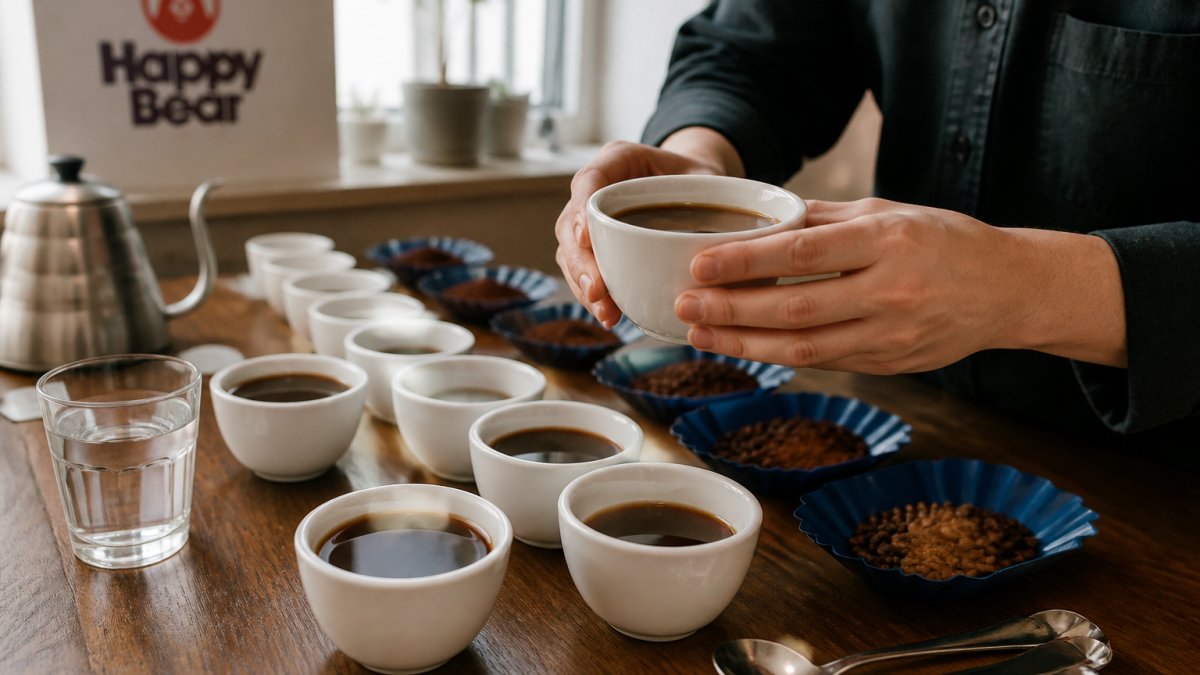
What You'll Need to Get Started
- Multiple coffee samples (3-5 is ideal for your first cupping)
- Cupping bowls or small coffee cups (white ceramic works best because it doesn't affect color perception)
- A gooseneck kettle or standard kettle for precise pouring
- Water heated to 200°F
- A spoon for each coffee sample
- A notebook to record your observations
- Reference flavors or the SCA Coffee Flavor Wheel for comparison
The setup doesn't need to be fancy. Professional cuppers use specific equipment, but home cuppers can improvise with standard kitchen items. The key is consistency, use the same cups, spoons, and water temperature for each sample so variables are controlled.
The Cupping Process Step by Step
Step 1: Grind and Measure Grind your coffee to a medium consistency, similar to sea salt.
Step 3: Add Hot Water Pour hot water (200°F) over the grounds, saturating them completely.
Step 5: Let It Cool Allow the coffee to cool for several minutes.
Step 7: Record Your Observations Write down what you taste. Use the flavor wheel or simple descriptors.
Key Sensory Elements: Acidity, Body, and Mouthfeel
Three sensory dimensions define how coffee feels and tastes on your palate: acidity, body, and mouthfeel.
Acidity is the brightness or tartness you perceive.
Body refers to the weight and thickness of the coffee on your tongue.
Mouthfeel is the overall tactile sensation, how the coffee feels in your mouth beyond just taste.
These three elements work together.
How Brewing Methods Influence Flavor Expression
The same coffee tastes dramatically different depending on how it's brewed because brewing method controls three critical variables: water temperature, contact time, and filtration. These variables determine which flavor compounds extract into your cup. Understanding the relationship between these variables and flavor lets you intentionally adjust your brew to emphasize or downplay specific notes in a coffee's profile.
Water Temperature and Flavor Extraction
Water temperature is the single most powerful lever for controlling flavor expression.
200-205°F (ideal for most specialty coffee): This range extracts balanced flavor.
205-210°F (for darker roasts and fuller body): Darker roasts and coffees you want to taste heavier benefit from hotter water.
A practical experiment: brew the same medium roast at 195°F and 205°F using identical grind size and contact time.
Contact Time and Extraction Completeness
Contact time, how long water touches the grounds, determines how much total extraction occurs.
Pour-over (2-4 minutes): Water flows through grounds quickly.
French press (4 minutes immersion): Grounds sit in hot water for a fixed time.
Espresso (25-30 seconds): Despite the brief contact time, espresso extracts intensely because water is forced through grounds under 9 bars of pressure.
Cold brew (12-24 hours): Extended contact time with cold water extracts slowly.
Grind Size: The Fine-Tuning Tool
Grind size controls how quickly water can reach and extract from the grounds.
Coarse grind (French press, cold brew): Large particles slow water flow and reduce surface area. This prevents over-extraction in long-contact methods.
Medium grind (pour-over, drip): Medium particles balance surface area and flow rate.
Fine grind (espresso, Turkish coffee): Small particles create maximum surface area.
A practical adjustment: if your pour-over tastes sour and thin (under-extracted), grind finer.
Filtration and Oil Content
Filtration method determines whether oils remain in the cup, directly affecting body and mouthfeel.
Paper filters (pour-over, drip machines): Paper removes oils and fine particles, creating a clean cup that emphasizes origin characteristics, acidity, and clarity of flavor.
Metal filters (French press, Moka pot): Metal allows oils to pass through, creating a heavier body and richer mouthfeel.
No filter (Turkish coffee, cowboy coffee): Unfiltered coffee has maximum body and intensity. Sediment and oils create a thick, intense cup.
Combining Variables: A Practical Framework
These variables interact. Adjusting one often requires adjusting others to maintain balance.
To emphasize body and sweetness: Use 205°F water, metal filtration, medium-coarse grind, 4+ minute contact time.
To reduce perceived acidity: Use hotter water (205°F), longer contact time, or coarser grind.
To increase perceived acidity and brightness: Use cooler water (195°F), shorter contact time, or finer grind.
The key insight: flavor profiles aren't fixed.
Food Pairing Guide for Specialty Coffee
Coffee's flavor profile determines what foods complement it best.
Light, fruity, and floral coffees pair well with pastries, light desserts, and fruit-forward foods.
Full-bodied, dark roasts pair with bold, savory foods and heavy desserts.
Floral coffees pair unexpectedly well with savory foods.
The principle is balance: lighter coffees pair with lighter foods, heavier coffees with heavier foods.
Troubleshooting Off-Flavors and Extraction Issues
Coffee sometimes tastes wrong, sour, bitter, flat, or unpleasant. Before assuming the coffee is bad, you need to diagnose whether the problem is the bean itself, your brewing technique, or how the coffee was stored. Most off-flavors are fixable by adjusting your brewing variables. Understanding the difference between extraction problems and genuine defects saves money and improves your coffee experience.
Extraction Problems: Fixable with Technique Adjustments
Extraction problems occur when water pulls too few or too many compounds from the grounds.
Under-extraction (tastes sour, thin, weak, or grassy)
Under-extraction means water didn't pull enough compounds.
Diagnosis: If your coffee tastes sour or sour-and-thin, you're under-extracting.
Fixes (in order of impact):
- Grind finer. Finer particles increase surface area, allowing water to extract more compounds in the same time. This is the easiest adjustment. If you're using a medium grind, move to medium-fine.
- Increase water temperature. Hotter water extracts faster. If you're brewing at 195°F, try 200°F or 205°F. Each 5-degree increase noticeably increases extraction.
- Extend contact time. Let water sit longer with the grounds. In pour-over, slow your pour rate. In French press, extend steeping from 4 to 5 minutes. In espresso, tamp harder to slow water flow.
- Use hotter water + finer grind together. Combining adjustments has a multiplicative effect. Hotter water + finer grind fixes most under-extraction problems.
Example: You brew a light roast pour-over and it tastes sour and thin.
Over-extraction (tastes bitter, harsh, burnt, or astringent)
Over-extraction means water pulled too many compounds, including bitter ones that dissolve slowly.
Fixes (in order of impact):
- Grind coarser. Larger particles reduce surface area, slowing extraction. If you're using a medium grind, move to medium-coarse. This is the easiest adjustment.
- Lower water temperature. Cooler water extracts slower. If you're brewing at 205°F, try 200°F or 195°F. Each 5-degree decrease noticeably reduces extraction.
- Shorten contact time. Reduce how long water touches the grounds. In pour-over, speed up your pour. In French press, reduce steeping from 4 to 3 minutes. In espresso, tamp lighter to speed water flow.
- Use cooler water + coarser grind together. Combining adjustments fixes most over-extraction problems quickly.
Example: Your French press tastes bitter and harsh.
Genuine Coffee Defects: When the Bean Is the Problem
Moldy or musty flavors (earthy, damp, basement-like)
Solution: Contact your supplier.
This indicates over-fermentation during processing or storage in high humidity.
Diagnosis: Fermented flavor tastes different from sour under-extraction.
Solution: Contact your supplier.
Phenolic or medicinal flavors (tastes like iodine, plastic, or chemicals)
This is rare but indicates contamination during processing or storage.
Solution: Do not drink this coffee.
Flat or cardboard-like flavors (tastes stale, papery, lifeless)
This indicates the coffee is old.
Diagnosis: Flat flavor tastes like the coffee has no character.
Solution: Buy fresher coffee.
Distinguishing Extraction Problems from Defects: A Decision Tree
When coffee tastes bad, follow this logic:
-
Does the flavor change when you adjust brewing variables? If yes, it's an extraction problem. If no, it's likely a defect.
- Sour taste that improves when you grind finer or use hotter water = under-extraction (fixable).
- Sour taste that persists regardless of grind, temperature, or contact time = fermented defect (not fixable).
-
Does the flavor persist across multiple brewing methods? If yes, it's likely a defect. If no, it's an extraction problem.
- Bitter taste in French press but not in pour-over = over-extraction in French press (fixable by shortening steeping time).
- Bitter taste in both French press and pour-over = defective bean (not fixable).
-
Is the flavor unpleasant in a way that tastes chemical or wrong? If yes, it's likely a defect. If it tastes like a natural flavor (sour, bitter, earthy) that's just too intense, it's extraction.
- Harsh bitterness that tastes like burnt coffee = over-extraction (fixable).
- Sharp, vinegary tang that tastes fermented = fermented defect (not fixable).
When to Contact Your Supplier
If you've adjusted grind size, water temperature, and contact time across multiple brewing methods and the coffee still tastes wrong, contact your roaster. Provide details: what the coffee tastes like, which brewing methods you've tried, and what adjustments you've made. Reputable roasters stand behind their product and will replace genuinely defective coffee.
Building Your Specialty Coffee Tasting Library
Developing your palate takes time and exposure.
Start by ordering single-origin coffees from different regions.
Try different roast levels of the same origin.
Keep tasting notes. Write down what you taste, what you like, and what you'd change.
Happy Bear Coffee's customizable bundle subscriptions make it easy to build a tasting library.
Understanding specialty coffee flavor profiles transforms how you experience coffee.
Frequently Asked Questions
What are the main categories of coffee flavor profiles?
Specialty coffee flavor profiles typically fall into four main categories: fruity and floral notes (citrus, berries, jasmine), chocolatey and nutty flavors (cocoa, almonds, hazelnuts), caramelized and sweet characteristics (toffee, brown sugar, honey), and earthy or herbal tones. These categories overlap, and a single coffee often displays notes from multiple groups. The specific combination depends on the bean's origin, altitude, processing method, and roast level, creating the complexity that makes specialty coffee so rewarding to explore.
How do I identify tasting notes in specialty coffee?
Start by slowing down and engaging all your senses. Smell the dry grounds and brewed coffee, noting what aromas come to mind. Sip slowly, letting the coffee coat your mouth, and ask yourself what flavors remind you of, fruit, chocolate, nuts, flowers, or spices. Use the SCA Coffee Flavor Wheel as a reference tool to expand your vocabulary. Compare coffees side by side to train your palate. Most people improve their tasting abilities within a few weeks of intentional practice. Remember that tasting notes are subjective; your experience is valid even if it differs from the roaster's description.
Does roast level affect the flavor profile of specialty coffee?
Roast level dramatically shapes flavor. Light roasts preserve the bean's origin characteristics, highlighting acidity and bright, complex fruity or floral notes. Medium roasts balance origin flavors with roast-induced sweetness and body, offering versatility. Dark roasts develop bold, roasted flavors like chocolate, caramel, and spice while reducing acidity and emphasizing mouthfeel. The roasting process creates new compounds through the Maillard reaction, which explains why the same bean roasted light versus dark tastes distinctly different. Choose your roast level based on whether you want to taste the coffee's origin or the roaster's craft.
What is the SCA Coffee Flavor Wheel and how do I use it?
The Specialty Coffee Association (SCA) Coffee Flavor Wheel is a circular reference tool that organizes tasting descriptors into families radiating from the center. Start with the broad category closest to the center (fruity, floral, nutty, etc.), then move outward to more specific descriptors. For example, fruity expands to citrus, berry, or dried fruit, then to even more precise terms like lemon or blueberry. Use it during tasting to find words that match your experience. It's not about getting the 'right' answer but expanding your sensory vocabulary and communicating flavor more precisely with other coffee enthusiasts.
How does origin influence specialty coffee flavor profiles?
Origin, the country, region, and altitude where coffee grows, profoundly influences flavor. Ethiopian coffees often exhibit floral and fruity notes, while Central American beans tend toward chocolate and nutty profiles. Altitude matters because higher elevations slow bean maturation, concentrating sugars and creating more complex flavors. Volcanic soil, rainfall patterns, and local climate all contribute to terroir, similar to wine regions. Single-origin coffees from specific farms or microlots showcase these regional characteristics distinctly. This is why specialty coffee roasters emphasize origin: it's the foundation of the flavor story before roasting even begins.
What brewing method best highlights specialty coffee flavor profiles?
Different brewing methods emphasize different aspects of flavor. Pour-over and Chemex brewing produce clean, bright cups that highlight origin characteristics and acidity, making them ideal for single-origin light roasts. French press creates fuller body and heavier mouthfeel, showcasing chocolate and nutty notes. Espresso concentrates flavors and adds crema, intensifying sweetness and complexity. For exploring flavor profiles systematically, pour-over or cupping (the professional tasting method) offers the clearest window into a coffee's true character. Experiment with the same coffee using different methods to understand how brewing impacts what you taste.
Can I improve my ability to taste coffee flavors, or is it a natural skill?
Tasting ability is absolutely learnable and improves with practice. Your palate develops through repeated exposure and intentional attention. Start by comparing two contrasting coffees side by side, a light fruity roast and a dark chocolatey one, to train your taste buds to recognize differences. Use descriptive words consistently, even if they seem imprecise at first. Smell everyday items like citrus, cocoa powder, or flowers to build your sensory reference library. Within weeks of regular tasting, most people notice dramatic improvement in their ability to identify and articulate flavors. This skill makes coffee more enjoyable and helps you choose beans you'll genuinely love.

Dejar un comentario
Este sitio está protegido por hCaptcha y se aplican la Política de privacidad de hCaptcha y los Términos del servicio.