
Blue Bottle Alternative: Best Specialty Coffee Beans
Table of Contents
- What Makes a Coffee Brand a True Blue Bottle Alternative
- Single-Origin Specialty Coffee Beans: The Core Difference
- Fresh Roasted Coffee Beans Delivery Service: What to Expect
- How to Choose a Coffee Subscription That Fits Your Taste
- Ethical Sourcing and Direct Trade: Beyond Marketing Claims
- Price Comparison: What You're Actually Paying For
- Brewing Method Compatibility and Bean Selection
- Decaf and Low-Caffeine Specialty Options
- Making the Switch: What You Need to Know First
- Frequently Asked Questions
Why Coffee Drinkers Switch From Blue Bottle to Specialty Beans
Coffee drinkers abandon mainstream brands for specialty coffee beans when they want more control over flavor, freshness, and sourcing. Blue Bottle built its reputation on single-origin beans, but now operates at scale, creating a gap for drinkers seeking fresher roasts, frequent rotation, and direct sourcing knowledge. Specialty roasters like Happy Bear Coffee thrive by offering small-batch roasting, flexible subscriptions, and transparent sourcing. More of your money goes toward quality beans and sustainable farming rather than marketing.
What Makes a Coffee Brand a True Blue Bottle Alternative
A genuine alternative shares key characteristics: direct-trade or transparent sourcing, roasting to order or within days of purchase, and curated single-origin selections. Happy Bear Coffee exemplifies this model with sustainable sourcing, small-batch roasting, and published roast dates on every bag. The subscription system lets you customize origins, skip months without penalty, and pause anytime.
Transparency is non-negotiable. A real alternative tells you the farm name, altitude, processing method, and expected flavor profile. Happy Bear Coffee's single-origin beans range from $19 to $67 per 12-ounce bag depending on rarity and origin.
The subscription model matters critically. A true alternative offers flexibility: change selections monthly, skip shipments, or pause without losing your spot. Many mainstream brands lock you into rigid plans or charge cancellation fees.
Single-Origin Specialty Coffee Beans: The Core Difference
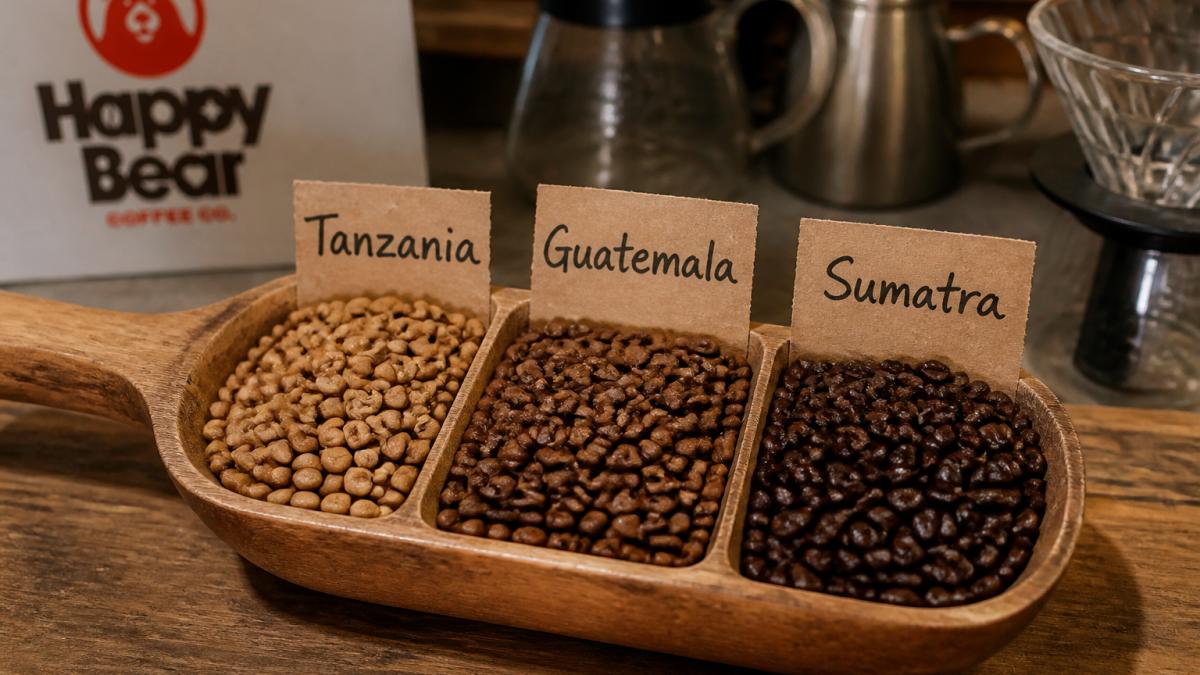
Single-origin specialty coffee beans come from one geographic region or farm, letting you taste terroir, the unique combination of altitude, soil, climate, and processing that defines a specific place. Tanzania Peaberry Punch from Happy Bear Coffee comes from volcanic soil at high altitude, creating bright acidity and tropical fruit notes. Blooming Bear, an Ethiopian Yirgacheffe, delivers floral and citrus characteristics nearly impossible to replicate elsewhere.

Blends combine multiple origins to create consistent flavor year-round, but they mask the nuances that specialty drinkers seek. A single-origin celebrates complexity.
Flavor Profiles and Roast Levels Explained
Flavor comes from three sources: the bean's origin (terroir), processing method, and roast level.
Roast levels directly impact flavor intensity and body. Light roasts preserve origin characteristics, you taste more acidity, brightness, and what the farm imparted. Light N' Cozy is pulled right before first crack, highlighting acidity and citrus while keeping body light. Medium roasts balance origin flavor with roast-induced sweetness and body. Blooming Bear and Guatemalan Glow offer both the bean's natural character and caramel and chocolate notes. Dark roasts emphasize roast flavors over origin, delivering smokiness, heaviness, and lower acidity. Smokey's Dark Sumatra is designed for drinkers wanting boldness and intensity.
Flavor profiles are tasting note descriptors of what you'll actually taste. Tanzania Peaberry Punch offers cocoa, tropical fruit, and lemongrass. Island Bear Jamaican Blue Mountain has orange, cream, and milk chocolate. These come from the bean's chemistry, not additives.
Processing method shapes flavor dramatically. Washed coffees emphasize acidity and clarity. Natural-process coffees are dried in the fruit, adding sweetness and body. Wet-hulled coffees like Sumatran Trail create earthy, herbaceous, intense profiles with low acidity.
How Roast Date and Freshness Impact Your Cup
Roast date is the most overlooked factor in specialty coffee quality. Coffee peaks 5-14 days after roasting. Before day 5, it's still degassing and tastes sharp. After day 14, it begins to fade. After 30 days, it's noticeably stale.
This is why freshness matters more than origin or roast level. A two-month-old rare Jamaican Blue Mountain tastes worse than a two-week-old everyday Costa Rican coffee. Happy Bear Coffee publishes roast dates on every bag.
Whole beans stay fresher longer than pre-ground coffee. Grinding increases surface area, accelerating oxidation and flavor loss. Buy whole beans and grind just before brewing. Keep beans in an airtight container away from light, heat, and moisture.
Fresh Roasted Coffee Beans Delivery Service: What to Expect
A fresh roasted coffee beans delivery service arrives with beans roasted days earlier, not weeks. Most operate on subscription models where you receive shipments every 2-4 weeks, selecting origins, quantities, and frequency. Happy Bear Coffee lets you customize bundles, mix single-origins, add decaf, choose roast levels, and adjust monthly without penalty.
Expect to pay between $19 and $67 per 12-ounce bag depending on origin rarity. Common origins like Guatemala and Costa Rica run $19-20. Rare coffees like Jamaican Blue Mountain ($62) or Hawaiian Kona ($67) command premium prices due to limited growing areas and labor-intensive harvesting.

Shipping typically takes 3-5 business days. Beans arrive whole with roast dates printed on the bag, plus tasting notes and brewing recommendations. The best services let you pause or skip shipments without cancellation fees.
How to Choose a Coffee Subscription That Fits Your Taste
Start by identifying your roast preference. If you like acidity and origin clarity, lean toward light and medium roasts. Light N' Cozy is ideal for brightness. If you prefer body and smoothness, medium roasts like Cubby's Go-To Costa Rican or dark roasts like Smokey's Dark Sumatra work better.
Next, consider origin. Ethiopian coffees tend toward floral and fruity. Central American coffees offer balance and sweetness. Indonesian coffees are earthy and full-bodied. Try one origin per month to build your palate.
Subscription frequency matters. If you drink coffee daily, you'll use about 1.2 pounds per week. Order every 2-3 weeks or adjust quantities to match consumption. Happy Bear Coffee subscriptions let you change frequency monthly.
Budget realistically. A 12-ounce bag at $20 makes about 17 cups, or roughly $1.18 per cup.
Consider decaf options if you drink coffee in the afternoon or evening. Sumatran Trail is available decaffeinated using Swiss Water Process, which removes caffeine without solvents.
| Roast Level | Best For | Flavor Profile | Origin Examples |
|---|---|---|---|
| Light | Bright, acidic lovers | Citrus, floral, tea-like | Ethiopia, Kenya, Central America |
| Medium | Balanced preference | Chocolate, caramel, fruit | Guatemala, Costa Rica, Tanzania |
| Dark | Bold, low-acid preference | Smoky, earthy, heavy body | Sumatra, dark roasts |
Ethical Sourcing and Direct Trade: Beyond Marketing Claims
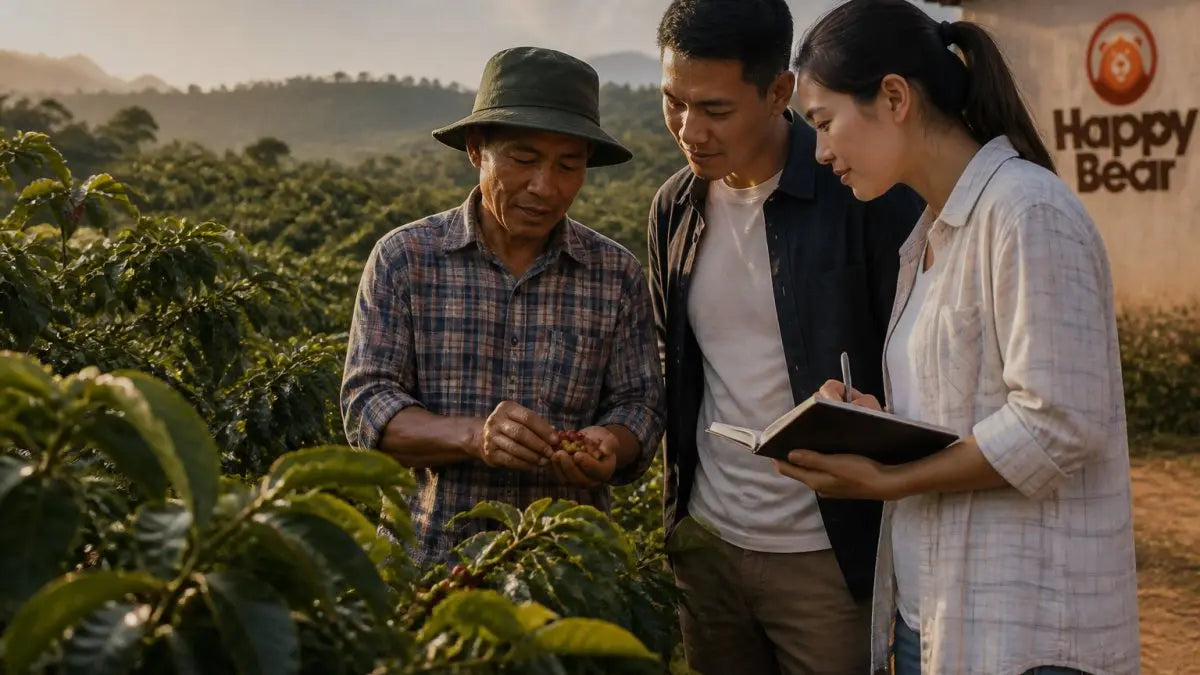
Direct trade means the roaster buys directly from farmers or cooperatives, eliminating middlemen and usually meaning farmers earn more per pound. Happy Bear Coffee sources sustainably, prioritizing relationships with farms using environmentally responsible practices. More of your money reaches the people who grew the coffee.
Fair trade certification guarantees minimum prices and labor standards but is often lower than direct-trade relationships. Look for roasters publishing sourcing relationships and pricing, not just certifications.
Sustainability means protecting water sources, soil health, and biodiversity. Ethical roasters work with farms using shade-grown methods, composting, and water conservation. Guatemalan Glow highlights Happy Bear Coffee's commitment to sustainable practices supporting environment and community.
Ask roasters directly: Where do you buy? What prices do you pay farmers? What certifications do your coffees hold? Transparent roasters answer these questions. Happy Bear Coffee's 5% donation model directing sales portions to charitable causes shows commitment beyond the transaction.
Price Comparison: What You're Actually Paying For
Specialty coffee beans cost more than supermarket coffee but less than café drinks. A 12-ounce bag ranges from $19 to $67, reflecting sourcing complexity and rarity. Common origins like Guatemala ($19.50) and Costa Rica ($20) are less expensive. Rare origins like Jamaican Blue Mountain ($62) and Hawaiian Kona ($67) command premiums due to limited growing regions and labor-intensive harvesting. Navigating these price tiers requires an understanding of how origin and processing methods influence the final cost of various premium coffee options available to discerning drinkers.
Processing method affects price. Washed coffees are straightforward and cheaper. Natural-process coffees require more labor, costing more. Wet-hulled coffees like Sumatran Trail ($19) are affordable despite complexity because Indonesia produces high volumes.
Roast date and freshness justify higher prices than aged supermarket coffee. You're paying for quality that degrades quickly.
Compare specialty coffee to alternatives:
- Supermarket coffee: $4-8 per pound
- Blue Bottle or similar mainstream brands: $15-20 per 12 ounces
- Happy Bear Coffee specialty beans: $19-67 per 12 ounces
- Café espresso: $4-6 per drink
Home brewing with premium specialty coffee costs roughly $1-3 per cup, 50-75% cheaper than café drinks with superior quality and freshness.
Brewing Method Compatibility and Bean Selection
Different brewing methods extract flavors at different rates and temperatures. Matching the right bean to the right brewer is the difference between a bright, complex cup and a muddy, over-extracted one.
Pour-Over and Chemex Brewing
Pour-over methods work best with medium and light roasts because the technique relies on precise water temperature and contact time to highlight acidity and origin clarity. Light roasts have denser bean structure and higher acidity, pairing well with slower, controlled extraction. Blooming Bear and Light N' Cozy are ideal for pour-over because their floral and citrus notes emerge clearly over 3-4 minutes.

Grind size matters critically. Pour-over requires medium-fine grind (similar to sea salt) to slow water flow and maximize contact time.
Water temperature should be 195-205°F. Hotter water extracts faster and pulls more bitter compounds from darker roasts. Cooler water (190°F) works better with light roasts to avoid over-extraction.
French Press
French press uses immersion brewing where grounds steep in hot water for 4 minutes before pressing. This method works best with medium and dark roasts because longer contact time can over-extract lighter roasts, making them taste harsh. Smokey's Dark Sumatra is designed for French press because its lower acidity and heavier body withstand aggressive extraction.
Grind size must be coarse (similar to breadcrumbs). Natural-process and wet-hulled coffees like Sumatran Trail are ideal for French press because their higher oil content and lower acidity complement the method's full-bodied extraction.
Water temperature should be 200-205°F. Cooler water under-extracts and creates weak cups.
Espresso Machines (Lever and Pump)
Espresso requires fine, consistent grind and high pressure (9 bars) to force hot water through grounds in 25-30 seconds. Medium and dark roasts are traditional because their lower density allows even water penetration. Light roasts have denser bean structure and can cause channeling, resulting in under-extracted, sour shots. However, modern espresso increasingly uses light roasts as single-origin shots.
Water temperature should be 200-204°F. Too hot, and light roasts taste burnt. Too cool, and extraction stalls.
Drip Coffee Makers (Automatic)
Automatic drip machines heat water to roughly 195-205°F and pour it over grounds in a filter basket. This method is forgiving because it's slow and consistent. Medium roasts are safest because they balance flavor without being too bright or heavy.
Grind size should be medium (similar to sand). Finer grinds can clog the filter basket and cause overflow, while coarser grinds under-extract.
Moka Pot and AeroPress
Moka pots and AeroPresses are hybrid methods combining immersion and pressure. Both produce concentrated, flavorful coffee working well with medium roasts ground medium-fine. These methods are versatile and forgiving, ideal for beginners experimenting with specialty coffee.
Moka pots heat water in a lower chamber, forcing steam and hot water up through grounds, then into an upper chamber. Medium roasts work best because slow pressure buildup doesn't over-extract lighter roasts.
AeroPresses use a plunger to force hot water through grounds in 1-2 minutes. This method is extremely versatile, working with any roast and grind size.
The Freshness Override
Regardless of brewing method, roast date trumps all other variables. Freshness is non-negotiable.
Decaf and Low-Caffeine Specialty Options
Quality decaf specialty coffee has improved dramatically. Most guides treat decaf as an afterthought, yet demand is real from afternoon and evening drinkers, caffeine-sensitive people, and those managing anxiety or sleep issues. Quality decaf from a specialty roaster tastes nearly identical to caffeinated versions if the decaffeination process is chosen carefully.
Decaffeination Methods and Flavor Impact
Swiss Water Process is the gold standard. It uses only water and temperature to extract caffeine with no chemical solvents. Green beans soak in hot water, dissolving both caffeine and flavor compounds. The water passes through activated charcoal, removing caffeine while leaving flavor compounds intact.
Swiss Water Process preserves 99.5% of flavor compounds while removing 99.9% of caffeine. The trade-off is cost: Swiss Water decaf runs $1-3 per pound higher than caffeinated versions.
CO2 Process uses pressurized carbon dioxide to extract caffeine from green beans. CO2 is selective, targeting caffeine molecules more aggressively than flavor compounds. The process is faster and cheaper than Swiss Water, with minimal flavor loss (roughly 5-10%).
Solvent-Based Processes (methylene chloride or ethyl acetate) are cheapest but strip more flavor compounds. Solvent-based decaf coffees taste noticeably flatter. Avoid solvent-based decaf from specialty roasters; if the method isn't specified, it's likely solvent-based.
Natural Decaffeination uses ethyl acetate derived from sugarcane instead of synthetic solvents. Flavor loss is moderate (10-15%), with cost between solvent-based and Swiss Water. This method is becoming more common in specialty roasting as a middle ground.
Caffeine Content Across Origins and Roasts
Arabica beans contain roughly 1.2-1.5% caffeine by weight. Since specialty roasters prioritize Arabica, you're already choosing lower-caffeine beans compared to mainstream brands blending in Robusta.
Dark roasts contain roughly 2-5% less caffeine than light roasts because roasting degrades caffeine molecules. The difference is small (5-10 fewer milligrams per cup), but it's measurable.
Processing method doesn't significantly affect caffeine content, but natural-process coffees have higher acidity and more complex flavor compounds, which can amplify caffeine's jittery effect. Washed coffees have cleaner flavor and lower acidity, making caffeine feel smoother.
Evaluating Decaf Quality
When shopping for decaf specialty coffee, look for these signals:
-
Decaffeination method is stated on the bag. If not specified, assume solvent-based and skip it. Specialty roasters using Swiss Water or CO2 advertise it.
-
Roast date is printed.
-
The origin is single-origin, not a blend.
-
Tasting notes are specific. Sumatran Trail decaf should list earthy, herbaceous, and full-bodied notes, not generic descriptors.
-
Price reflects the decaffeination method. Swiss Water decaf should cost $2-4 more per pound than caffeinated. If decaf costs the same, it's likely solvent-based.
Brewing Decaf Specialty Coffee
Decaf brews the same as caffeinated coffee, but bean structure is slightly more fragile after decaffeination. Use slightly cooler water (195-200°F instead of 200-205°F) to avoid over-extracting.
For pour-over, use medium-fine grind and brew 3-4 minutes. For French press, use coarse grind and steep 4 minutes. For espresso, use fine grind and pull a 25-30 second shot. Only water temperature should be slightly lower.
The Decaf Specialty Gap
Decaf drinkers have historically been treated as second-class citizens in specialty coffee culture. That's changing. Quality decaf specialty coffee is worth seeking out, especially if you drink coffee in the afternoon or evening, or if sensitive to caffeine.
Making the Switch: What You Need to Know First
Switching from Blue Bottle to specialty coffee alternatives requires adjusting expectations and habits slightly.
First, expect flavor variation. Specialty roasters rotate origins seasonally based on harvest cycles. A coffee you love in January might not be available in July. Embrace the rotation and use it to expand your palate.
Second, invest in a burr grinder if you don't have one. Pre-ground coffee loses flavor rapidly. A $30-100 burr grinder transforms your coffee quality more than any bean upgrade.
Third, learn your brewing method's basics. Pour-over, French press, and espresso each have optimal grind sizes, water temperatures, and brew times. Specialty coffee's flavor is only revealed with proper technique.
Fourth, adjust storage habits. Keep beans in an airtight container away from light and heat. Room temperature in a dark cabinet is ideal.
Fifth, give yourself a month to adjust. Your palate has been trained on darker, more forgiving roasts. Light and medium roasts will taste brighter and more complex. This is good, you're tasting more.
Sixth, start with medium roasts and common origins. Guatemalan Glow or Cubby's Go-To Costa Rican are approachable, balanced coffees. Once you understand how good specialty coffee tastes, expand to light roasts and unusual origins.
Finally, use subscription flexibility. Most specialty roasters let you skip months or change selections. If a coffee doesn't work, swap it next month.
Making the shift to specialty coffee beans from mainstream brands prioritizes freshness, transparency, and flavor over convenience and consistency. Happy Bear Coffee delivers all three through sustainably sourced single-origin beans, published roast dates, and flexible subscriptions. Start with a medium roast from an appealing origin, dial in your brewing method, and let your palate guide you. The specialty coffee world is built on the belief that better coffee is worth the small effort required to make it well. That belief is justified.
Frequently Asked Questions
What makes specialty coffee beans different from Blue Bottle?
Specialty coffee beans emphasize terroir, roast date transparency, and direct trade relationships with farmers. Unlike mass-market brands, specialty roasters publish cupping scores, exact harvest dates, and processing methods. Many specialty options offer single-origin beans roasted to order, ensuring maximum freshness. The key difference is traceability: you know exactly where your beans came from and when they were roasted, not just a vague origin region.
How do I choose a coffee subscription that matches my brewing method?
Start by identifying your primary brewing method, pour-over, espresso, French press, or drip, since each requires different grind consistency and bean density. Light roasts work best for pour-over to highlight acidity and flavor complexity. Medium roasts suit most brewing methods. Dark roasts excel in French press and espresso due to their lower acidity and heavier body. When selecting a subscription, confirm the roaster offers roast dates within 2-4 weeks of shipment for optimal freshness.
Are specialty coffee subscriptions actually fresher than buying from a local store?
Yes, when sourced from direct roasters. Fresh roasted coffee beans delivery services ship beans within days of roasting, typically with roast dates printed on the bag. Retail store beans often sit for weeks or months before purchase. Specialty subscriptions let you track freshness precisely, beans peak between 5-30 days post-roast depending on roast level. The subscription model ensures you receive fresh inventory on a predictable schedule rather than guessing shelf age at a store.
What certifications should I look for in ethically sourced specialty coffee?
Look for Fair Trade certification, direct trade partnerships (where roasters publish farmer relationships), and Specialty Coffee Association membership. Some roasters highlight specific practices like shade-grown or organic cultivation. Transparent sourcing means the roaster names the farm, region, and altitude. Avoid vague claims like 'sustainably sourced' without third-party verification. Check if the roaster publishes information about farmer payments or participates in cupping competitions, these indicate genuine quality commitment rather than marketing language.

댓글 남기기
이 사이트는 hCaptcha에 의해 보호되며, hCaptcha의 개인 정보 보호 정책 과 서비스 약관 이 적용됩니다.