
Article: 7 Best Coffee Storage Containers for Travel and Camping
7 Best Coffee Storage Containers for Travel and Camping
Last Updated: October 28, 2026
Quick Summary
The best coffee storage containers for travel need an airtight seal, light protection, bag-friendly size, and a lid that stays shut when tossed around. Match capacity to trip length: a weekend for one person needs roughly 6 to 9 ounces of beans.
- The BruTrek Cargo Can costs $22.00 and suits weekend camping and pre-measured servings.
- The Airscape Classic costs $37.50 and comes in 10 oz or 1 lb whole bean sizes.
- The Airscape Kilo holds up to 2.5 pounds of whole beans and measures 6.5 by 8 inches.
- Run a shake-and-drop test on any canister before trusting it in a pack.
- Keep the canister out of a cooler with melting ice, since moisture ruins beans fast.
Table of Contents
- What to Look for in Travel Coffee Storage Containers
- Quick Comparison: Top Picks for Portable Coffee Storage
- 1. BruTrek Cargo Can: Best for Weekend Camping and Pre-Measured Servings
- 2. Airscape Classic: Best Overall Travel Coffee Canister for Short Trips
- 3. Airscape Kilo: Best for Long Trips and Bulk Beans
- Coffee Storage for Camping: What Works in the Outdoors
- How to Keep Coffee Fresh While Traveling
- Whole Bean vs. Ground Coffee: Which Travels Better?
-
Mistakes to Avoid When Packing Coffee for a Trip
- Mistake 1: Filling a Valveless Canister to the Top
- Mistake 2: Trusting a Friction-Fit Lid in a Pack
- Mistake 3: Packing Coffee Next to Smelly Gear
- Mistake 4: Bringing the Home-Size Canister on a Short Trip
- Mistake 5: Grinding the Whole Bag Before You Leave
- Mistake 6: Leaving the Canister Open Between Cups
- Mistake 7: Storing Coffee in a Cooler with Melting Ice
- Mistake 8: Ignoring Altitude and Pressure Changes
- A Pre-Trip Checklist
- Choose Your Travel Coffee Container and Pack for the Trip
- Frequently Asked Questions
What to Look for in Travel Coffee Storage Containers
The best coffee storage containers for travel solve a problem your kitchen canister never faces: they have to hold a seal through a car trunk, a backpack, and a temperature swing between a warm tent and a cold morning.
Here is the short answer. A travel coffee canister needs four things: an airtight seal, protection from light, a size that fits your bag, and a lid that stays shut when the bag gets tossed around.
Coffee storage containers are vessels designed to limit a roasted bean's exposure to oxygen, light, heat, and moisture, the four things that pull aroma and flavor out of coffee fastest.
That definition matters more on the road than at home. Your kitchen is climate-controlled. A campsite is not.
Airtight Seals and One-Way Valves
Roasted coffee releases carbon dioxide for days after roasting (pubmed.ncbi.nlm.nih.gov). In a sealed container, that gas builds pressure. A one-way valve lets it escape without letting oxygen back in.
Not every travel canister has a valve. That is not automatically a dealbreaker, but it changes how you pack. If your canister is fully sealed with no valve, leave a little headspace and burp the lid after the first day. If it has a valve, you can fill it right to the top.
The seal itself matters just as much. Look for a gasket or silicone ring, and check that the lid locks rather than just rests. A friction-fit lid that feels snug on your counter will pop open in a backpack.
Size, Weight, and Packability
Match the canister to the trip, not to your home shelf.
Ask three questions before you buy:
- How many days am I packing for?
- Am I bringing whole beans or ground coffee?
- Is this going in a car, a pack, or a checked bag?
For a weekend, a small canister holding a few servings is plenty. For a week or longer, a larger canister saves you from rationing. Weight matters most for backpackers; car campers can afford a heavier stainless steel model. Either way, a flat-sided or cylindrical canister packs better than an odd-shaped one.
Quick Comparison: Top Picks for Portable Coffee Storage
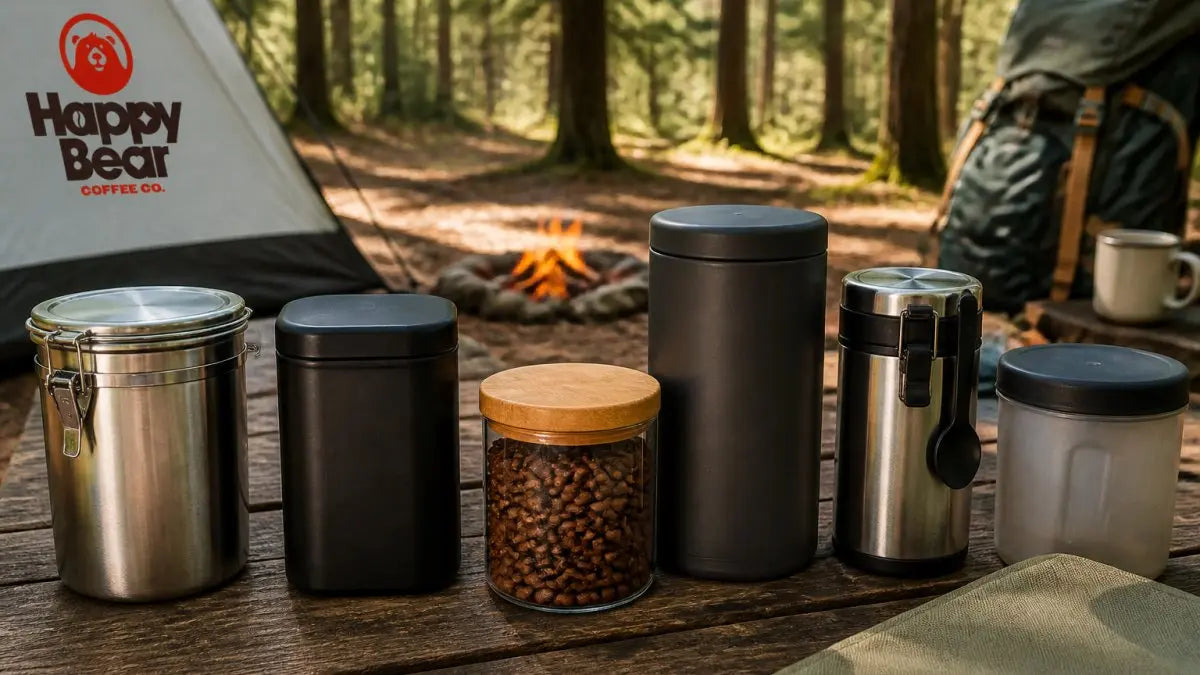
Three Happy Bear Coffee canisters are listed below.
| Container | Price | Capacity | Best For | Seal Type |
|---|---|---|---|---|
| BruTrek Cargo Can | $22.00 | Pre-measured day or weekend servings | Weekend camping, portioning | Screw-top with writable lid |
| Airscape Classic | $37.50 | 10 oz or 1 lb whole bean | Short trips, everyday travel | Patented airtight inner lid |
| Airscape Kilo | $49.00 | Up to 2.5 lbs whole bean | Long trips, bulk beans | Patented inner lid, galvanized steel |
1. BruTrek Cargo Can: Best for Weekend Camping and Pre-Measured Servings
The BruTrek Cargo Can holds pre-measured servings of coffee, tea, or protein powder.
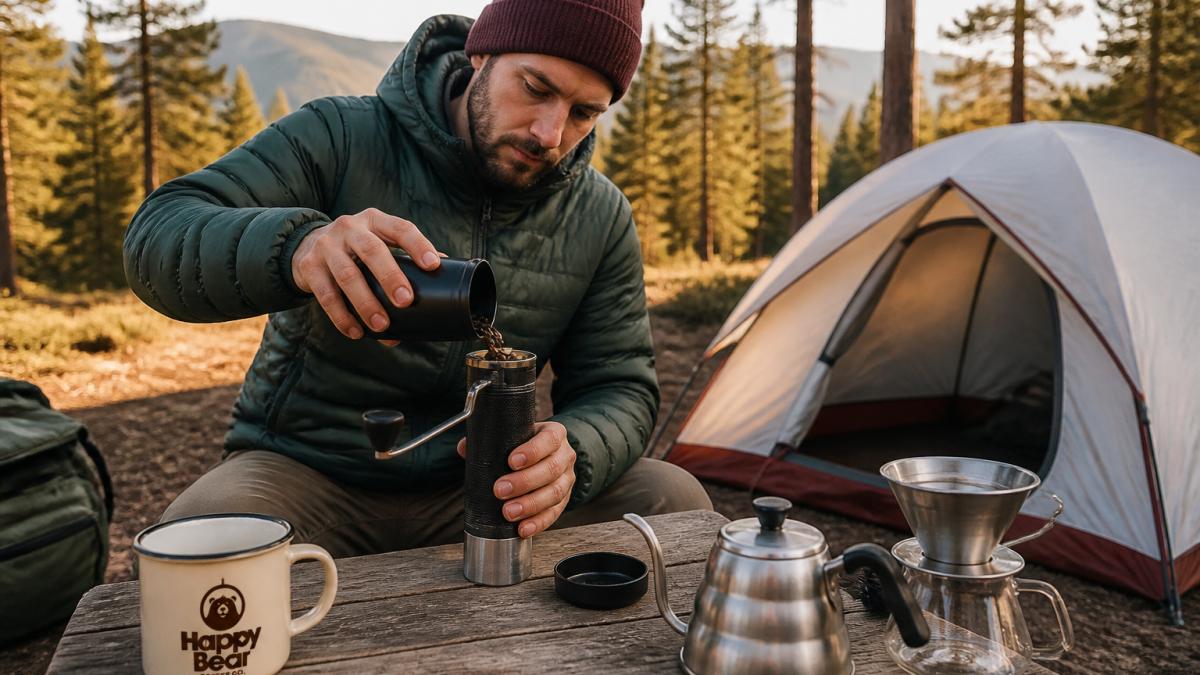
The writable top lid lets you label what is inside. The magnetic bottom is another listed feature.
The Cargo Can is also described as suitable for preserving spices and other oxygen-, humidity-, and light-sensitive goods.
Best for: Weekend campers and anyone who pre-portions coffee. Skip if: You are packing for a week and want to bring a full bag of beans.
You can shop the BruTrek Cargo Can and see the sizing for yourself.

2. Airscape Classic: Best Overall Travel Coffee Canister for Short Trips
The Airscape Classic listing describes patented airtight technology that removes oxygen.
The listing describes the Airscape Classic as food-grade stainless steel and gives sizes for 10 oz or 1 lb of whole bean coffee.
A cotton refill bag comes included.
The one drawback is that it is heavier and larger than a portion canister. For a two-night trip, that extra bulk is a fair trade for better freshness. For a backpacking trip where every ounce counts, it is not.
Best for: Short trips and travelers who want the best overall seal. Skip if: You are counting grams in a thru-hike pack.
Take a closer look at the Airscape Classic coffee canister to compare the two sizes.

3. Airscape Kilo: Best for Long Trips and Bulk Beans
The Airscape Kilo holds up to 2.5 pounds of whole coffee beans.
The listing describes a patented inner lid and a galvanized steel body. It measures 6.5 inches wide by 8 inches high.
The honest limitation: at that size, it is a car-camper's container, not a backpacker's. It is built to live in a tote, a van, or a cabin cupboard. If your travel involves a pack on your back, size down.
Best for: Long trips, group camping, and anyone who buys beans in bulk. Skip if: You are traveling solo with a small pack.
Check the Airscape Kilo canister for the full dimensions and capacity.

Coffee Storage for Camping: What Works in the Outdoors
Camping exposes coffee to conditions your kitchen never does: direct sun, temperature swings that can span 40°F between afternoon and dawn, humidity from a damp tent floor, and the physical abuse of a pack or truck bed. Most storage guides stop at "keep it in the shade." That is not enough. Here is what actually happens to beans in the field, and how to test whether your container is up to it before you leave. Even the most rugged vessel cannot compensate for beans that have already lost their character, so selecting the right coffee for camping remains the final step in ensuring your morning brew survives the elements.
Temperature Swings
Roasted beans degas and stale faster in heat. A canister left on a sunny tailgate can climb well above ambient air temperature, and a sealed container traps that heat against the beans. The fix is not complicated, but it is specific: store the canister in the coolest part of your setup, the shade side of the vehicle, a bear canister in the shade, or inside the tent at night when temperatures drop. Avoid the dashboard, the stove-side table, and any spot that gets direct sun after 10 a.m.
A common pattern among campers is to treat the cooler as a safe haven. It is not. A cooler with melting ice is a moisture trap, and coffee absorbs that humidity through the lid seal over a day or two. Keep the canister out of the cooler unless it is in a sealed outer bag.
Cargo Can Storage Container for BruTrek® →
Pressure Changes and Altitude
If your travel takes you from low elevation to a mountain pass, a fully sealed canister with no one-way valve will build pressure as external pressure drops. That pressure finds the weakest point, usually the lid gasket, and can pop a friction-fit lid or force stale air back through the seal when you open it. A one-way valve solves this by letting internal gas escape without letting outside air in. If your canister has no valve, open it briefly at the start of each day at altitude to equalize, then reseal.
Moisture and Condensation
Condensation forms when a cold canister meets warm, humid air, for example, pulling a steel canister out of a cold vehicle into a warm tent. Wipe the outside dry before opening, and keep the lid closed except while scooping. Silica gel packets tucked in the outer bag (not inside the coffee) can absorb ambient moisture without affecting flavor.
Rough Handling and Leak Resistance
A container that seals on a counter can fail in a duffel. Test yours before the trip: fill it halfway with water, seal it, and shake it vigorously for 30 seconds over a sink. Then wrap it in a towel and drop it from waist height onto a hard floor. If water escapes or the lid shifts, it will not survive a pack. Repeat the test with coffee grounds, a fine grind will find any gap water misses.
Trip Duration and Capacity
Match capacity to trip length rather than hauling your home canister. A useful rule of thumb: one ounce of whole beans per cup, and most travelers drink two to three cups a day. A weekend trip for two people is roughly 12 to 18 ounces of beans, a small canister. A week for a family of four can exceed two pounds, which is where a larger canister earns its bulk. For day trips, pre-measured portion canisters eliminate the scale and the guesswork.
Packing Mechanics
Cylindrical and flat-sided canisters pack better than round jars with protruding lids. Put the canister in a stuff sack or a hard-sided bin so it does not roll against stove fuel or bug spray, coffee absorbs odors through the seal over time. Keep it upright in transit; a screw-top lid that is snug on a shelf can loosen under vibration. If you are checking a bag, place the canister in the center of soft clothing rather than against the bag wall.
What to Skip
Leave the freezer at home. Freezing works when beans are sealed completely and thawed once, but a cooler with melting ice is a moisture source, not a storage solution. Likewise, do not transfer beans into a zip-top bag as a backup, bags are not light-blocking and the seal fails after a few openings.
How to Keep Coffee Fresh While Traveling
Keeping coffee fresh while traveling comes down to limiting air, light, heat, and moisture, and the container does most of that work for you. What you control is how you use it.
Follow this routine:
- Fill the canister close to full to minimize the air pocket above the beans.
- Press the inner lid down after every scoop, not just at the start of the trip.
- Keep the canister out of direct sun and away from the stove.
- Reseal it fully after each use, even if you are coming back in an hour.
- Bring whole beans if you can, and grind just before brewing.
For a deeper look at the storage principles behind all of this, our guide on how to store coffee beans fresh covers timelines, containers, and freezing methods in detail.
Whole Bean vs. Ground Coffee: Which Travels Better?
Whole beans travel better, and it is not close. A whole bean has far less surface area exposed to oxygen than ground coffee, so it holds its aroma and flavor longer. Once you grind, the clock speeds up considerably.
That does not mean ground coffee is off the table. If you are bringing a small hand grinder, whole beans are the obvious choice. If space or weight rules out a grinder, pre-grind at home and accept that the last cup of the trip will taste flatter than the first.
Here is how we would decide:
- Weekend trip, grinder packed: whole beans.
- Weekend trip, no grinder: pre-grind, and pack only what you will drink.
- Week-long trip: whole beans plus a hand grinder, every time.
- Backpacking: pre-ground in a portion canister, because weight wins.
Match your coffee format to your brewing setup, too. A pour-over cone and a French press both want a different grind, and packing the wrong one means a bad cup no matter how fresh the beans are.
Mistakes to Avoid When Packing Coffee for a Trip
Most travel coffee failures are packing decisions, not bean quality. The mistakes below are the ones that show up repeatedly in real trips, and each comes with a fix you can apply before you leave.
Mistake 1: Filling a Valveless Canister to the Top
Freshly roasted beans release carbon dioxide for several days. In a fully sealed canister with no one-way valve, that gas builds pressure and can force the lid open or push stale air back through the seal when you open it. Fix: leave an inch of headspace and burp the lid once a day for the first two days. If your canister has a valve, fill it to the top, the valve handles the gas.
Mistake 2: Trusting a Friction-Fit Lid in a Pack
A lid that feels snug on the counter will pop open under the vibration and compression of a packed bag. Fix: use a canister with a locking latch or a screw-top, and run the shake-and-drop test described in the camping section before you trust it. A rubber band around the lid is a cheap backup, not a solution.
Mistake 3: Packing Coffee Next to Smelly Gear
Coffee absorbs odors through the lid seal over hours. Fuel, bug spray, and last night's dinner will migrate into your beans. Fix: pack the canister in its own stuff sack, away from fuel and food, and never store it in the same bin as scented toiletries.
Mistake 4: Bringing the Home-Size Canister on a Short Trip
Weight and bulk you do not need become resentment by mile three. Fix: size the container to the trip. A weekend for one person needs roughly 6 to 9 ounces of beans; a week for two needs about 1.5 to 2 pounds. If you are backpacking, pre-measured portion canisters beat a full-size canister every time.
Mistake 5: Grinding the Whole Bag Before You Leave
Ground coffee stales far faster than whole beans because of the increased surface area. Fix: bring whole beans and a hand grinder when weight allows, or pre-grind only what you will drink and accept that the last cup will be flatter. For backpacking, pre-ground in a portion canister is the right trade-off.
Mistake 6: Leaving the Canister Open Between Cups
Every minute open is oxygen working on your beans. Fix: reseal fully after each scoop, even if you are coming back in an hour. Press the inner lid down after every use, not just at the start of the trip.
Mistake 7: Storing Coffee in a Cooler with Melting Ice
This is the mistake that ruins a trip's worth of beans fastest. Moisture gets in through the seal, and there is no drying it back out. Fix: keep the canister out of the cooler entirely, or seal it inside a waterproof outer bag if it must ride along.
Mistake 8: Ignoring Altitude and Pressure Changes
A sealed canister taken from low elevation to a mountain pass will build internal pressure as outside pressure drops. Fix: open briefly at the start of each day at altitude to equalize, then reseal. A one-way valve makes this automatic.
A Pre-Trip Checklist
Before you pack, confirm: the lid locks or screws, the seal passes the shake test, the capacity matches your trip length, the canister is opaque, and it is packed away from fuel and moisture. Five minutes of checking beats a week of flat coffee.
Choose Your Travel Coffee Container and Pack for the Trip
Picking the right container is the easy part once you know your trip. Weekend camping with pre-portioned servings points to the Cargo Can. Short trips where freshness is the priority point to the Airscape Classic. Long trips and bulk beans point to the Airscape Kilo.
Happy Bear Coffee offers sustainably sourced specialty coffee, including single-origin beans, blends, flavored varieties, and decaf options, along with camping and travel gear. The company offers customizable bundle subscriptions and a 5% donation program.
If you are gearing up for a season of trips, browse our full camping and travel coffee collection to see the containers, brewing gear, and beans that fit your setup.
Frequently Asked Questions
What is the best way to store coffee beans while traveling?
The Airscape Classic listing describes patented airtight technology and sizes for 10 oz or 1 lb of whole bean coffee. The Airscape Kilo holds up to 2.5 pounds of whole coffee beans. The BruTrek Cargo Can is described as suitable for pre-measured servings of coffee, tea, or protein powder.
Do coffee beans need an airtight container when traveling?
The Airscape Classic listing describes patented airtight technology that removes oxygen. The Airscape Kilo listing describes a patented inner lid.
How do you keep ground coffee fresh on a trip?
The BruTrek Cargo Can is described as suitable for pre-measured servings of coffee, tea, or protein powder.
What size coffee container should I bring on a trip?
The Airscape Classic is available in sizes for 10 oz or 1 lb of whole bean coffee, and the Airscape Kilo holds up to 2.5 pounds of whole coffee beans. The BruTrek Cargo Can is described as suitable for pre-measured servings.
Your next trip deserves better than a stale cup at sunrise. Happy Bear Coffee can help you pack fresh: choose from our travel-ready canisters, build a bundle subscription around the roasts you actually drink, and know that 5% of your purchase supports something bigger than breakfast. Get started with Happy Bear Coffee and drink better coffee wherever you pitch your tent.


Leave a comment
This site is protected by hCaptcha and the hCaptcha Privacy Policy and Terms of Service apply.