
Article: Does a Portable Coffee Press Work Well?
Does a Portable Coffee Press Work Well?
Last Updated: November 2, 2026
Quick Summary
A portable coffee press makes good coffee when you use coarse grounds, water around 200°F and a steep of about four minutes. Its cup is full-bodied, though it carries more sediment than an AeroPress-style brewer. Used with care, it works well for most travelers.
- Use coarse grounds, since fine grounds slip past the mesh and muddy the cup.
- Let boiling water rest 30 to 60 seconds to reach roughly 200°F before pouring.
- Steep for about four minutes, then press slowly and steadily.
- Pour the coffee out right away, because leaving it in the press turns it bitter.
- Rinse with a small amount of water and pack out used grounds.
Table of Contents
- Does a Portable Coffee Press Actually Make Good Coffee?
- What Affects Taste and Brew Quality in a Travel French Press
- How to Use a Travel French Press Step by Step
- Portable Coffee Press vs AeroPress: Which Travels Better
- Heat Retention, Spill Resistance and Durability on the Road
- Best Portable Coffee Maker for Camping: What to Look For
- How to Clean a Portable French Press in the Field
- Common Mistakes That Make Portable Press Coffee Disappoint
- Choosing a Travel Press for Your Next Trip
- Frequently Asked Questions
Does a Portable Coffee Press Actually Make Good Coffee?
A portable coffee press can make genuinely good coffee, provided you handle the grind, the water and the timing with some care. The brewing method is simple: coarse grounds steep in hot water, then a mesh plunger pushes the grounds to the bottom. What changes on the road is the equipment, not the principle. Travel presses are usually smaller and lighter than home presses.
Most people who buy one expect the same cup they get at home. That is a reasonable expectation, but it is not always met on the first try. In general, coffee from a travel press tastes close to a home press when the grind is right and the brew is timed, and it tastes flat or bitter when either goes wrong.
The short answer is yes, it works well for most travelers. The longer answer depends on what you value most, and the sections below walk through that.
What Affects Taste and Brew Quality in a Travel French Press
Grind size matters more than anything else. A press is a steep-and-strain method, so coarse grounds are essential. Fine grounds slip past the mesh, leave sediment in the cup and make the plunger hard to push. Many travel users buy pre-ground coffee from a general grocery shelf, which is often too fine for a press. Bringing your own coarse grounds, or grinding beans before you leave, solves this.
Water temperature comes next. Water that is just off the boil, around 200°F, extracts well without scorching. Water poured straight from a kettle and left to sit for a minute before pressing tends to be the right temperature. On a campsite stove, the water can overshoot, so a short wait helps.
Coffee-to-water ratio is the third factor. A common starting point is about one ounce of coffee to every 15 ounces of water, then adjust to taste.
Brew time rounds out the picture. Four minutes is a common target. Pressing too early leaves the coffee weak. Waiting too long can bring out bitterness.
Watch out: pressing hard and fast on a fine grind can crack the seal and push grounds into your cup. Press slowly and steadily.
How to Use a Travel French Press Step by Step
The process is short, and the steps are the same as a standard press. Follow them in order and you will get consistent results.
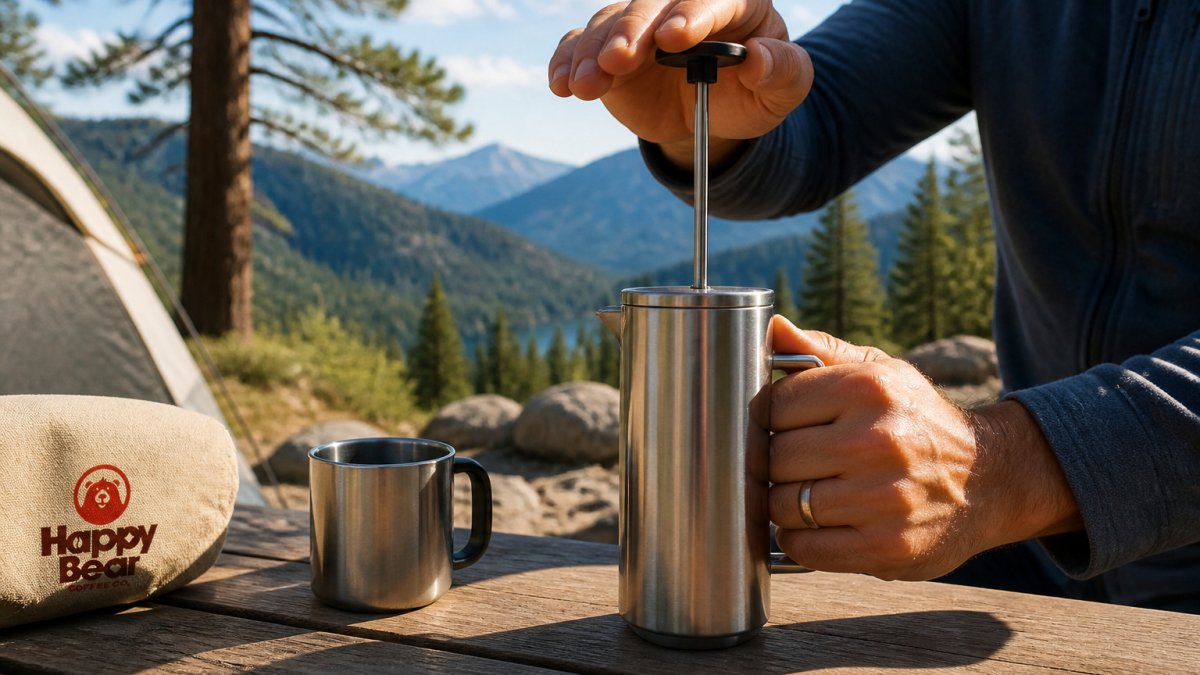
- Heat the water. Bring water to a boil, then let it rest for about 30 to 60 seconds to reach roughly 200°F.
- Add the coarse grounds. Add grounds to the empty carafe.
- Pour the water. Pour all the water over the grounds in one steady motion, so the grounds saturate evenly.
- Stir gently. Give the surface a quick stir with a spoon to break up any dry clumps.
- Place the lid and plunger. Set the lid on top with the plunger pulled up, but do not press yet.
- Steep for four minutes. Set a timer. Keep the press in a stable spot.
- Press slowly. Push the plunger down with steady, even pressure until it reaches the bottom.
- Pour immediately. Transfer the coffee to your mug or a second container. Leaving it in the press keeps extracting and turns bitter.
Most travel presses are simple to use once you have done it twice. The first brew is usually the hardest.
Portable Coffee Press vs AeroPress: Which Travels Better
The two methods are the most common choices for travel brewing, but they are not the only ones. A fair comparison puts a travel French press, an immersion press, and a pressure brewer side by side on the same coffee, water and recipe, then judges the results on repeatable criteria rather than impressions. Here is how the main portable brewer types actually differ.
The three portable brewer types, compared
| Criterion | Travel French press (steep-and-strain) | Immersion press (chamber-style) | Pressure brewer (AeroPress-style) |
|---|---|---|---|
| Brew mechanism | Coarse grounds steep, mesh plunger strains | Grounds steep in a chamber, then a plunger or valve releases the brew | Pressure pushes water through a compact bed of grounds |
| Typical grind | Coarse | Medium-coarse | Medium-fine to fine |
| Sediment in cup | Most; fine particles pass the mesh | Moderate; depends on filter stack | Least; paper or fine metal filter |
| Body and mouthfeel | Full, oily, heavy | Full to medium | Lighter, cleaner |
| Brew time | About 4 minutes steep, plus press | About 3 to 4 minutes | About 1 to 2 minutes |
| Cleanup effort | Highest; grounds sit in the carafe | Moderate; chamber empties in a clump | Lowest; grounds form a puck |
| Grind forgiveness | Low; fine grounds clog the mesh | Moderate | High |
| Best for | Classic press taste at camp or hotel | Travelers wanting press body with easier cleanup | Commuters and ultralight travelers prioritizing speed and clean cups |
What the same recipe reveals
Run all three with the same dose and water, for example, one ounce of coffee to 15 ounces of water at roughly 200°F, and the differences show up in predictable places. The travel French press delivers the heaviest body and the most sediment. The immersion press lands close on body but usually leaves less grit because the chamber empties more cleanly. The pressure brewer produces the cleanest cup and the shortest brew time, and it tolerates a wider range of grinds, which matters when you are buying pre-ground coffee on the road.
Repeatability is the other test. Brew each type three times with the same variables and note brew time, yield and how much sediment settles in the cup. A press that produces the same cup twice in a row is easier to trust on a trip than one that swings with small changes in grind or pour.
Which one travels better for you
- Choose a travel French press if you already like press coffee and want that full-bodied cup outdoors, and you have water and a moment to clean up.
- Choose an immersion press if you want press-style body with a cleaner emptying process and less grit.
- Choose a pressure brewer if speed, easy cleanup and a lighter cup matter more than heavy body, or if you cannot control grind size.
Neither approach is wrong. The right choice depends on whether you prioritize taste, cleanup or speed, and on how much room your pack and water supply allow.
Heat Retention, Spill Resistance and Durability on the Road
Travel is hard on equipment, so three features are worth checking before you buy.
Heat retention. Double-walled, vacuum-insulated bodies keep coffee warm for a much longer time than single-walled models. This matters on long hikes or slow mornings. Expect the coffee to cool gradually even with good insulation, so drink it reasonably soon after brewing.
Spill resistance. A tight-fitting lid that seals against the carafe is what keeps coffee in your bag. Look for a lid with a locking or snapping closure. Test it with water at home before a trip.
Travel Coffee Press – OVRLNDR® →
Durability. Stainless steel is more durable than glass for travel use. A plunger with a strong mesh and secure frame is less likely to bend under repeated use. Check how the base comes apart, since a removable base can make cleaning and repairs easier. Material choice extends beyond the press itself, as the interior coating of ceramic travel mugs can also influence the flavor profile and maintenance requirements of your daily brew.
Happy Bear Coffee offers the OVRLNDR® Travel Coffee Press, a stainless steel, double-walled press with a sip-and-snap lid and a 24 fl. oz. capacity, at $58.00. You can view the Travel Coffee Press - OVRLNDR® here. The Brutrek French Press with Bru-Stop™ is also available in 32 fl oz and 48 fl oz sizes, priced at $69.00.

Best Portable Coffee Maker for Camping: What to Look For
Camping adds constraints that a commute does not. You may have limited water, no electricity and little room in your pack. The right press depends on how you camp.
For solo or two-person trips, a compact press in the 16 to 24 ounce range keeps weight low and brews enough for a couple of cups. For groups, a larger capacity saves time, but it also adds bulk and weight.
Cleanup in the backcountry is another factor. Look for a press that disassembles easily so you can rinse it with a small amount of water. Less water used means less to carry out, and fewer leftover grounds to deal with.
Size, Packed Weight and Capacity
Size and weight are where travel presses differ most. A 24 fl. oz. press fits in most day packs, while a 48 fl. oz. model usually needs a dedicated spot. Packed weight matters on any trip where you carry everything yourself. Measure the press with its lid on, then compare that footprint against your pack's side pockets or cook kit.
Capacity should match the number of people you plan to serve. Remember that a press brewed for one person is easier to make consistently than one stretched across a group.
How to Clean a Portable French Press in the Field
Cleaning is a common frustration with travel presses. A practical field routine is outlined below.
A measured field-cleaning routine
- Empty the grounds first. Pour or scoop used grounds into a trash bag or a designated waste container. Coffee grounds should be packed out, not dumped into a stream, lake or campsite. Getting the bulk out before rinsing is what keeps the rinse water low.
- Rinse with a small, controlled amount of water. A small amount of water, used sparingly, is enough to swirl and loosen residue. Swirl, then pour the rinse water into your waste container rather than onto the ground.
- Disassemble the plunger. If your model allows it, separate the mesh screen and frame. Fine particles collect in the mesh, and a removable base lets you clean the screen on its own.
- Scrub the screen if needed. A small brush removes the fines that rinsing leaves behind. Without a brush, a finger and a second short rinse usually suffice.
- Dry and store with the lid off. Trapping moisture invites odors. Leave the press open to air-dry before packing it away.
Water use and cleanup time: what to expect
Water efficiency is the trade-off most travelers underestimate. A travel French press typically needs a rinse plus a screen cleaning, which can add up to several ounces of water per brew, meaningful when every ounce is carried in. A pressure brewer that forms a grounds puck often needs less rinse water because the bulk leaves in one piece. An immersion press sits between the two.
Cleanup time follows the same pattern. Emptying and rinsing a press is usually a few minutes of hands-on work; a pressure brewer is often faster because the puck pops out. If you brew several times a day, those minutes and ounces add up over a trip.
Making cleanup easier before you leave
- Grind coarser than you think. Coarse grounds empty more cleanly and leave less residue in the mesh.
- Clean soon after brewing. Dried grounds are harder to remove and take more water to loosen.
- Carry a small brush and a waste bag. Both are light and make field cleaning faster and more water-efficient.
- Choose a press with a removable base. Being able to separate the screen is the single biggest cleanup upgrade.
A press that is easy to clean gets used more often. Weigh cleanup time and water use alongside taste when you choose a travel brewer, on a long trip, they matter as much as the cup.
Common Mistakes That Make Portable Press Coffee Disappoint
Most poor results come from a small set of avoidable errors.
- Using fine grounds. Pre-ground coffee from a grocery store is often too fine. It clogs the mesh and creates a muddy cup.
- Pressing too early. Less than three minutes of steeping usually produces weak coffee.
- Leaving the coffee in the press. The brew keeps extracting, and the taste turns bitter within minutes.
- Using boiling water. Water that is too hot scorches the grounds.
- Skipping the rinse. Old oils and grounds build up and affect the flavor of the next cup.
Many problems with press coffee come from the grind or the timing rather than the press itself.
Choosing a Travel Press for Your Next Trip
Start with your trip type. Commuting and car travel allow for a larger, heavier press. Backpacking and camping favor compact, lightweight models with simple cleaning. Day hikes call for the smallest option you can carry.
Next, decide what matters most. If taste is the priority, a stainless steel press with good insulation gives you a classic cup. If cleanup and convenience matter more, consider an AeroPress or a pour-over alternative.
Finally, check the details before you buy: capacity, lid security, plunger quality and how the base comes apart. A press that matches your trip and your habits will do good work for years. If you want to explore the options, you can browse our full range of travel coffee gear at Happy Bear Coffee, where the OVRLNDR® and Brutrek presses are available alongside our coffee.
Frequently Asked Questions
Does a portable French press make good coffee?
A portable French press can make good coffee when the grind is coarse, the water is hot and the brew time is kept to a few minutes. Its main weakness is heat, so drink it reasonably soon after pressing. A double-walled, vacuum-insulated model such as the OVRLNDR Travel Coffee Press, which brews 24 fl. oz., is designed to keep coffee warmer for longer.
Is an AeroPress better than a portable French press for travel?
Each has trade-offs. An AeroPress is lightweight and, according to CleverHiker's 2026 camping coffee maker roundup, is versatile enough to brew espresso-style and French press-style coffee. Reviewers have also noted that a French press can break more easily than an AeroPress on the road, while AeroPress filtration removes more fine particles from the cup. A stainless steel travel press like the Brutrek French Press with Bru-Stop, sold in 32 fl oz ($69.00) and 48 fl oz sizes, trades some compactness for a heavier-duty build and a fuller-bodied cup.
How do you clean a travel French press?
Rinse the press immediately after use, while the grounds are still loose, so they do not dry into the mesh. The OVRLNDR Travel Coffee Press has a patented removable base that makes it easier to reach the filter area, and the Brutrek press uses a Bru-Stop plate that keeps grounds out of the cup. Use a small amount of water for the rinse, which keeps water use low on the trail. Rinse all parts thoroughly before packing so residual grounds do not sour in your bag.


Leave a comment
This site is protected by hCaptcha and the hCaptcha Privacy Policy and Terms of Service apply.