
Article: How to Brew Better Coffee at Home Without a Machine
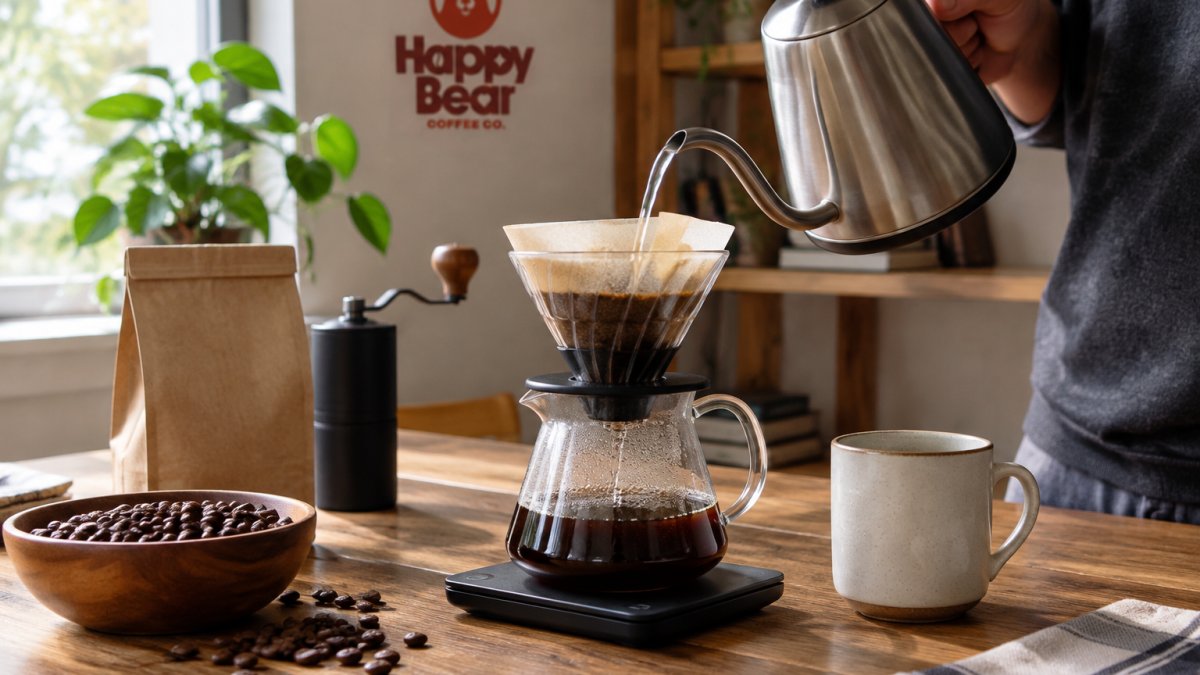
How to Brew Better Coffee at Home Without a Machine
Last Updated: November 5, 2026
Quick Summary
To brew better coffee at home without a machine, use a pour-over cone, a filter, and a kettle, then control your grind, dose, water temperature, and brew time. Start with a 1:15 to 1:18 coffee-to-water ratio, water between 195°F and 205°F, and a medium grind, then adjust one variable at a time by taste.
- Fresh coffee means whole beans roasted recently and ground just before you brew.
- For a standard 12-ounce cup, aim for about 20 grams of coffee, or roughly 2 tablespoons.
- Boil your kettle, then let it sit for about 30 seconds to reach the right temperature range.
- Match coarse grind to French press, medium to drip and pour-over, and fine to AeroPress.
- A beginner baseline recipe uses 20 g coffee, 320 g water at 200°F, medium grind, and 3 minutes.
Table of Contents
- Start With Fresh Beans and the Right Gear
- Different Ways to Brew Coffee at Home
- How to Make Good Coffee at Home Without a Machine
- How Much Coffee to Use Per Cup
- The Best Water Temperature for Coffee
- Grind Size and Why It Changes Everything
- Troubleshoot by Taste: Fix Bitter, Sour, or Weak Coffee
- Store, Clean, and Keep It Consistent
- Build Your First Repeatable Recipe
- Frequently Asked Questions
Start With Fresh Beans and the Right Gear
Learning how to brew better coffee starts with two things you can control before the water ever boils: fresh beans and a few simple tools. At Happy Bear Coffee, we've learned that most disappointing cups trace back to stale coffee or the wrong grind, not a lack of fancy equipment. According to the National Coffee Association's 2026 data trends report, 75% of Americans drink coffee, yet plenty of those cups taste flat because the beans sat too long on a shelf.
What Fresh Coffee Actually Means
Fresh coffee means whole beans roasted recently and ground just before you brew. Oxygen and time are the enemies here. Once beans are ground, they lose aroma fast, often within hours.
Look for a roast date, not just a best-by date. A bag with no roast date tells you nothing about how long it sat in a warehouse.
U.S. Chamber of Commerce reporting shows coffee prices were up 18.3% year over year as of January 2026, so paying more means freshness matters even more. Buy whole beans, store them right, and grind at home.
Different Ways to Brew Coffee at Home
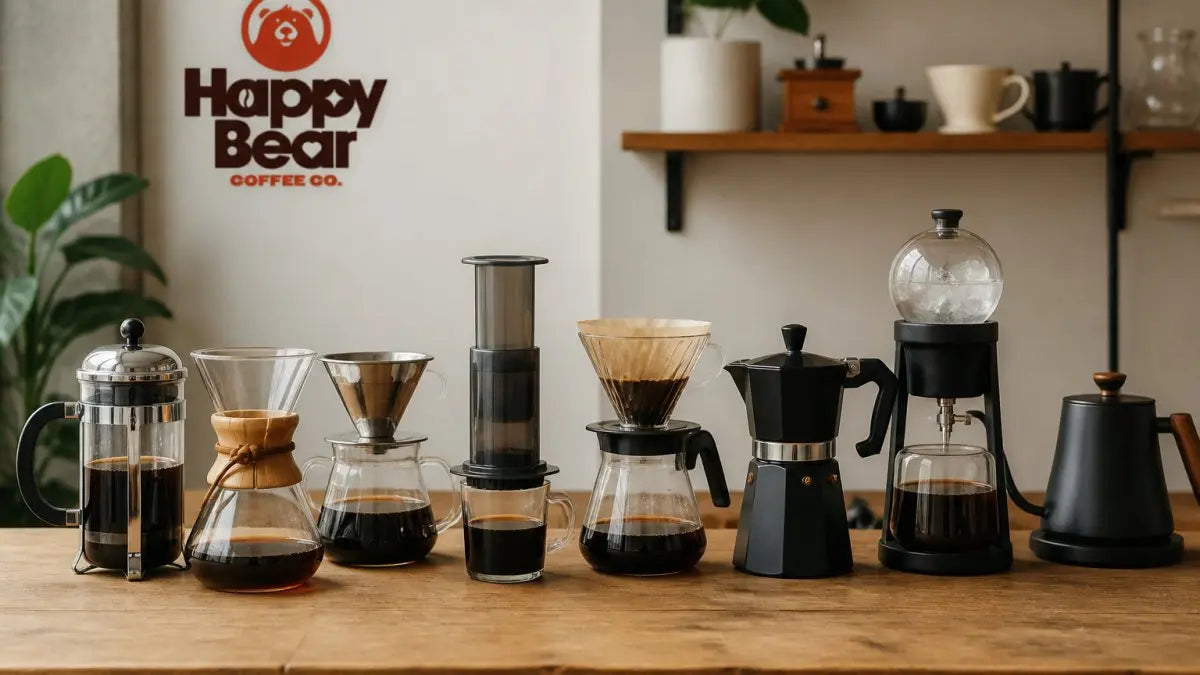
Every brewing method is a trade-off between time, gear, flavor, and cleanup. There is no single best option, which is why a home-brewing review from Coffee Chronicler frames the choice as method-dependent. Pick the one that fits your morning, your counter space, and your budget.
Pour-Over, Drip, French Press, and AeroPress Compared
Here is how the common methods stack up on the variables that actually decide whether you will keep using them:
| Method | Active Time | Gear Needed | Flavor Profile | Cleanup | Best For |
|---|---|---|---|---|---|
| Pour-over | 3-4 min | Cone, paper filter, gooseneck kettle, scale | Clean, bright, tea-like | Rinse cone, toss filter, quick wipe | Control and clarity |
| Drip | 5-8 min (mostly hands-off) | Machine, basket filter | Balanced, mild | Toss filter, rinse carafe, weekly descale | Hands-off mornings |
| French press | 4 min steep + 1 min press | Press, coarse grounds, spoon | Rich, full-bodied, oily | Disassemble, rinse mesh, dry fully | Bold cups and low gear cost |
| AeroPress | 2-3 min | AeroPress, paper or metal filter | Smooth, concentrated, versatile | Rinse plunger, toss filter | Speed, travel, small kitchens |
Match the Method to Your Constraints
A few practical patterns most home brewers discover:
- Lowest gear cost: A drip machine or a French press gets you brewing with one purchase and no scale. A pour-over cone is inexpensive on its own but rewards a gooseneck kettle and scale, which add cost.
- Lowest effort per cup: Drip wins on hands-off mornings. AeroPress wins when you want a single cup fast with almost no cleanup.
- Lowest cleanup: AeroPress and pour-over. French press takes the most rinsing because the mesh traps oils and fines.
- Most control: Pour-over, because you manage pour rate, temperature, and contact time directly. French press controls only steep time and grind.
- Smallest footprint: AeroPress and a collapsible pour-over cone pack flat and travel well.
If you want a deeper breakdown, our guide to the 9 best home coffee brewing methods compared walks through each one side by side.
Watch out: buying a method that needs gear you do not own (a scale, a gooseneck kettle) often means the brewer sits unused. Choose the method whose full kit you will actually assemble.
How to Make Good Coffee at Home Without a Machine
You can make excellent coffee without a machine using a pour-over cone, a filter, and a kettle. This is the most forgiving path for beginners who want control without buying a $300 brewer.
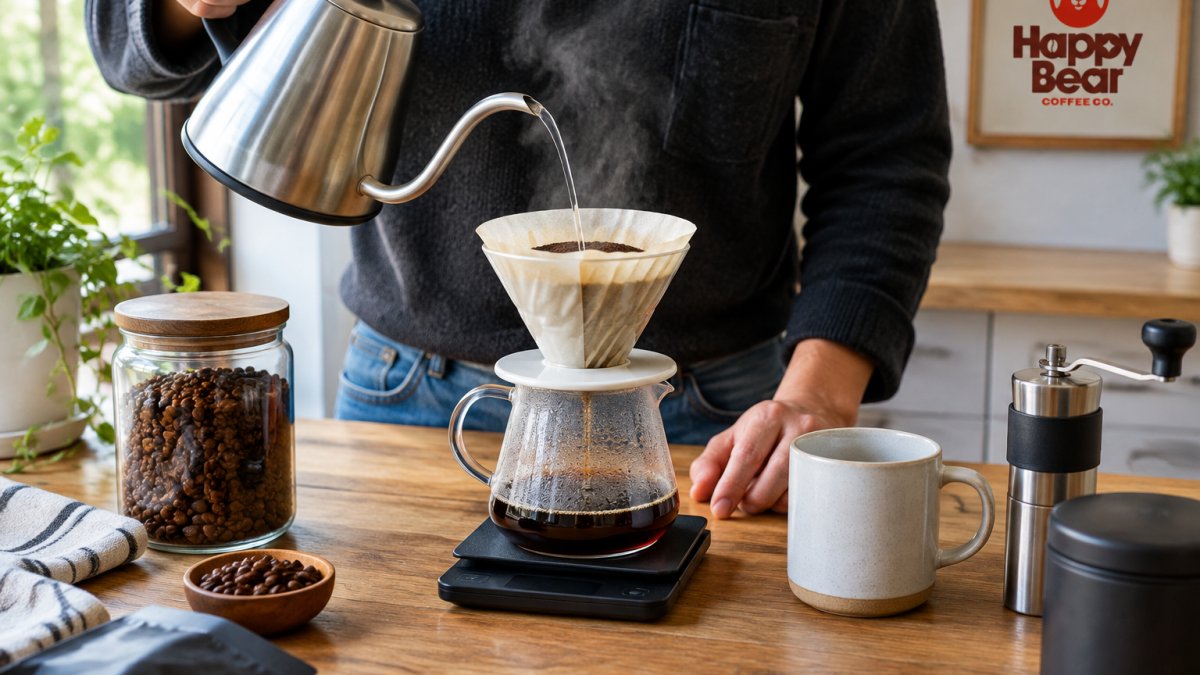
Our Collapsible Pour Over Coffee Maker makes this easy, and it folds down for travel and camping. Here's the basic no-machine routine:

- Heat water to just off a boil.
- Place a filter in the cone and rinse it.
- Add medium-fine grounds.
- Pour a little water to bloom the coffee for 30 seconds.
- Pour the rest in slow circles.
- Let it drain fully, then enjoy.
Want a maker you can actually buy and use tomorrow? Our collapsible pour-over handles both kitchen and campsite.
How Much Coffee to Use Per Cup
The reliable starting point is a coffee-to-water ratio of 1:15 to 1:18, according to Feast Magazine's brewing guidance. That means roughly 1 gram of coffee for every 15 to 18 grams of water.
For a standard 12-ounce cup, aim for about 20 grams of coffee, or roughly 2 tablespoons. A kitchen scale gives you the most accuracy, but a scoop works fine to start. Our Coffee Scoop - 2 Tbsp. measures exactly two tablespoons, so you get consistent doses every time.

Weigh your beans once, note the number, and adjust from there. Consistency beats guessing.
The Best Water Temperature for Coffee
The best water temperature for coffee is between 195°F and 205°F. Water that's too cool under-extracts and tastes sour; water at a rolling boil scorches the grounds and turns the cup bitter.
A simple trick: boil your kettle, then let it sit for about 30 seconds before pouring. That pause drops the temperature into the right range without a thermometer.
If you use a machine, check whether it heats to this range. Many budget models run too cool. For no-machine brewing, a gooseneck kettle gives you both temperature control and a steady pour.
Grind Size and Why It Changes Everything
Grind size controls how fast water pulls flavor from the grounds. Smaller particles expose more surface area, so water extracts faster; larger particles expose less, so extraction slows. Too coarse and the water rushes past, leaving weak, sour coffee. Too fine and it over-extracts into bitterness and a muddy cup.
Collapsible Pour Over Coffee Maker →
Match your grind to your method:
- Coarse (like sea salt): French press
- Medium (like table salt): drip and pour-over
- Fine (like powdered sugar): AeroPress and espresso
A University of Pennsylvania physics study on pour-over brewing looked at how to brew more efficiently with fewer beans, and grind consistency sits at the center of that. Freshly ground beans generally brew with more aroma than pre-ground coffee, because grounds lose aroma quickly.
Grind Consistency Matters as Much as Grind Size
A burr grinder produces particles of similar size; a blade grinder produces a mix of dust and boulders. That mix is why blade-ground coffee often tastes both sour and bitter at once: the fines over-extract while the boulders under-extract. If your cups taste inconsistent from batch to batch with the same recipe, grind consistency is the first suspect.
Our BruTrek® Hand Coffee Grinder offers adjustable grind settings for a range of brewing methods, so you can dial in the right grind at home or on the trail.

Dial In Grind by Taste, One Step at a Time
Use this sequence when a cup misses the mark:
- Bitter or drying finish: grind one step coarser. Taste again before changing anything else.
- Sour or thin body: grind one step finer.
- Both sour and bitter: the grind is likely inconsistent, not just wrong. Clean the grinder and check the burr setting.
- Weak but not sour: add coffee before you change the grind, since dose is the easier variable to control.
Change one variable per brew. If you adjust grind and dose together, you cannot tell which fix worked, and you will not be able to repeat the good cup.
Watch out: a grind that works for one bag of beans may need a small adjustment for the next, because roast level and bean density shift how fast water extracts.
Troubleshoot by Taste: Fix Bitter, Sour, or Weak Coffee
Your tongue is the best diagnostic tool you have. Most brewing problems show up as one of three tastes, and each has a clear fix.
| Taste Problem | Likely Cause | Fix |
|---|---|---|
| Bitter | Over-extraction, water too hot | Coarser grind, cooler water |
| Sour | Under-extraction, water too cool | Finer grind, hotter water |
| Weak | Too little coffee or too coarse | More grounds, finer grind |
| Muddy | Too many fines, over-steeped | Clean the grinder, shorter steep |
Start with one change at a time. If your cup tastes bitter, grind coarser before you touch anything else. Sour? Go finer or bump the temperature. This trial-and-error approach teaches you more than any recipe.
Store, Clean, and Keep It Consistent
Freshness after opening matters as much as freshness at purchase. Store whole beans in an airtight container away from light, heat, and moisture. Skip the freezer for daily-use beans; the temperature swings do more harm than good.
Our Airscape Coffee Canister - Classic uses patented airtight technology that removes oxygen, which helps preserve flavor and freshness. For the full routine, read our guide on how to store coffee for maximum freshness.
Clean your gear weekly. Old oils turn rancid and ruin every cup that follows. Rinse paper filters, scrub the press, and descale machines regularly.
Build Your First Repeatable Recipe
A repeatable recipe removes the guesswork. Write down four numbers and keep them fixed while you adjust one variable at a time.
Beginner baseline recipe:
- Dose: 20 g coffee (about 2 Tbsp)
- Water: 320 g at 200°F
- Grind: medium
- Brew time: 3 minutes
Brew it once exactly as written. Then change only the grind, finer or coarser, and taste. Repeat until the cup tastes balanced. That single controlled habit is how you brew better coffee consistently, batch after batch.
Watch out: changing several variables at once makes it impossible to know what fixed the cup.
Brewing great coffee at home comes down to fresh beans, the right grind, and a recipe you can repeat. Happy Bear Coffee can help you get there with sustainably sourced specialty beans, customizable bundle subscriptions, and a 5% customer-powered donation program. Our gear, from the collapsible pour-over to the BruTrek hand grinder, is designed to help you brew at home or on the go. Get started with Happy Bear Coffee and taste the difference a repeatable recipe makes.
Frequently Asked Questions
How can I make my coffee taste better at home?
Start with fresh whole beans and a consistent ratio. A hand-brewing guide recommends a coffee-to-water ratio of 1:15 to 1:18, so weigh your dose instead of scooping by eye. Grind just before brewing, use filtered water, and keep water temperature between 195 and 205 degrees Fahrenheit. Change one variable at a time so you can taste what actually improved. Small, repeatable adjustments beat a closet full of new gear.
How much coffee should I use per cup?
Use the 1:15 to 1:18 coffee-to-water ratio as your starting point. For a standard 10-ounce cup, that means roughly 16 to 20 grams of coffee to about 300 grams of water. A level 2-tablespoon scoop is a decent starting estimate, but a scale gives you repeatability. If the cup tastes weak, nudge the dose up before changing anything else.
What is the best water temperature for brewing coffee?
Aim for 195 to 205 degrees Fahrenheit, which is just off a boil. Water that is too hot pulls out bitter compounds, while water that is too cool leaves the cup sour and thin. If you do not have a thermometer, boil water and let it sit for about 30 seconds before pouring. For French press and pour-over, preheat your vessel so the brew does not cool too fast.
Why does my home-brewed coffee taste bitter or sour?
Bitter usually means over-extraction: the grind is too fine, the water too hot, or the brew ran too long. Sour or weak points to under-extraction: too coarse a grind, water that is not hot enough, or too short a brew time. Adjust one variable at a time and taste again.


Leave a comment
This site is protected by hCaptcha and the hCaptcha Privacy Policy and Terms of Service apply.