
Article: How to Choose Coffee Roast Types: A Taster's Guide

How to Choose Coffee Roast Types: A Taster's Guide
Table of Contents
- Understanding Coffee Roast Levels: What Happens During Roasting
- Light vs Medium vs Dark Roast: Flavor, Acidity, and Body Compared
- Coffee Roast Levels Chart: Visual Reference for Bean Color and Characteristics
- Does Dark Roast Have More Caffeine Than Light Roast?
- Best Coffee Roast for Espresso: Matching Roast to Your Machine
- How Roast Choice Affects Grind Size and Brewing Variables
- Freshness, Storage, and Roast Dates: What to Look for When Shopping
- A Practical Decision Tree: Choose Your Roast Based on Taste Preference
- Frequently Asked Questions
Last Updated: October 13, 2026
Understanding Coffee Roast Levels: What Happens During Roasting
When you choose coffee roast types, you're making one of the most important decisions about your final cup. At Happy Bear Coffee, we've learned that understanding what happens during the roasting process transforms how you shop and brew.
Here's what actually happens: green coffee beans enter a roaster at room temperature. Heat gradually raises the bean's internal temperature. Around 350°F, the beans start to crack, this is called "first crack." Keep heating, and you reach "second crack" around 420°F. The roast level you choose depends on when the roaster stops this process.
This matters because roasting fundamentally changes the bean's chemistry. Longer roasting develops deeper, darker flavors. Shorter roasting preserves the bean's origin characteristics, the natural flavors from where it grew. The roast profile determines your coffee's acidity, body, sweetness, and bitterness.
Think of it like cooking: a quick sear locks in different flavors than a slow braise. Same ingredient, completely different result.
Light vs Medium vs Dark Roast: Flavor, Acidity, and Body Compared
Light Roast: Bright Acidity and Origin Flavors
A light roast is pulled right before or just as first crack begins. The bean stays light brown, almost cinnamon-colored. This is where you taste what the bean actually is.
Light roasts have the highest acidity. Don't let that word scare you, in coffee, acidity means brightness and complexity. It's what makes your mouth water slightly. Light roasts shine with origin flavors: citrus, floral, fruity, tea-like notes. You taste the terroir, the altitude, soil, and climate where the beans grew.
The body is lighter and more delicate. The mouthfeel feels crisp. Light roasts also contain slightly more caffeine than darker roasts because less time on heat means fewer compounds break down.
Our Light N' Cozy is a perfect example. It's a single-origin light roast with notes of nectarines, jasmine, and cane sugar. Pulled right before first crack, it highlights the bean's natural acidity and lets those bright, citrusy qualities shine through.

Medium Roast: Balance and Versatility
Medium roast hits the sweet spot for most people. The beans are medium brown, and you've moved past first crack but stopped before second crack begins. This is where balance lives.
Medium roasts have moderate acidity, enough brightness to taste interesting, but not so much that it dominates. The body is fuller than light roast but not heavy. You get some origin flavors, but they blend with roasted flavors. Think chocolate, caramel, nuts, and subtle fruit notes together.
Medium roast works with almost any brewing method. Drip coffee, pour-over, French press, espresso, they all work beautifully. This versatility is why medium roast is the most popular choice for home brewers.
Hunny's Den is our medium roast blend with a sprinkle of dark roast for richness. It delivers a smooth, balanced cup with deep chocolate notes and hints of fruitiness. It's designed for coffee lovers who want complexity without overwhelming intensity.
Dark Roast: Bold Body and Roasted Flavors
Dark roast means the beans have passed second crack. They're nearly black, shiny with oils on the surface. At this point, roasted flavors completely dominate. You taste the roasting, not the origin.
Dark roasts have low acidity. The body is heavy and full. The mouthfeel is thick and syrupy. Flavor notes are bold: dark chocolate, caramel, smoke, roasted nuts, sometimes a slight bitterness. There's no delicate complexity here, it's a powerful, straightforward cup.
Dark roast works best in brewing methods that can handle the intensity. Espresso, French press, and Turkish coffee all shine with dark roast. Drip coffee can work, but the boldness might overwhelm some palates.
Our Hibernation is a dark roast blend that delivers exactly this: bold, cozy, and perfect for cold mornings. It's a blend of Central American and Pacific coffees roasted dark and rich. Expect deep chocolate, caramel, and roasted nuttiness without acidity getting in the way.
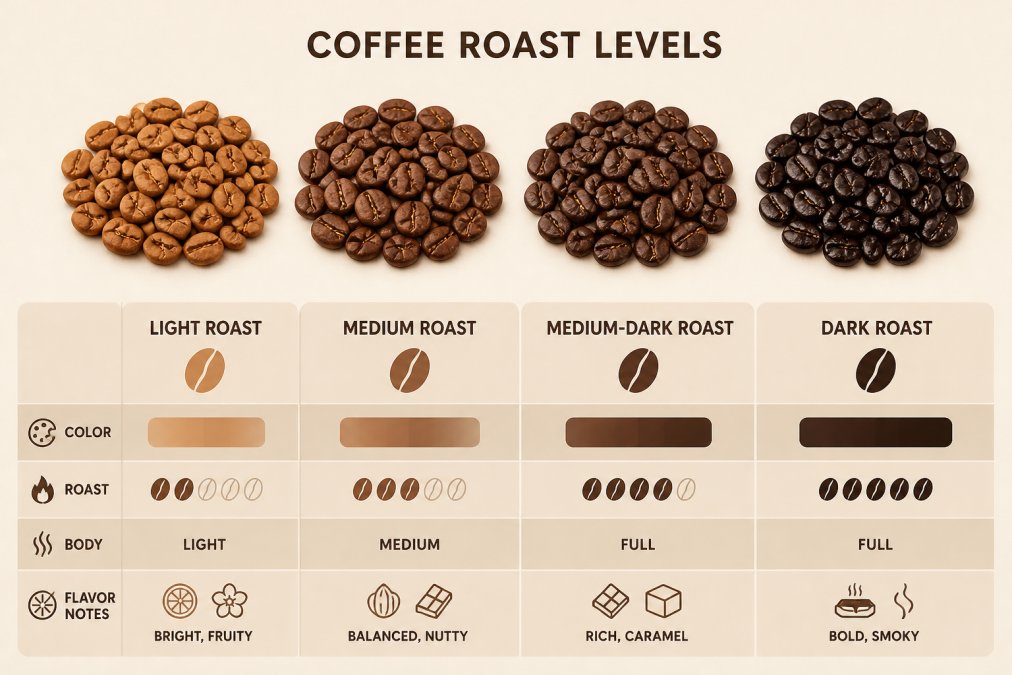
Coffee Roast Levels Chart: Visual Reference for Bean Color and Characteristics
| Roast Level | Bean Color | Acidity | Body | Flavor Profile | Best For |
|---|---|---|---|---|---|
| Light | Cinnamon brown | High | Light, crisp | Origin flavors, citrus, floral, fruity | Specialty brewing, tasting origin |
| Medium | Medium brown | Moderate | Medium, balanced | Origin + roasted flavors, chocolate, caramel | Drip coffee, versatile brewing |
| Dark | Nearly black | Low | Heavy, syrupy | Bold roasted flavors, smoke, nuts, chocolate | Espresso, French press, intensity |
Does Dark Roast Have More Caffeine Than Light Roast?
No, dark roast does not have more caffeine than light roast. If anything, the difference runs the other way, but it is small enough that it almost never decides your cup. The more useful answer is that roast level is one of the least important variables for caffeine, and the way you measure and brew coffee matters far more.

Why roast level barely moves caffeine
Caffeine is a stable compound in the green bean. It survives roasting temperatures largely intact, so the roast level itself does not create or destroy much caffeine. What changes is bean mass. Dark roasting drives off moisture and organic matter, so a dark-roasted bean weighs less than a light-roasted bean of the same original size. If you measure by weight, a dark roast can actually deliver slightly less caffeine per gram because you are getting less bean material per scoop. Most practitioners find the gap is small, often in the low single digits as a percentage, and it is easily swamped by other variables.
The measurement caveat that actually matters
Caffeine comparisons fall apart when people mix up weight and volume. Here is the distinction:
- By weight: A scale measures actual coffee mass. Two coffees at the same weight contain roughly the same caffeine regardless of roast, with only a small roast-related difference.
- By volume: A scoop measures space, not mass. Dark roast beans are less dense and often larger, so a scoop of dark roast holds less coffee by weight than a scoop of light roast. That means a level scoop of dark roast can brew a slightly weaker cup than the same scoop of light roast.
This is why two people can brew "the same" coffee and get different caffeine levels. One uses a scale, the other uses a scoop, and the roast level changes how those two measurements diverge.
What actually drives caffeine in your cup
Ranked by real-world impact, these factors matter more than roast level:
- Dose, how much ground coffee you use. This is the single biggest lever.
- Brewing method, espresso concentrates caffeine into a small volume, while drip and French press produce larger servings with more total caffeine per cup.
- Serving size, a 16-ounce drip coffee has more total caffeine than a 1-ounce espresso shot, even though espresso tastes stronger.
- Grind and extraction, finer grinds and longer contact time extract more caffeine, up to a point.
- Bean species, Arabica and Robusta differ substantially in caffeine content, and that difference dwarfs anything roast level does.
Practical takeaway
If caffeine is your priority, stop shopping by roast level and start controlling dose and serving size. Use a scale, note your brew method, and adjust from there. A strong brew of any roast will beat a weak brew of any other roast. Roast level is a flavor decision, not a caffeine decision.
Best Coffee Roast for Espresso: Matching Roast to Your Machine
The best coffee roast for espresso depends on your machine, your grinder, and what you want in the cup. There is no single right answer, but there is a clear mechanism behind why some roasts behave better than others under pressure, and once you understand it you can dial in any roast with confidence.
Why espresso behaves differently from other brew methods
Espresso forces hot water through a compact puck of finely ground coffee at roughly nine bars of pressure (Defining the Ever-Changing Espresso - 25 Magazine: Issue 3). That pressure extracts flavors fast and intensely, in about 25 to 30 seconds for a typical double shot. Because the window is so short, small changes in grind, dose, and roast level produce large changes in the cup. This is why espresso is less forgiving than drip or French press, and why roast choice interacts so strongly with your setup.
How each roast level performs under pressure
Dark roast is the traditional espresso choice. Dark beans are more porous and less dense, so water moves through them quickly and extracts roasted, chocolatey, caramel, and smoky flavors. The low acidity and heavy body stand up to milk and sugar. The trade-off is that dark roast has a narrow sweet spot: grind too fine or pull too long and you get harsh, burnt, ashy notes fast.
Medium roast is the most versatile for home espresso. It preserves some origin character while still delivering enough body and sweetness to balance the shot. Medium roast is more forgiving of small grind and dose errors, which is why it is a common starting point for people learning to dial in a machine.

Light roast is the hardest to pull as espresso. Light beans are denser and more resistant to water, so they need a finer grind, a longer ratio, and often a higher brew temperature to extract fully. Done well, a light roast espresso tastes bright, fruity, and complex. Done poorly, it tastes sour and thin. Light roast espresso is a technique challenge, not a roast problem.
A repeatable dial-in process for any roast
Instead of guessing, work through these steps in order. Change one variable at a time.
- Start with a dose. Weigh your coffee in grams. A common starting point is 18 grams in, aiming for about 36 grams out (a 1:2 ratio) in 25 to 30 seconds.
- Taste and diagnose. If the shot runs too fast and tastes sour or thin, the grind is too coarse or the dose is too low. If it runs too slow and tastes bitter or harsh, the grind is too fine or the dose is too high.
- Adjust grind first. Grind is the most powerful lever. Move finer to slow the shot and increase extraction, coarser to speed it up and decrease extraction.
- Adjust dose second. If grind changes are not enough, adjust dose in small increments, usually 0.5 to 1 gram at a time.
- Adjust temperature last. If a light roast still tastes sour after grind and dose are dialed in, raise the brew temperature slightly. If a dark roast tastes ashy, lower it.
Matching roast to machine type
- Pump espresso machines with a pressurized basket: These are forgiving and work with any roast. Medium or dark roast will give the most consistent results.
- Pump machines with a non-pressurized basket: These reward good technique. Medium roast is the easiest starting point; light roast requires a capable grinder.
- Manual levers and high-end machines: These give you enough control to pull light roasts well, but they also expose every flaw in grind and technique.
- Super-automatic machines: These have limited adjustment. Medium or dark roast tends to perform best because the machine cannot compensate for a stubborn light roast.
The grinder matters as much as the roast
A common pattern is that people blame the roast when the real limit is the grinder. Espresso needs a grinder that can make small, repeatable adjustments. If your grinder cannot produce a fine enough or consistent enough grind, a light roast will taste sour no matter what you do, and a dark roast will taste bitter no matter what you do. If you are choosing between upgrading your roast or upgrading your grinder, the grinder usually wins.
How Roast Choice Affects Grind Size and Brewing Variables
Your roast level changes how the bean behaves during grinding and brewing. This matters more than most people realize.
Light roasts are denser. They're harder to grind. They need slightly finer grinding to extract properly because water moves through them faster. Light roasts also extract slower, they're more resistant to water. Brewing time might need to increase by 10-20 seconds.
Dark roasts are more porous. They grind easier. They need slightly coarser grinding because water extracts from them quickly. Over-extract dark roast and you get bitter, burnt flavors. Under-extract and they taste thin.
Medium roasts sit in the middle. They're the most forgiving for grind size and brewing time. This is another reason they're popular for home brewing.
When you choose coffee roast types, remember that your brewing method interacts with your roast choice. A light roast in a French press needs adjustment from what the medium roast instructions say. A dark roast in pour-over needs different timing than a light roast.
Freshness, Storage, and Roast Dates: What to Look for When Shopping
Roast date matters more than roast level. A fresh light roast beats a stale dark roast every time.
Coffee is freshest 3-10 days after roasting. During this window, CO2 is still releasing from the beans, and flavors are at their peak. Coffee is still good 2-4 weeks after roasting, but flavors fade. After a month, you're drinking old coffee.
When you shop, always look for the roast date on the bag. Not the best-by date, the actual roast date. If there's no roast date, ask. If they won't tell you, the coffee is probably old.
Store beans in an airtight container away from light, heat, and moisture. A sealed bag with a one-way valve works fine. Don't freeze or refrigerate, temperature swings create condensation that damages flavor. Room temperature in a dark cabinet is ideal.
Grind right before brewing. Ground coffee goes stale in hours, not days. Whole beans stay fresh much longer.
At Happy Bear Coffee, we roast in small batches and pack fresh. Every bag ships with a roast date so you know exactly how fresh your coffee is when it arrives.
A Practical Decision Tree: Choose Your Roast Based on Taste Preference
Here's how to actually choose coffee roast types without overthinking it:
Do you like bright, complex flavors with a crisp mouthfeel?
- Yes → Light roast
- No → Continue
Do you like bold, intense flavors with a heavy body?
- Yes → Dark roast
- No → Medium roast
Are you brewing espresso?
- Yes → Medium or dark roast (easier to dial in)
- No → Continue with your answer above
Are you new to specialty coffee?
- Yes → Start with medium roast, then explore light and dark
- No → Choose based on your taste preference above
Do you want to taste where the coffee comes from?
- Yes → Light roast
- No → Medium or dark roast
This decision tree works because it matches roast level to what you actually want in your cup. Your taste preference is the only thing that matters.
If you're unsure, start with medium roast. It's balanced enough to taste good with any brewing method. Once you know what you like, you can explore lighter or darker roasts with confidence.
Cubby's Go-To Costa Rican is a medium roast single-origin that's perfect for exploring. It delivers brightness and balance, showing you what a well-roasted specialty bean tastes like without overwhelming intensity.
Choosing the right roast level transforms your coffee experience. But roast choice is just the beginning. The real magic happens when you combine fresh beans with proper brewing technique and quality equipment. At Happy Bear Coffee, we help you navigate every step. Our sustainably sourced specialty coffees come with roast dates so you always know freshness. Our customizable bundle subscriptions let you explore different roast levels without commitment. And when you're ready to dive deeper, our brewing equipment and resources make the process straightforward. The Specialty Coffee Association's guide to coffee quality emphasizes that freshness and proper brewing matter as much as bean selection. Start with a medium roast you enjoy, learn your brewing method, and build from there. That's how you discover what coffee really tastes like.
Frequently Asked Questions
How do I know which coffee roast to choose if I'm new to specialty coffee?
Start by considering your taste preferences. If you enjoy bright, acidic flavors and want to taste the bean's origin characteristics, try a light roast. For a balanced, smooth cup that works with most brewing methods, choose medium roast. If you prefer bold, full-bodied coffee with less acidity and deeper roasted flavors, go with dark roast. Happy Bear Coffee's Light N' Cozy offers citrusy notes, Cubby's Go-To Costa Rican provides balanced medium roast, and Hibernation delivers bold dark roast, each is a good entry point for understanding your preference.
Does dark roast have more caffeine than light roast?
This is a common misconception. Dark roast and light roast contain nearly identical caffeine levels, the roasting process doesn't significantly reduce caffeine content. The difference is in flavor and body. Light roasts often taste brighter and more acidic, while dark roasts taste bolder and smokier. Choose based on flavor preference, not caffeine content. If you need more caffeine, brew a stronger cup regardless of roast level.
What's the best coffee roast for espresso?
Espresso traditionally pairs well with medium to dark roasts because they produce the body, crema, and bold flavors espresso machines are designed to highlight. Medium roasts like Hunny's Den offer balance and sweetness, while dark roasts like Hibernation deliver the intensity and full body espresso lovers expect. Light roasts can work in espresso but may taste thin or overly acidic. Your machine's pressure and extraction time also matter, experiment to find your preference.
How should I store coffee beans to keep them fresh after roasting?
Coffee is freshest within 2-4 weeks of roasting. Store beans in an airtight container away from direct sunlight, heat, and moisture. Check the roast date on the bag before buying, this tells you how fresh the beans are. Avoid the freezer, as thawing can introduce moisture. Buy smaller quantities more often rather than stockpiling, and grind just before brewing. Happy Bear Coffee packs beans fresh, so look for the roast date on your order to ensure peak flavor.

Leave a comment
This site is protected by hCaptcha and the hCaptcha Privacy Policy and Terms of Service apply.