
Article: How to Store Coffee Beans Fresh: A Complete Guide
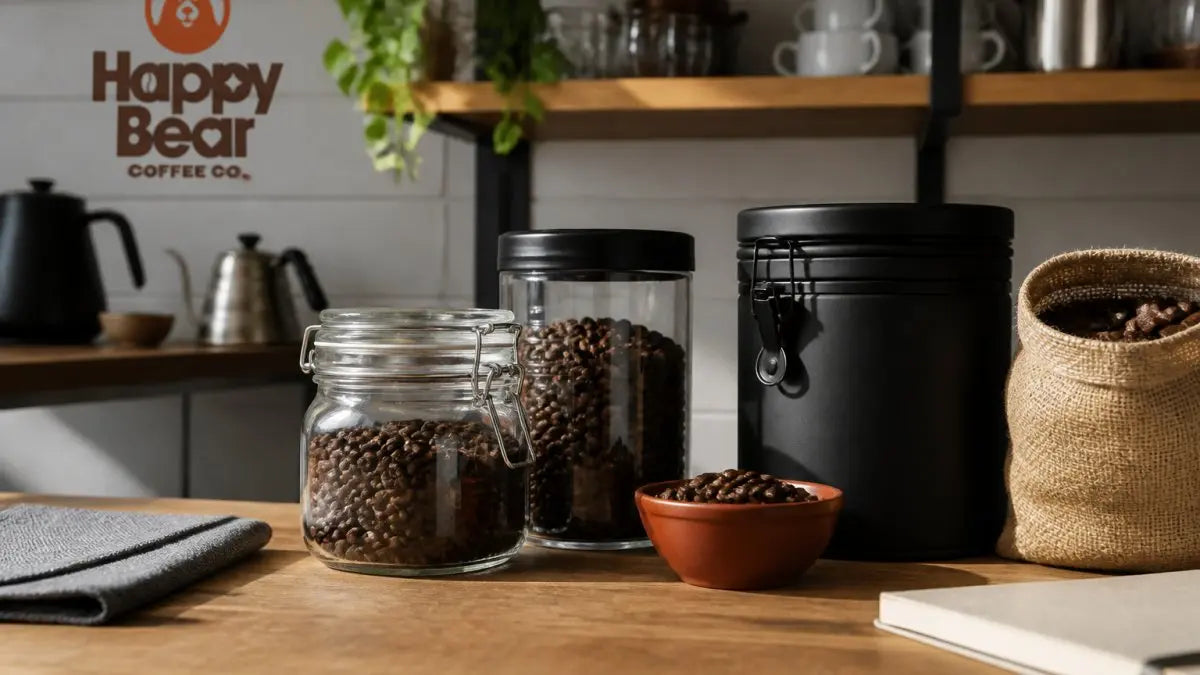
How to Store Coffee Beans Fresh: A Complete Guide
Table of Contents
- Why Proper Storage Matters for Coffee Freshness
- The Four Enemies of Coffee: Oxygen, Light, Heat, and Moisture
- Choosing the Right Coffee Bean Storage Container
- Room-Temperature Storage: The Standard Method
- How Long Do Coffee Beans Stay Fresh
- Storing Coffee Beans in the Freezer: A Precise Method
- Should Coffee Beans Be Refrigerated or Frozen
- Storage Decision Guide by Use Frequency and Package Size
- Common Storage Mistakes to Avoid
- Frequently Asked Questions
Last Updated: October 18, 2026
Why Proper Storage Matters for Coffee Freshness
Storing coffee beans fresh is one of the simplest ways to get better coffee at home. Yet most people get it wrong from day one.
Freshness matters more than origin or roast level. A premium single-origin bean stored poorly tastes flat and stale; a solid everyday blend stored correctly tastes vibrant and complex. The difference is storage.
At Happy Bear Coffee, we've seen how proper storage can transform brewing results. They simply protect their coffee from the four enemies of freshness: oxygen, light, heat, and moisture.
When you store coffee beans fresh, you preserve the natural oils and aromatic compounds that make specialty coffee worth buying. These start breaking down the moment the bag is opened; your job is to slow that process.
The good news: it's not complicated. The right container, location, and habits will keep your beans tasting fresh for weeks.
The Four Enemies of Coffee: Oxygen, Light, Heat, and Moisture
Coffee freshness depends on protecting beans from four threats, each degrading flavor differently. Understanding what each does helps you make better storage choices.
Exposure to Oxygen and Oxidation
Oxidation is the primary enemy of coffee freshness. When oxygen touches coffee beans, it reacts with the oils and compounds that give coffee its flavor. This process starts immediately and never stops.
Think of oxidation like rust forming on metal, a chemical reaction that changes the substance. With coffee, it makes beans taste flat, dull, and lifeless as the bright, complex flavors fade.
This is why whole beans stay fresh longer than ground coffee: grinding increases surface area dramatically, and more surface area means more oxygen contact.
The solution is simple: minimize air exposure. This means choosing airtight containers and keeping beans sealed when not in use.
Effects of Light and Sunlight
Light degrades coffee much like it fades photographs. Ultraviolet rays break down flavor compounds in beans, especially in the outer layers.
This is why coffee comes in opaque bags with one-way valves: clear containers or bags expose beans to light damage.
Direct sunlight is the worst, even a few hours can noticeably harm flavor, while indirect light in a bright kitchen causes gradual damage over weeks.
The fix: store beans in dark containers or in a dark location. If you use a clear container, keep it in a cabinet or pantry away from light.
Effects of Heat and Temperature
Heat speeds up every chemical process that degrades coffee: faster oxidation, faster moisture loss, faster flavor breakdown.
Room temperature (around 70°F) is ideal. Warm kitchens near stoves or ovens are the worst; heat from appliances, sunlight, or warm countertops accelerates staleness.
Temperature swings are also problematic: moving beans from cold to warm creates condensation inside the container, which damages them. That's why refrigeration and freezing backfire if not done carefully.
Effects of Moisture and Humidity
Moisture causes mold and speeds up oxidation. Beans are porous and absorb humidity from the air, creating an environment where mold grows and flavors deteriorate rapidly.
High-humidity spots like bathrooms or kitchens near sinks are risky, and even in dry climates, opening a sealed container in a humid room can draw moisture inside.
The solution is a dry storage location and an airtight seal that keeps moisture out.
Choosing the Right Coffee Bean Storage Container
Not all containers work the same way. The best removes oxygen, blocks light, and stays dry, but the right answer depends on how fast you drink coffee and what the beans arrived in.
Airtight Containers and One-Way Valves
An airtight container is non-negotiable for storing coffee beans fresh. It seals oxygen out and prevents oxidation.
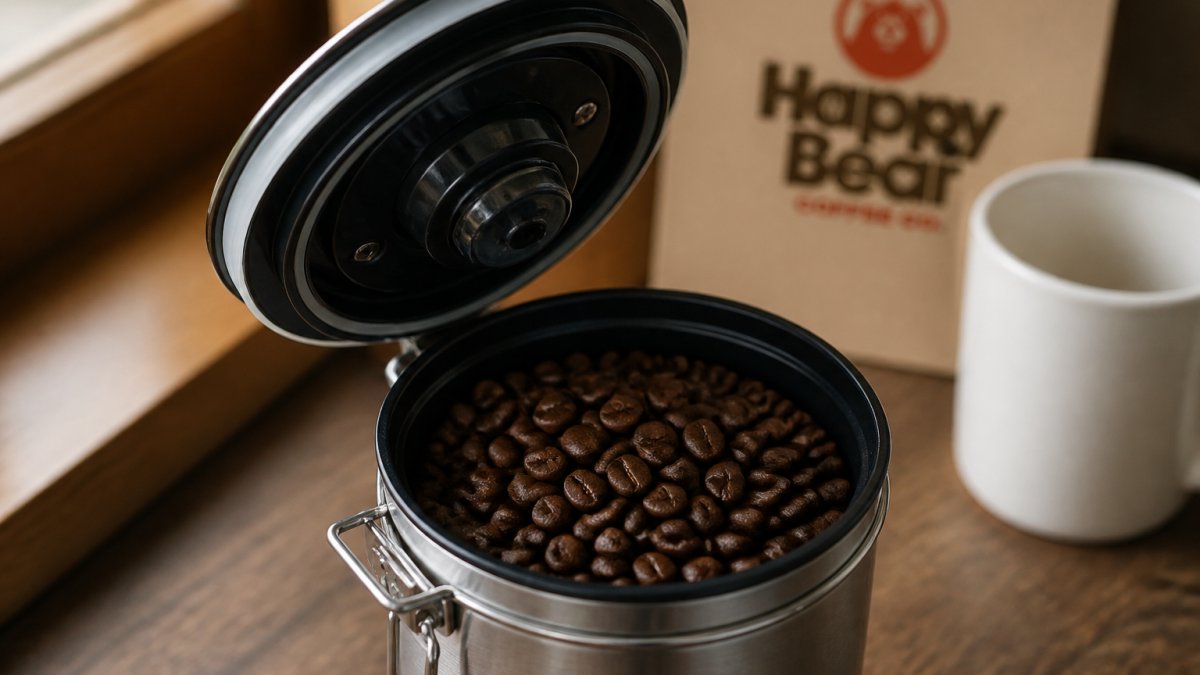
The best containers use a compression or vacuum mechanism rather than a simple snap lid. The Airscape Coffee Canister's inner lid presses down to displace air from the headspace above the beans, removing most oxygen without a pump, and that trapped air is what oxidizes them first.

One-way valves are common in coffee bags and some containers. Fresh-roasted beans release carbon dioxide for several days; the valve lets that CO2 escape so the bag doesn't balloon, while a thin membrane stops outside air flowing back in. Valves help during transport and the first week after roasting, but they are no substitute for an airtight seal once the bag is opened, a valve bag left open still exchanges air every time you reach in.
Look for containers that:
- Seal completely with no air gaps
- Use food-grade materials (stainless steel or BPA-free plastic)
- Have a simple, reliable sealing mechanism
- Come in sizes that match your usage (small for light use, larger for bulk storage)
The Airscape Kilo Coffee Canister holds up to 2.5 pounds of whole beans and uses the same patented airtight technology. For smaller quantities, the classic Airscape canister comes in sizes for 10 ounces or 1 pound.
When the Original Bag Is Enough, and When to Transfer
Whether you need to move beans out of the original bag depends on the bag and your timeline.
Keep beans in the original bag if:
- The bag has a one-way valve and a resealable zip or fold-over top
- You will finish the bag within 2-3 weeks of opening
- You store the bag in a dark, cool cabinet and press out excess air before sealing
Transfer to an airtight canister if:
- The bag is a simple folded paper or plastic sack with no valve
- You bought a large bag (2 pounds or more) that will last beyond 3 weeks
- You keep the bag in a bright or warm spot
- You want to scoop daily without opening and closing a fragile bag
A practical middle path: keep the original valve bag for the first week or two while the beans degas, then move the remainder to an airtight canister once the bag is half empty. That preserves the valve's benefit during active degassing and gives a better seal for the longer tail.
Opaque or Dark Containers
Light protection matters as much as airtight sealing. Choose opaque or dark-colored containers.
Stainless steel blocks all light, and dark glass or ceramic works well. Avoid clear plastic or glass even if they seal well, light exposure still degrades flavor over time.
If you use a clear container, store it inside a cabinet or pantry. The container itself provides the seal. The cabinet provides the darkness.
Matching Container Size to Use Frequency
Container size is underrated. A mostly empty canister holds a large volume of air above the beans, and that air oxidizes them; a nearly full one has little headspace to displace.
A simple rule: choose a canister that holds roughly the amount of beans you will use in 2-3 weeks, not the amount you bought. If you buy a 5-pound bag, split it into a working canister and smaller freezer portions rather than pouring all of it into one large container.
| Use pattern | Best container approach |
|---|---|
| 1-2 cups per day | 10-ounce to 1-pound airtight canister; refill from a larger bag every 2-3 weeks |
| 3-5 cups per day | 1-pound airtight canister; buy 1-pound bags on a 2-3 week cadence |
| 6+ cups per day or bulk buyer | 2.5-pound canister for the working supply; freeze the rest in weekly portions |
| Occasional drinker | Small 4-8 ounce canister or the original valve bag; freeze most of the bag |
Room-Temperature Storage: The Standard Method
Room temperature (around 65-75°F) is the best place to store coffee beans fresh. This is the standard recommendation for a reason: it balances freshness with convenience.
Choose a location that meets these criteria:
- Away from direct sunlight
- Away from heat sources (stoves, ovens, radiators)
- Away from moisture (sinks, dishwashers, humid areas)
- Cool and dry (a pantry or cabinet is ideal)
- Stable temperature (no big swings between day and night)
A kitchen pantry is often perfect. It's dark, dry, and usually stays at a consistent temperature. A cabinet away from the stove works well too.
Never store beans on a windowsill, countertop near appliances, or in a warm kitchen. Never store them in the refrigerator unless you're using a specific freezing method.
Room-temperature storage keeps beans fresh for 2-4 weeks after opening, depending on how well sealed the container is.
How Long Do Coffee Beans Stay Fresh
Freshness timelines depend on three factors: the roast date, whether the bag is opened, and how well the beans are sealed. Most guides give a single vague window. A more useful approach is to separate peak flavor from basic usability and to count from the roast date, not the purchase date.
Freshness Timelines by Roast Date and Opening
Whole beans are freshest 5-14 days after roasting. This is the "peak freshness" window. Beans taste most vibrant and complex during this time because the initial burst of carbon dioxide has settled and the aromatic oils are still intact.
After opening the bag, here is a practical way to think about the clock:
Airscape Coffee Canister – Classic →
- Days 0-14 after opening: peak flavor. Brightness, aroma, and complexity are at their best.
- Days 14-28 after opening: still good, with a noticeable decline in brightness. Most drinkers will still enjoy the coffee, especially with milk or in a blend.
- Days 28-56 after opening: acceptable but noticeably stale. The coffee may taste flat or one-note.
- Beyond 56 days after opening: flat and dull. Usable for baking or cold brew, but not for a showcase cup.
These timelines assume proper storage in an airtight, opaque container at room temperature. A bag left open on the counter will move through these stages much faster.
Before opening:
- Unopened bags with one-way valves: 4-8 weeks from roast date is a reasonable working range, though this varies with the roaster's packaging quality and the roast level.
- Unopened bags without a valve: treat as shorter, roughly 2-4 weeks from roast date, because the bag cannot vent CO2 and may balloon or trap stale air.
The roast date matters more than the "best by" date. Always buy beans with a recent roast date. Check the bag for the roast date before purchasing. If a bag shows only a "best by" date, subtract roughly 6-12 months to estimate the roast date, a rough guide, not a guarantee.
Whole Beans vs. Ground Coffee Storage Differences
Whole beans and ground coffee have completely different storage needs because of surface area.
Whole beans have minimal surface area exposed to oxygen. They oxidize slowly. In an airtight container, whole beans stay fresh for 2-4 weeks after opening.
Ground coffee has massive surface area. Every grain is exposed to oxygen. Ground coffee oxidizes rapidly. Even in an airtight container, ground coffee starts tasting stale within 3-5 days. By day 7-10, it tastes noticeably flat.
This is why specialty coffee shops grind beans to order. They know that grinding destroys freshness quickly.
For home brewing, buy whole beans and grind just before brewing. Invest in a decent burr grinder. The combination of whole beans plus fresh grinding makes a bigger difference than any other single choice.
| Storage Type | Freshness Window | Best Storage Method |
|---|---|---|
| Whole beans, unopened | 4-8 weeks from roast date | Original bag with one-way valve |
| Whole beans, opened | 2-4 weeks (peak), up to 8 weeks (usable) | Airtight opaque container |
| Ground coffee | 3-5 days (good), 7-10 days (acceptable) | Airtight opaque container |
How Opening Frequency Changes the Clock
Every time you open the container, you exchange the air inside for room air. That exchange is the single biggest variable most guides ignore. A bag opened once a day for a week has seen seven full air exchanges; a bag opened once a week has seen one.
A practical pattern: if you open your container more than once a day, expect the shorter end of the ranges above. If you portion beans into a smaller working canister and refill it weekly from a larger sealed bag, you effectively reset the clock on the larger bag and get closer to the longer end.
This is also why the freezer method works: portioning into weekly containers means each portion is opened once, not daily.
Storing Coffee Beans in the Freezer: A Precise Method
Freezing works, but only if done correctly. Done wrong, it ruins beans through moisture damage.
The freezer extends freshness to 3-4 months, but only with proper technique.
Here's the precise method:
-
Use an airtight, opaque container. Place whole beans in a sealed container designed for freezer storage. Stainless steel works best because it doesn't sweat or absorb odors.
-
Freeze immediately after opening. Don't wait. Transfer beans to the freezer container right away. The longer beans sit at room temperature, the more oxidation happens before freezing.
-
Portion into small amounts. Divide beans into portions you'll use in 1-2 weeks. Each time you open the container, temperature changes create condensation. Smaller portions mean fewer openings.
-
Don't open the container until you're ready to use. Let the container warm to room temperature before opening. This prevents condensation from forming on the beans. Open, scoop what you need, and return to freezer immediately.
-
Use within 3-4 months. Freezer storage slows oxidation dramatically, but it still happens. After 3-4 months, quality noticeably declines.
The Cargo Can Storage Container for BruTrek holds pre-measured servings and works well for freezer storage.

Should Coffee Beans Be Refrigerated or Frozen
Refrigeration is not recommended. The refrigerator creates temperature swings and humidity problems that damage beans.
Every time you open the fridge, warm air enters and cold air escapes. The beans experience temperature changes. This causes condensation inside the container. Moisture damages beans and creates mold risk.
Freezing is different. If done correctly, freezing works well. The key is minimizing temperature swings and condensation.
Room-temperature storage in an airtight container beats refrigeration. It's simpler and produces better results.
Freezing beats both if you're storing beans long-term (beyond 4 weeks) or if you buy in bulk and want to preserve freshness for months.
Storage Decision Guide by Use Frequency and Package Size
Choose your storage method based on how much coffee you drink and how often you buy.
Light drinkers (1-2 cups per day, buy small bags):
- Buy 4-8 ounce bags
- Store at room temperature in an airtight container
- Use within 2-3 weeks
- No freezing needed
Regular drinkers (3-5 cups per day, buy 1-pound bags):
- Buy 1-pound bags every 2-3 weeks
- Store at room temperature in an airtight container
- Use within 3-4 weeks
- Consider an Airscape Coffee Canister for optimal freshness
Heavy drinkers (6+ cups per day, buy in bulk):
- Buy 2.5-5 pound bags or subscribe for regular delivery
- Use the Airscape Kilo Coffee Canister for main storage
- Freeze additional portions in smaller containers
- Rotate frozen portions weekly
- Subscribe to Happy Bear Coffee for consistent freshness and the convenience of customizable bundles
Occasional drinkers (1-2 cups per week, buy small bags):

- Buy small 4-ounce bags
- Freeze immediately after opening
- Use the precise freezer method above
- Thaw one week's portion at a time
Common Storage Mistakes to Avoid
Mistake 1: Storing beans in the original bag without sealing. The original bag often has a one-way valve but isn't airtight after opening. Oxygen enters every time you open it. Transfer to an airtight container instead.
Mistake 2: Using the refrigerator. Temperature swings and humidity create condensation. Beans absorb moisture and taste worse. Room temperature or freezing are better choices.
Mistake 3: Grinding beans ahead of time. Pre-ground coffee oxidizes 5-10 times faster than whole beans. Grind just before brewing. It takes 60 seconds and makes a huge difference in flavor.
Mistake 4: Storing beans on the counter or near appliances. Heat and light degrade beans quickly. A dark cabinet or pantry is far better.
Mistake 5: Opening the freezer container too often. Each opening causes temperature changes and condensation. Portion beans into weekly amounts so you open the container less often.
Mistake 6: Buying large quantities and storing for months at room temperature. Beans start declining noticeably after 4 weeks at room temperature. For bulk purchases, freeze portions you won't use within 3-4 weeks.
Storing coffee beans fresh is simple once you understand what damages them. Protect beans from oxygen, light, heat, and moisture. Use an airtight, opaque container. Store at room temperature or freeze for longer storage. Grind just before brewing.
The difference in flavor is immediate and dramatic. Stale coffee tastes flat and one-dimensional. Fresh coffee tastes vibrant, complex, and alive. This is why freshness matters more than origin or roast level.
At Happy Bear Coffee, we help you start with the best beans. Our sustainably sourced specialty coffees arrive fresh-packed and ready to brew. Pair them with proper storage, like the Airscape Coffee Canister, and you'll experience coffee the way it's meant to taste. Shop our single-origin beans and brewing equipment today.
Frequently Asked Questions
What is the enemy of coffee beans?
Coffee beans face four primary threats: oxygen causes oxidation that degrades flavor and aroma, light breaks down coffee oils and compounds, heat accelerates staling, and moisture promotes mold and clumping. Protecting beans from all four preserves freshness. Store in an airtight, opaque container away from direct sunlight and heat sources.
How long do coffee beans stay fresh after opening?
Whole beans stay fresh for 2-4 weeks after opening if stored properly in an airtight container at room temperature. Ground coffee loses freshness faster, typically within 1-2 weeks. The roast date matters most: beans are peak fresh within 2-4 weeks of roasting. After 4 weeks, flavor degrades noticeably, though beans remain drinkable for several months.
Should coffee beans be refrigerated or frozen?
Room-temperature storage in an airtight container is ideal for regular use. Refrigeration causes temperature fluctuations and condensation that damage beans. Freezing works well for long-term storage: seal beans in an airtight container or freezer bag and freeze for up to 3-4 months. Thaw at room temperature without opening to prevent condensation, then use within 1-2 weeks of thawing.
Is vacuum sealing coffee beans a good idea?
Vacuum sealing removes oxygen and extends shelf life significantly, making it excellent for long-term storage. However, vacuum-sealed beans can develop a stale taste if stored at room temperature for months. For best results, vacuum seal beans in small portions and freeze them. Open only one portion at a time to minimize air exposure to the rest.

Leave a comment
This site is protected by hCaptcha and the hCaptcha Privacy Policy and Terms of Service apply.