
Article: How to Verify Coffee Sourcing Transparency
How to Verify Coffee Sourcing Transparency
Table of Contents
- Why Coffee Sourcing Transparency Matters for Your Cup
- Coffee Traceability: How to Follow a Bag Back to the Farm
- Coffee Origin and Farm Information: What Brands Should Disclose
- Ethical Coffee Certifications: What They Prove and What They Do Not
- How to Read Farmer-Paid Prices and Payment Data
- Coffee Sourcing Questions to Ask Roasters Before You Buy
- Red Flags: Unverifiable Claims and Transparency Gaps
- Your Step-by-Step Verification Checklist
- Conclusion: Building Trust Through Verified Coffee Sourcing
- Frequently Asked Questions
Last Updated: October 5, 2026
Why Coffee Sourcing Transparency Matters for Your Cup
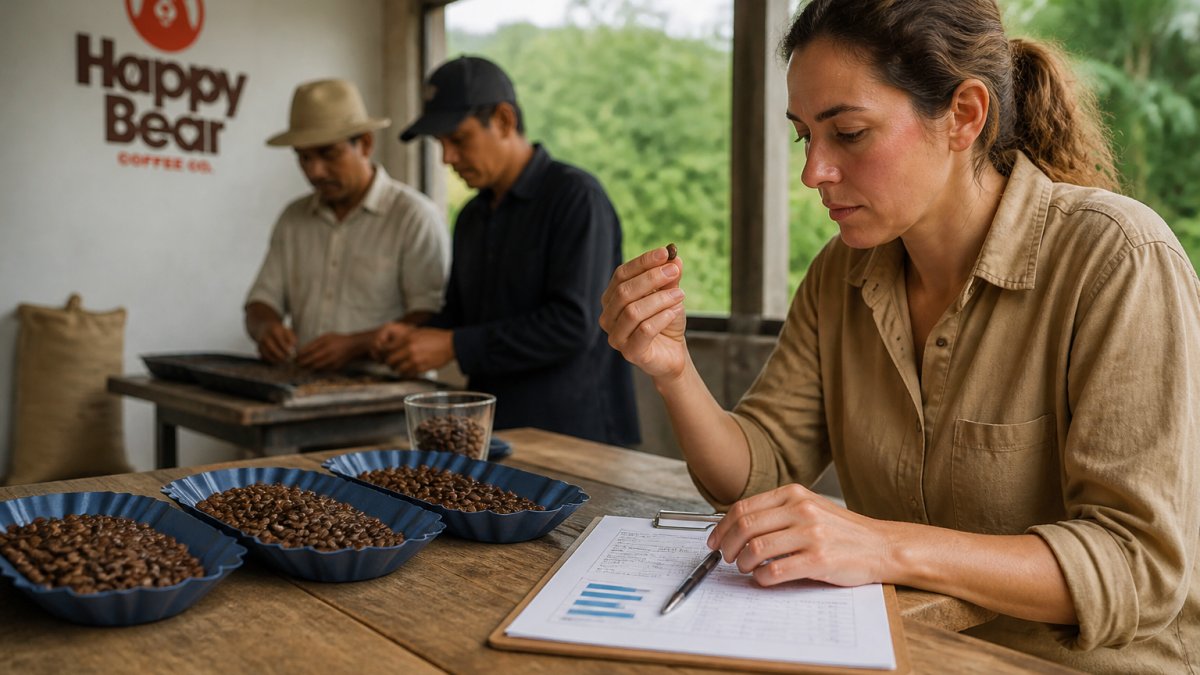
Coffee sourcing transparency is the practice of disclosing where beans come from, who grew them, and what was paid for them. It turns vague labels like "ethically sourced" into claims you can actually check.
That matters because coffee passes through many hands before it reaches your kitchen. Beans move from small farms to cooperatives, exporters, importers, and finally roasters. Each step adds distance between you and the person who grew your coffee. Transparency closes that gap.

At Happy Bear Coffee, we built our sourcing around that idea. Every bag we sell traces back to a known origin. This guide shows you how to verify coffee sourcing transparency for any brand, including ours.
Below, we'll walk through traceability, certifications, price data, and the questions that separate real disclosure from marketing talk. You'll finish with a checklist you can use the next time you stand in a coffee aisle.
Coffee Traceability: How to Follow a Bag Back to the Farm
Traceability is the record that connects a finished bag of coffee to the farm that grew it. Strong traceability names the country, region, farm or cooperative, and often the harvest period.
Start with the label. A traceable bag usually lists:
- Country of origin, such as Guatemala or Costa Rica
- Region or growing area within that country
- Farm, cooperative, or producer group name
- Harvest year or crop season
- Processing method, such as washed or wet-hulled
If a bag says only "100% Arabica" or "South American blend," you have almost nothing to trace. That is a gap, not a crime, but it limits what you can verify.
Batch-Level Tracking and QR Codes
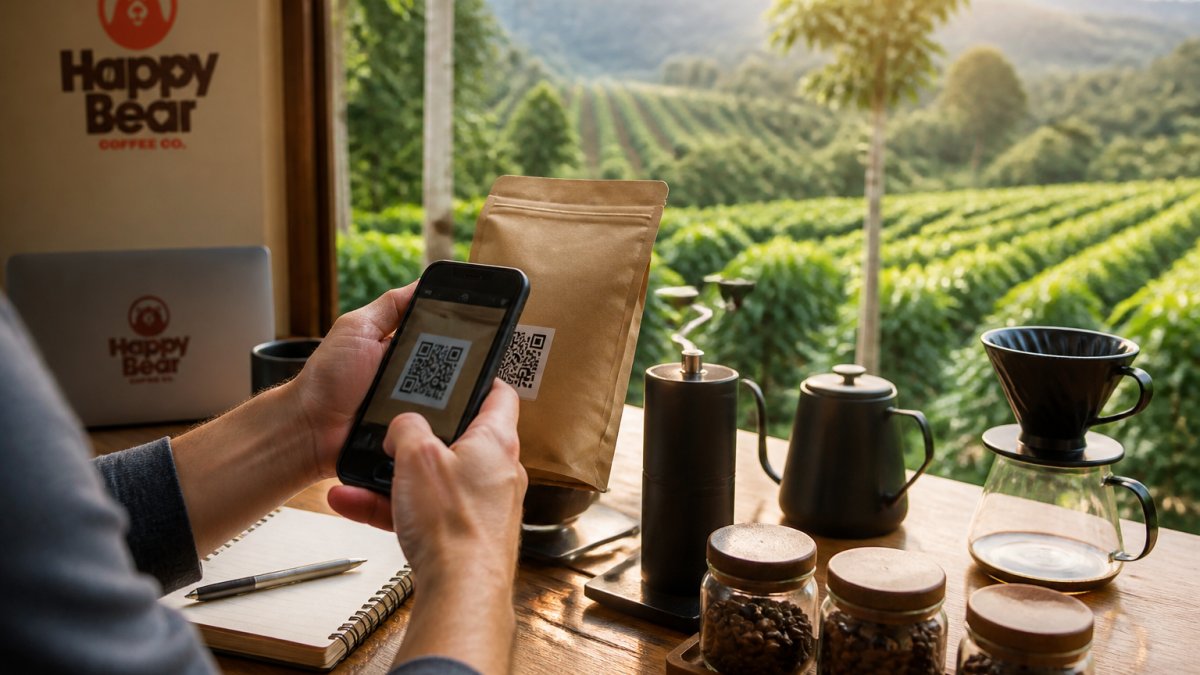
Batch-level tracking links a specific roast date and lot number to a specific shipment of green coffee. Many roasters now print a QR code on the bag that opens a page with that batch's details.
Scan the code and check what loads. You want to see:
- The farm or cooperative name
- The region and altitude
- The processing method
- The roast date and lot number
If the QR code opens a generic homepage or a marketing video, that is a red flag. Real batch tracking shows data, not branding.
What Origin-Specific Traceability Looks Like on a Label
Origin-specific traceability means the label names one place, not a broad region. "Huehuetenango, Guatemala" tells you more than "Central America."
A strong label reads like this: farm or cooperative, region, country, altitude, variety, and process. A weak label reads like this: "Premium world blend."
The difference matters because broad labels can hide beans from many sources, including ones the roaster knows little about.
Coffee Origin and Farm Information: What Brands Should Disclose
Farm information is the human side of traceability. It covers who grew the coffee, how they farm, and what conditions they work in.
Brands that disclose well typically share:
- Farm or cooperative names and locations
- Altitude and varietal information
- Farming practices, such as shade-grown or organic methods
- Processing details, like washed, natural, or wet-hulled
- Social and environmental programs tied to that origin
Our Guatemalan Glow is a good example of what this looks like in practice. It comes from the Huehuetenango region, one of the highest growing areas in the country, where volcanic soil shapes the flavor. The listing also notes that many growers there work through cooperatives that support fair compensation and community programs.

Ethical Coffee Certifications: What They Prove and What They Do Not
Certifications are third-party audits that confirm specific practices against a published standard. They prove something real, but each one covers a narrow slice of the supply chain, and none of them is a substitute for direct disclosure from the roaster.
The most useful way to read a seal is to ask three questions: What does the standard actually require? Who audits it, and how often? And what does the label not cover?
What Each Common Seal Actually Verifies
- Fair Trade (Fairtrade America / Fairtrade International) sets a minimum price for green coffee plus a social premium paid to the producer organization. It also requires certain labor and environmental standards. It does not set a living-wage guarantee for every worker, does not verify cup quality, and does not require the roaster to publish what it paid above the minimum.
- USDA Organic is a production standard. It governs soil, inputs, pest control, and separation of organic from non-organic lots. It says nothing about farmer pay, labor conditions, or price. Certification is handled by USDA-accredited certifying agents, and the label can apply to a blend sourced from many farms.
- Rainforest Alliance combines environmental criteria (biodiversity, water, shade, agrochemicals) with social criteria (worker conditions, community relations). It is a farm- and group-level standard, not a per-bag price guarantee.
- Bird Friendly (Smithsonian Migratory Bird Center) requires shade-grown, organic-compatible production that preserves habitat (Smithsonian Bird Friendly®). It is a narrow environmental standard and says nothing about price or labor.
- 4C (Common Code for the Coffee Community) is a baseline sustainability code focused on eliminating the worst practices. It is a floor, not a premium standard, and is often used as a first step toward more rigorous schemes.
What the Labels Do Not Tell You
A seal on a bag is a claim about a standard, not a claim about your specific lot. Three limits matter:
- Chain-of-custody vs. identity-preserved. Some certifications allow mass-balance or certificate-trading models, where certified volume is booked against a pool rather than physically tracked to your bag. That means the bag may not contain beans from a certified farm at all, the roaster simply purchased the equivalent volume of certificates. Identity-preserved or segregated supply chains are stronger, but the seal alone does not tell you which model was used.
- Audit frequency and scope. Most schemes audit annually and rely on a sample of records. A passing audit is a snapshot, not a continuous guarantee.
- No price transparency. With the exception of Fair Trade's minimum and premium, none of these standards require the roaster to publish the price paid to the specific producer behind your bag.
How to Use Certifications Without Over-Trusting Them
Treat a seal as one signal among several. The strongest combination is a named farm or cooperative, a harvest year, a published price or transparency report, and a certification that matches the claim you care about. If you care about farmer income, look for Fair Trade plus published prices. If you care about habitat, look for Bird Friendly or Rainforest Alliance plus origin detail. If you care about chemicals, look for USDA Organic.
USDA Organic certification and accredited certifying agents
Fair Trade, Organic, and Rainforest Alliance Compared
| Certification | Main Focus | Audit Body | What It Does Not Cover |
|---|---|---|---|
| Fair Trade | Minimum price, social premium, labor standards | Fairtrade International / Fairtrade America | Cup quality, above-minimum prices, full living wage |
| USDA Organic | Soil, inputs, pest control, lot separation | USDA-accredited certifying agents | Farmer pay, labor conditions, price |
| Rainforest Alliance | Environment and social criteria at farm/group level | Rainforest Alliance approved auditors | Per-bag price, cup quality |
| Bird Friendly | Shade-grown habitat, organic-compatible | Smithsonian Migratory Bird Center | Price, labor, quality |
| 4C | Baseline sustainability code | Independent approved auditors | Premium pricing, quality |
The smarter move is to treat certifications as one signal among several. Pair them with origin details and payment data before you decide a brand is trustworthy.
How to Read Farmer-Paid Prices and Payment Data
Payment data tells you what the farmer actually received. This is the hardest information to find and the most valuable when you do, but finding a number is not the same as understanding it. The skill is knowing which price you are looking at, what benchmark to compare it to, and what the disclosure leaves out.
The Four Prices You Will See
- Farmgate price is what the producer receives at the farm, before milling, transport, or export. It is the number that most directly reflects farmer income.
- FOB (Free On Board) price is what the exporter charges once the coffee is loaded at the port of origin. It includes milling, grading, bagging, inland transport, export documentation, and exporter margin. FOB is typically well above farmgate.
- CIF / landed price is what the importer pays to get the coffee to a destination port, including freight and insurance. It is higher still.
- Roaster's cost includes the importer margin, warehousing, roasting loss (green coffee loses roughly 15-20% of its weight during roasting), packaging, and overhead. The retail price you pay is several multiples of farmgate.
When a roaster publishes "what we paid," the first question is: which of these four is it? A farmgate figure and an FOB figure can differ by 50% or more on the same lot, so comparing them directly is misleading.
How to Benchmark a Disclosed Price
The most common public reference point is the commodity market price for green coffee, often quoted as the "C price" on the ICE futures exchange (Coffee C Futures). It is a baseline for ordinary commercial coffee, not a target for specialty. A useful rule of thumb among specialty buyers is that a transparent, quality-focused roaster should be paying well above the commodity baseline, often two to three times the C price for specialty-grade lots, and more for microlots or competition coffees. Treat that as a directional benchmark, not a rule.
A second benchmark is the Fair Trade minimum price, which is published and updated periodically. If a roaster claims fair sourcing but pays below the Fair Trade minimum, that is a contradiction worth raising.
A third is the cost of production at the farm. Few roasters publish this, but some cooperatives do. If the disclosed farmgate price is below the estimated cost of production, the farmer is losing money on the lot regardless of how the number compares to the C price.
What a Good Disclosure Includes
When a roaster publishes payment data, look for:
- The price per pound (state whether it is green or roasted weight, they are not the same)
- Whether the figure is farmgate, FOB, or another point in the chain
- The benchmark it is compared against (C price, Fair Trade minimum, prior-year price)
- The volume the price applies to, and whether it is an average across many farms or a single lot
- The harvest year the price refers to
- Whether premiums, quality bonuses, or second payments were paid on top
A single number without these context points is a marketing figure, not a disclosure.
Common Ways Disclosures Mislead
- Averaging across many farms. A high average can hide very low payments to the smallest producers.
- Quoting FOB as if it were farmgate. The farmer may have received a fraction of the number shown.
- Omitting the harvest year. A price from three seasons ago tells you nothing about current practice.
- Comparing to the C price only. Beating a low commodity baseline is a low bar.
- Publishing a percentage above commodity without the absolute number. Percentages without a base are unverifiable.
A Quick Interpretation Workflow
- Identify which price point the disclosure uses (farmgate, FOB, or other).
- Note the unit (per pound of green or roasted coffee) and the harvest year.
- Compare it to the C price and, if relevant, the Fair Trade minimum.
- Check whether the figure is a single-lot price or an average.
- Look for premiums, quality bonuses, or second payments on top of the base price.
- If any of these are missing, ask the roaster directly and note whether they answer with specifics.
A disclosed price you can interpret is worth more than a higher price you cannot. The goal is not the biggest number on the page, it is a number you can place in context and trust.
Coffee Sourcing Questions to Ask Roasters Before You Buy
Roasters expect questions from curious customers. The ones doing real work will answer with specifics.
Ask these:
- Which farm or cooperative grew this coffee?
- What region and altitude is it from?
- What price did you pay the producer?
- How does that compare to the commodity market?
- Which certifications apply, and who audited them?
- Can I see a transparency report for this lot?
- What happens to the farmer relationship after this harvest?
Vague answers signal vague sourcing. Specific answers, even ones that admit limits, signal a brand that knows its chain.
Red Flags: Unverifiable Claims and Transparency Gaps
Some claims sound good and prove nothing. Watch for these patterns:
- "Ethically sourced" with no farm, region, or certification named
- Certifications displayed without an audit body or certificate number
- "Direct trade" claims with no published prices
- A QR code that leads to a homepage instead of batch data
- Origin stories that change between the bag, the website, and social media
- No harvest year anywhere on the packaging
One red flag alone is not proof of bad practice. A pattern of them is a reason to look elsewhere.
Your Step-by-Step Verification Checklist
Use this checklist before you commit to a brand. It takes about five minutes per bag.
- Confirm the country, region, and farm or cooperative are named
- Check for a harvest year or crop season
- Scan the QR code and confirm it shows batch-level data
- Note which certifications appear and who audited them
- Look for published farmer-paid prices or a transparency report
- Compare the origin story across the bag, website, and social media
- Email the roaster one sourcing question and note how they respond
- Score the brand out of 8 and revisit after your next purchase
A brand that scores 6 or higher is doing real work. A brand that scores 3 or lower has gaps worth questioning.
Conclusion: Building Trust Through Verified Coffee Sourcing
Verifying coffee sourcing transparency takes a few minutes and a handful of questions. The payoff is a cup you can trust and a supply chain you actually understand.
At Happy Bear Coffee, we publish origin details for every single-origin roast, from Costa Rican highlands to Sumatran small farms. Our customizable bundle subscriptions let you explore origins on your own schedule. We are also a Specialty Coffee Association member and an NGLCC Certified LGBT Business Enterprise, and 5% of every purchase goes back through our donation program.

Start with one bag. Scan the code, read the origin, ask the question. Then shop Happy Bear Coffee and taste the difference verified sourcing makes.
Frequently Asked Questions
What information should a transparent coffee brand share about its sourcing?
A transparent brand shares the coffee origin down to the region or farm, the producer's name, the price paid to the farmer, and any certifications with verification details. Look for a transparency report or sourcing disclosure that includes farmgate price, FOB price, and whether the farmer was paid above commodity rates. Brands that publish batch-level tracking and QR codes for traceability give you the most verifiable data.
How can I tell whether a coffee sourcing claim is independently verified?
Check for third-party verification from recognized certifiers like Fair Trade, Organic, or Rainforest Alliance. Ask the roaster which auditor conducted the verification and request the certificate number. If a brand claims ethical sourcing but cannot name its certifier or show audit results, treat the claim as unverified.
Are certifications enough to prove that coffee is ethically sourced?
Certifications set a baseline but do not guarantee living wages or full supply-chain visibility. A Fair Trade label confirms minimum price standards, but it does not show the actual farmgate price paid for a specific batch. Combine certification checks with direct questions about farmer compensation, producer relationships, and whether the roaster publishes price transparency data. The strongest verification comes from multiple sources agreeing.
What is the difference between traceable coffee and ethically sourced coffee?
Traceable coffee means you can follow the beans from roaster back to a specific farm or cooperative using batch-level tracking, QR codes, or origin documentation. Ethically sourced coffee means the farmer was paid fairly and working conditions meet certain standards. A coffee can be traceable without being ethical, and ethical without being fully traceable. The best brands provide both: verifiable origin data and proof of equitable compensation.

Leave a comment
This site is protected by hCaptcha and the hCaptcha Privacy Policy and Terms of Service apply.