
Article: How to Taste Acidity in Specialty Coffee

How to Taste Acidity in Specialty Coffee
Last Updated: November 9, 2026
Quick Summary
To taste acidity in specialty coffee, brew a light roast and slurp a small spoonful at about 160°F, then hold it in your mouth for three seconds. Notice where the brightness lands and whether your mouth waters. Name a fruit it resembles, such as lemon, green apple or grapefruit.
- Acidity is a bright, lively quality, unlike the puckering sourness of an under-extracted cup.
- Use a 1:16.7 ratio, 18 grams of coffee to 300 grams of water, and keep it fixed.
- Slurp to spread the coffee across your palate and push aroma to the back of your nose.
- Watch for mouth-watering, which is a reliable cue for acidity rather than bitterness.
- If a cup tastes sharply sour, try a finer grind or slightly longer brew before changing beans.
Table of Contents
- What Coffee Acidity Actually Is (and Why It Isn't Sourness)
- How to Describe Acidity in Coffee Using Plain Language
- A Repeatable Tasting Exercise for Finding Acidity
- Telling Acidity Apart from Bitterness and Astringency
- Reading Acidity by Flavor: A Coffee Acidity Chart
- How Roast Level, Origin and Brewing Shape the Acidity You Taste
- How to Fix a Cup That Tastes Too Acidic
- Put Your Palate to Work: Try the Light N' Cozy Side by Side
- Frequently Asked Questions
What Coffee Acidity Actually Is (and Why It Isn't Sourness)
Acidity is one of the most prized qualities in specialty coffee, yet many people confuse it with sourness, and learning to taste acidity clearly takes practice. The difference between the two is simpler than most guides suggest. Acidity is a bright, lively quality, like biting into a crisp apple or a squeeze of lemon over fish.
Sourness is the unpleasant, puckering taste you get from an under-extracted cup. Acidity is a welcome brightness that makes a coffee feel alive on the tongue.
Researchers at the University of Southern Denmark have found something useful here. Danish researchers on whether individual coffee acids can be tasted at real-world concentrations Their work suggests that individual acids are present at concentrations too low to taste on their own. What we perceive as acidity is a blend of acids, aroma, sweetness and body working together.
Acidity is the bright, fruit-like tang that makes a coffee taste lively.
Watch out: a cup that tastes sharp and sour may be under-extracted, not overly acidic. Coarser grinds or shorter brew times can pull out the sour notes without the sweetness that balances them.
How to Describe Acidity in Coffee Using Plain Language
You do not need a sommelier's vocabulary to describe acidity. Most people reach for fruit comparisons when they taste acidity, and that works well.
Try these common descriptors:
- Citrus: lemon, lime or grapefruit
- Orchard fruit: green apple or pear
- Stone fruit: peach or apricot
- Berry: blueberry or cranberry
Ask yourself whether the acidity feels bright and juicy or flat and sharp. Bright acidity is pleasant. Sharp acidity that stings the back of the tongue usually points to a brewing issue.
A Repeatable Tasting Exercise for Finding Acidity
The best way to learn acidity is to taste it on purpose, with the same setup every time so your palate has a fair comparison. This exercise takes about fifteen minutes and works for beginners. Start with a light roast, like our Light N' Cozy, which is pulled right before first crack to highlight the acidity of the bean.
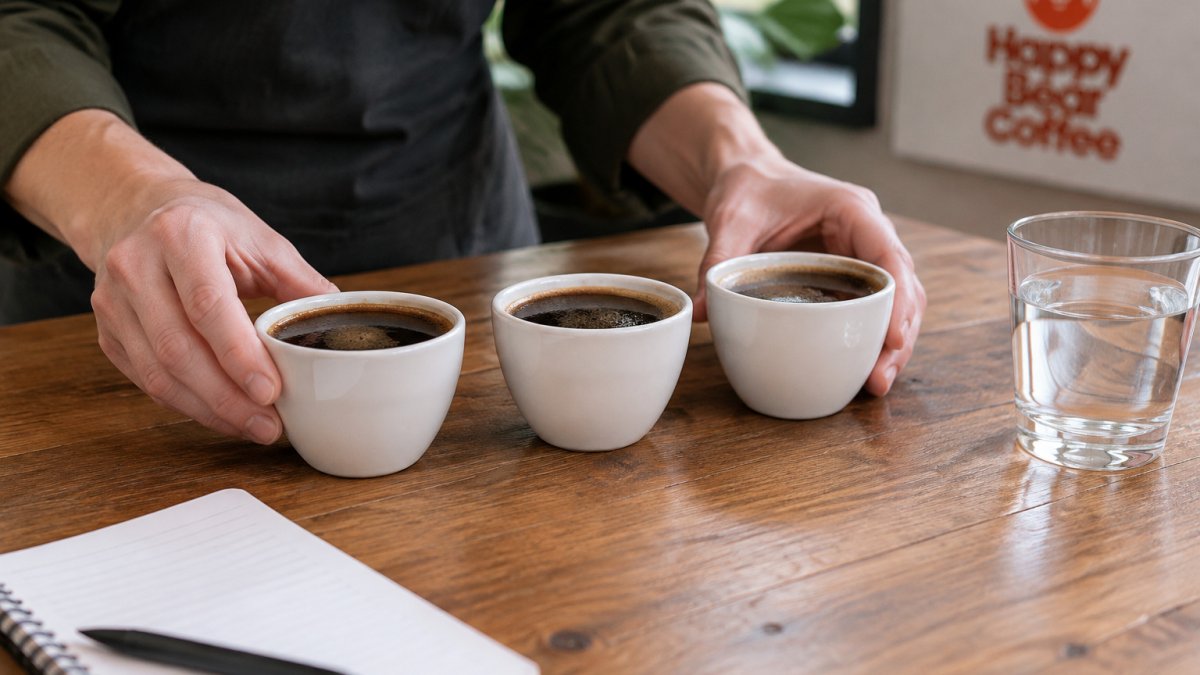
What you need: two coffees (one light, one medium or dark), a burr grinder or pre-ground coffee, a scale, a kettle, two identical cups, a spoon, water, and a pen. A simple scoring sheet is below.
The sequence:
- Weigh 18 grams of coffee and 300 grams of water (a 1:16.7 ratio) for each coffee. Keep the dose and ratio identical so the only variable is the bean.
- Grind both at the same setting, medium-fine for a pour-over or medium for a drip brewer. If you use a French press, go coarse.
- Heat water to 200°F. Brew each coffee the same way and the same length of time. Note the brew time on your sheet.
- Let each cup cool to about 160°F, roughly two minutes after brewing. Slurp a small spoonful, slurping spreads the coffee across your palate and pushes aroma to the back of your nose, which is where much of what you call "brightness" is actually perceived.
- Hold the coffee in your mouth for three seconds. Notice where the sensation lands: the front of the tongue, the sides, or the back. Notice whether your mouth waters. That watering response is a reliable cue for acidity rather than bitterness.
- Name one fruit or food the acidity reminds you of, and write it down. Do not edit yourself; the first comparison is usually the most honest.
- Rinse with water, wait sixty seconds, and taste the second coffee the same way.
- Score each coffee from 1 to 5 on three lines: brightness (how lively it feels), sweetness (how much the fruit is supported), and finish (how long the impression lasts).
A simple scoring sheet:
| Coffee | Brightness (1-5) | Sweetness (1-5) | Finish (1-5) | Fruit comparison |
|---|---|---|---|---|
| Light roast | ||||
| Medium or dark roast |
Repeat the exercise with the same two coffees a week later to build a repeatable observation.
Watch out: if you change grind size, water temperature, or dose between the two coffees, you are tasting the brew, not the bean. Keep every variable fixed except the coffee itself.
Setting Up a Fair Side-by-Side Comparison
A fair comparison controls four things: water, temperature, grind, and brew method. Use the same water for both cups, filtered tap or bottled, not a mix, because water hardness and mineral content change how acidity reads. Keep the water temperature within a degree or two for both brews. Use the same grinder and the same setting. And brew both coffees with the same method and the same contact time.
Pour both into identical cups so the shape of the vessel does not change how the aroma reaches you. Taste them in the same order each time, and rinse between sips. If you can, have a second person pour so you taste blind; knowing which cup is which biases what you notice.
Our Peruvian Elevated Delight is a medium roast with notes of caramelized sugar and grapefruit.
How Acidity Changes as Coffee Cools
Coffee is not a static drink. As it cools from about 160°F to room temperature, the volatile aroma compounds that carry much of the fruit character change how they reach your nose, and your tongue's sensitivity to sweetness and bitterness shifts too. Many drinkers find that brightness becomes more noticeable as the temperature drops, while sweetness can fade and bitterness can step forward.
Taste the same cup at three points: hot (about 160°F), warm (about 120°F), and cool (about 90°F). At each point, write one word for brightness and one for sweetness. A coffee that tastes balanced hot but sharp when cool is often lightly under-extracted; a coffee that tastes flat hot but sweet when cool is usually well extracted. This temperature-by-temperature check is one of the fastest ways to diagnose a brew without changing anything.
Telling Acidity Apart from Bitterness and Astringency
Acidity, bitterness and astringency can blur together, but they feel different.
- Acidity is bright and fruity, and it makes your mouth water.
- Bitterness is a lingering, roasty flavor, often on the back of the tongue.
- Astringency is a dry, drying sensation, like strong tea.
A coffee can be high in acidity and low in bitterness, or the reverse. Learning to spot each one makes you a sharper taster.
Reading Acidity by Flavor: A Coffee Acidity Chart
Use this quick reference to match flavor notes with the acidity you might taste:
| Flavor note | Acidity feel | Typical roast |
|---|---|---|
| Lemon, lime | Crisp, sharp | Light |
| Green apple, pear | Clean, juicy | Light to medium |
| Grapefruit | Bright, sweet-tart | Medium |
| Cranberry, berry | Lively, tangy | Light to medium |
| Chocolate, caramel | Soft, low | Medium to dark |
This coffee acidity chart is a starting point, not a rule. Origin and brewing shift the results. For a deeper look at how flavor notes like these map to specialty coffee, read our guide to specialty coffee flavor profiles.
How Roast Level, Origin and Brewing Shape the Acidity You Taste
Roast level has a big effect on acidity. Lighter roasts keep more of the bean's natural brightness. Darker roasts mute acidity and bring out bittersweet, roasty flavors. Our Best Light Roast Coffee For Beginners guide explains which light roasts are easiest to taste.
Origin matters too. Coffees from high-altitude regions often show brighter fruit notes. Brewing matters just as much. Grind size, contact time and brew ratio all change how acidity lands. If you are still choosing a roast style, our guide on how to choose coffee roast types can help you narrow it down.
How to Fix a Cup That Tastes Too Acidic
A cup that tastes sharply sour is usually under-extracted: the water pulled out the bright acids but left the sugars and body behind. The fix is to extract more, not to buy a different coffee. Work through the adjustments below one at a time, in this order, and taste after each change so you know which one helped.
1. Grind finer. A finer grind exposes more surface area, so water extracts more sweetness and body in the same time. Move one step finer on your grinder, brew again, and compare. If the cup turns bitter or drying, you have gone too far, back off half a step.
2. Extend the brew time slightly. If your grind is already where you want it, add fifteen to thirty seconds to the brew. This is easiest with a pour-over or French press, where you control contact time directly. For a drip brewer, a finer grind is usually the more practical lever.
3. Raise the water temperature a few degrees. Hotter water extracts faster. Move from 195°F to 200°F, or from 200°F to 205°F, and taste. Water above about 205°F risks scorching the grounds and adding bitterness, so stop there.
4. Adjust the brew ratio. A tighter ratio, more coffee per unit of water, increases strength and can make acidity read as more balanced. Try 18 grams of coffee to 280 grams of water instead of 300 grams, and compare.
5. Try a darker roast if the brightness is still overwhelming. Darker roasts mute acidity and bring out bittersweet, roasty flavors. This is a last resort when you have already dialed in the brew, because it changes the coffee rather than the extraction.
Diagnose before you adjust. If the sourness sits at the front of the tongue and makes your mouth water, it is likely under-extraction. If it stings at the back of the tongue and lingers, it may be bitterness from over-extraction or from water that is too hot. If your mouth feels dry after the sip, that is astringency, not acidity, and the fix is usually a coarser grind or a shorter brew, the opposite direction.
Change one variable at a time and keep notes. A simple log with columns for grind setting, water temperature, brew time, and your one-word impression will show you the pattern within a few brews. Our comparison of home coffee brewing methods shows which methods handle acidity best.
Put Your Palate to Work: Try the Light N' Cozy Side by Side
Now it is your turn. Pick up a bag of our Light N' Cozy and run the tasting exercise from above. Brew it next to a medium roast and note where the brightness shows up.
The Light N' Cozy is a good first coffee for practicing acidity. Shop the Light N' Cozy and start tasting for yourself. At Happy Bear Coffee, we think every cup is a chance to notice something new.

Frequently Asked Questions
How do you taste acidity in specialty coffee?
Start with a hot, freshly brewed cup and take a small sip, letting it spread across the front and sides of your tongue. Acidity shows up as a bright, lively sensation that makes your mouth water, similar to biting into a ripe fruit. Sourness is a sharper, more puckering feeling that tends to linger. Try a light roast such as the Light N' Cozy, which is pulled right before first crack to highlight the acidity of the bean, then compare it with a medium roast like the Peruvian Elevated Delight.
How can you tell the difference between acidity and bitterness in coffee?
Acidity is a bright, fruity brightness felt on the sides of the tongue and often tied to flavors like citrus or apple. Bitterness is felt at the back of the tongue and creates a dry, lingering finish. If a cup seems sharp but finishes clean, it is likely acidic. If it leaves a dry, heavy aftertaste, bitterness or over-extraction is more likely. Tasting a light roast and a dark roast side by side helps you feel the contrast.
How can you fix coffee that tastes too acidic?
Acidity that tastes sour usually signals under-extraction. Try a finer grind, a slightly longer brew time, or a slightly hotter water temperature to pull out more sweetness and body. Adjusting the brew ratio so there is more coffee relative to water can also round out sharp edges. Make one change at a time so you can tell which adjustment made the difference.



Leave a comment
This site is protected by hCaptcha and the hCaptcha Privacy Policy and Terms of Service apply.