
Article: Is a Mobile Coffee Cart Wedding Rental Worth It?
Is a Mobile Coffee Cart Wedding Rental Worth It?
Last Updated: October 30, 2026
Quick Summary
A mobile coffee cart wedding rental is worth it if you want a live barista station that fills the post-dinner lull and serves espresso drinks, cold brew, and custom beverages on-site. Most two-hour bookings run $700 to $1,800, averaging about $1,000, so compare all-in quotes before you book.
- Wedding coffee catering packages are listed at $1,050 to $2,500+ for two to four hours of service.
- Per-guest espresso bar pricing typically lands at $10 to $18 per person.
- Plan for one barista per 75 to 100 guests during peak service.
- Keep the menu to six to eight drinks so service stays fast.
- Ask for a certificate of liability insurance naming the venue as additional insured.
Table of Contents
- Why Couples Are Booking a Mobile Coffee Cart for Weddings
- What a Wedding Coffee Cart Rental Cost Actually Includes
- Building a Coffee Cart Wedding Menu Guests Will Love
- Mapping Your Coffee Cart Wedding Timeline
- Capacity and Service-Speed Planning for Your Guest Count
- Venue Requirements, Power, and Contingency Planning
- Questions to Ask a Wedding Coffee Cart Vendor Before You Book
- Decaf, Non-Dairy, and Non-Coffee Options for Every Guest
- Booking Your Wedding Coffee Cart With Happy Bear Coffee
- Frequently Asked Questions
Why Couples Are Booking a Mobile Coffee Cart for Weddings
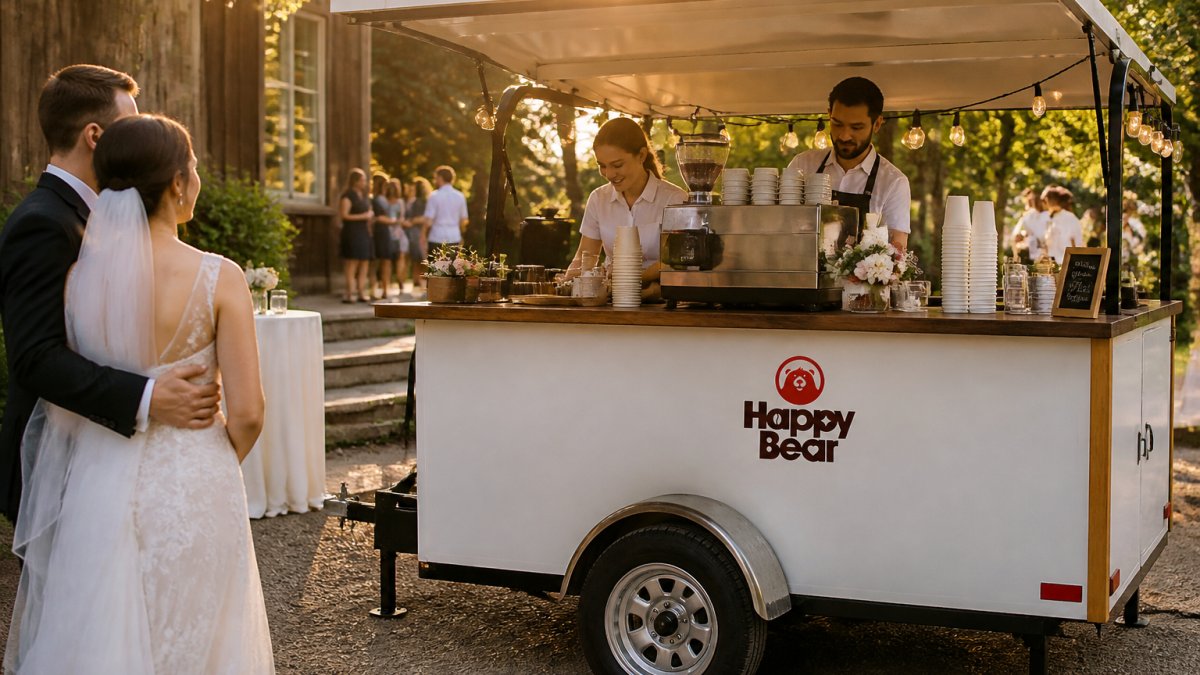
Wedding coffee catering packages are listed at $1,050 to $2,500+ for two to four hours of service, according to Reform Coffee Co.'s 2026 coffee catering pricing guide. That figure explains the surge in interest: couples want a late-night espresso bar without paying for a full dessert course, which is why mobile coffee cart wedding rental demand keeps climbing. A mobile coffee cart wedding rental is a compact, self-contained espresso station, staffed by a barista, that serves espresso drinks, cold brew, and custom beverages on-site at your reception.
At Happy Bear Coffee, we run a mobile coffee cart for events in the Greater Philadelphia and Reading region. Below, we break down what a rental costs, what is actually included, and how to plan capacity so your guests never stand in a 20-minute line.
What a Mobile Espresso Bar Adds to a Reception
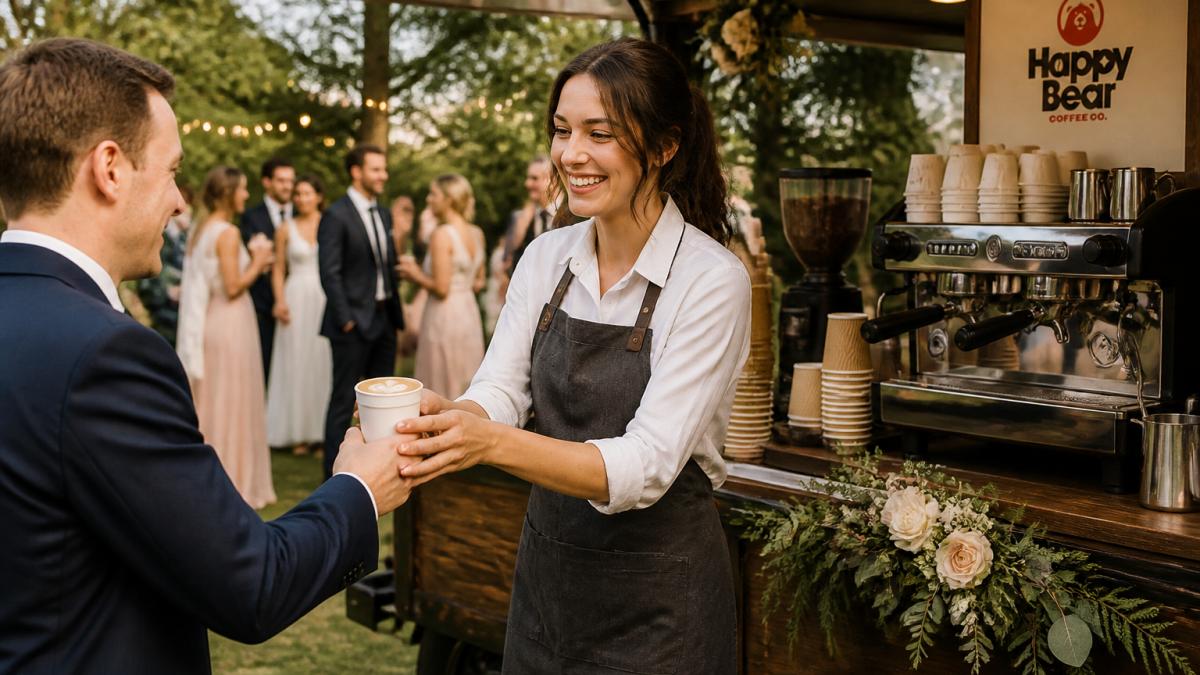
A mobile espresso bar turns a dead zone in the reception schedule into a gathering point. Most weddings hit a lull between dinner and dancing. A cart fills that gap with an activity guests actually want, and it gives non-drinkers something to hold besides water.
The format matters more than the machine. A live barista pulling shots to order creates a café experience that a self-serve urn never will. Cold brew has become a fixture on these menus too, and if you want to understand why, our guide on why cold brew is on the rise explains the trend.
What a Wedding Coffee Cart Rental Cost Actually Includes
A wedding coffee cart rental cost breaks into four parts: the base booking fee, the drinks, the staffing, and the logistics. The base fee covers the cart, the machine, and setup. Drinks and barista hours are where quotes diverge most.
Most two-hour coffee cart bookings run $700 to $1,800, averaging about $1,000, per Find Coffee Carts' booking data. A live-barista espresso bar priced per guest typically lands at $10 to $18 per person, according to MyLatteda's 2026 per-guest breakdown. Which model your vendor uses changes your total dramatically.
Bean quality is the line item couples overlook. If espresso quality matters to you, read our guidance on the best coffee roast for espresso before you approve a menu.
The Line Items Behind Every Quote
When you request quotes, ask each vendor to itemize the same six lines so you can compare apples to apples:
| Line Item | What It Covers | Typical Range | Questions to Ask |
|---|---|---|---|
| Service minimum | The smallest booking a vendor will accept | Often a two-hour block or a set guest count | Is the minimum in hours, guests, or dollars? |
| Hourly or per-guest rate | Barista time and drinks | Hourly flat rate or $10-$18 per guest | Does the rate include unlimited drinks or a cap? |
| Travel fee | Distance from the vendor's base to your venue | Varies by mileage and region | Is it flat or per mile, and is it waived inside a radius? |
| Staffing | Number of baristas on site | One barista per 75-100 guests at peak | Is a second barista an add-on or included? |
| Add-ons | Signature drinks, custom cups, toppings, non-dairy milk | Priced per item or per guest | Which add-ons are already in the package? |
| Gratuity and tax | Service charge and sales tax | Confirm the percentage in writing | Is gratuity built in or expected on site? |
Ask for an all-in number before you compare vendors, and confirm whether the deposit is refundable and how final guest counts affect the total.
Per-Guest, Flat-Rate, and Package Pricing Models
Three pricing structures dominate the market, and each suits a different guest count.
| Pricing Model | How It Works | Best For | Watch Out For |
|---|---|---|---|
| Per-guest | $10-$18 per person | Large weddings, 150+ | Cost climbs fast with headcount |
| Flat-rate, time-based | Fixed fee, unlimited drinks | Couples wanting cost certainty | Shorter windows cap total drinks |
| Package | Bundled hours, drinks, extras | Full-service planning | Extras may be excluded |
Some vendors, including Sequel Coffee Co.'s mobile cart service, price on a flat time-based rate with unlimited beverages regardless of guest count. That model protects you if your guest list grows. Per-guest pricing protects you if it shrinks.
Building a Coffee Cart Wedding Menu Guests Will Love
A coffee cart wedding menu should be short. Six to eight drinks covers nearly every guest, and a shorter menu means faster service. Long menus slow the line and confuse guests who just want a latte.
Build your menu in three tiers:
- Core espresso drinks: latte, cappuccino, americano, espresso
- Crowd-pleasers: mocha, chai latte, hot chocolate
- Signature drinks: one or two custom options tied to you as a couple
Flavored syrups let guests customize without lengthening the base menu. If you want to see what a range of flavor options looks like, browse the flavored coffee collection to understand the profiles a vendor might stock.
Mapping Your Coffee Cart Wedding Timeline
Your coffee cart wedding timeline should anchor the cart to the reception flow, not to the vendor's convenience. The best slot is usually right after dinner service, when guests are moving between tables and the dance floor.
A standard service window looks like this:
- 60 minutes before service: vendor arrives, sets up, tests the machine
- Dinner ends: cart opens, barista begins service
- Peak window: first 45 minutes, expect the longest line
- Final 30 minutes: volume drops, ideal for custom orders
- Teardown: 20 to 30 minutes after close
Ask whether booking blocks are available for longer receptions before you sign.
Capacity and Service-Speed Planning for Your Guest Count
Plan for one barista per 75 to 100 guests during peak service. A single barista can typically pull and finish a drink in 60 to 90 seconds, so 100 guests ordering at once means a real wait.
Capacity planning comes down to three numbers: guest count, the share who order coffee, and drinks per order. Assume 60 to 70 percent of guests visit the cart, and most order one drink. That gives you a working estimate.
A mobile trailer setup is often presented for 150 to 300+ guests over two to four hours, per Colada Kulture's mobile trailer guide. Carts suit intimate gatherings better. Match the equipment to the crowd, not the other way around.
Venue Requirements, Power, and Contingency Planning
Venue fit decides whether your cart works before the first shot is pulled. Ask your venue three questions: where can the cart park, what power is available, and is there a water source nearby.
Power, Water, and Footprint
Espresso machines draw serious wattage. Espresso machines draw substantial power, so confirm the venue's outlet capacity with your vendor. Confirm the venue's outlet capacity and whether you need a generator. Ask the vendor for the cart's power draw in watts or amps and hand that number to your venue contact, who can confirm whether the circuit is dedicated.
Water matters too. Many carts carry their own supply, but a vendor who needs a venue tap will want to know where it is and whether it is potable. Ask whether the cart is self-contained or needs a hookup.
Footprint is the third constraint. A cart needs room for the unit, the barista, and a guest queue that does not block a doorway or a fire lane. Ask the vendor for the cart's dimensions and recommended clearance, then walk the space with your venue coordinator.
Permitting and Insurance
Espresso Outlet's wedding setup guidance advises checking with the venue and the relevant authority about requirements for the unit, menu, and service arrangement, and cautions against assuming a private event is exempt from permitting. In practice, that means asking your venue whether mobile food or beverage vendors need approval, and asking the vendor for a certificate of liability insurance naming the venue as additional insured. Get both answers in writing before you sign.
Weather and Delay Contingencies
Build a contingency plan for weather and delays. An indoor backup location, a covered spot for an outdoor cart, and a vendor who confirms setup access in advance all reduce risk. Get the setup location in writing in your contract, along with the load-in time, the nearest door, and whether stairs or elevators are involved.
Questions to Ask a Wedding Coffee Cart Vendor Before You Book
The right questions separate a professional vendor from a hobbyist with a rented machine. Ask them before you pay a deposit, and get the answers in writing.
- How many baristas will staff my guest count?
- What is included in the base fee, and what costs extra?
- What is your setup and teardown time, and who handles it?
- Do you carry liability insurance, and can you provide a certificate?
- What happens if the machine fails mid-service?
- How much notice do you need for a final guest count?
- What is your cancellation and rescheduling policy?
Watch out: a quote that looks low often excludes barista hours, travel, or gratuity. Ask for an all-in number before you compare vendors.
Decaf, Non-Dairy, and Non-Coffee Options for Every Guest
Inclusive drink options are not a nice-to-have. Roughly a third of your guests will want decaf, a non-dairy milk, or something other than coffee, and running out reads as poor hospitality.
Stock at minimum:
- Decaf espresso or decaf drip
- Oat and almond milk alongside whole milk
- Hot chocolate and chai for non-coffee drinkers
- A caffeine-free herbal tea option
If you want to see what a vendor's decaf range looks like, browse the decaffeinated coffee selection to understand the options available. Confirm non-dairy milk quantities with your vendor in advance; it is the most common mid-event shortage.
Booking Your Wedding Coffee Cart With Happy Bear Coffee
Booking early is the single biggest factor in getting the cart you want. Booking early is recommended, as availability for specific dates is not guaranteed.
Here is how we would approach it:
- Lock your date and venue first
- Confirm guest count range and service window
- Request a quote with an all-in breakdown
- Ask about decaf, non-dairy, and custom drink options
- Sign the contract and confirm setup logistics
Happy Bear Coffee is a Specialty Coffee Association member and an NGLCC Certified LGBT Business Enterprise, and we offer sustainably sourced specialty coffee. You can read the Happy Bear history to learn how we got here.
Frequently Asked Questions
How much does a coffee cart rental for a wedding cost?
Pricing depends on guest count, service duration, menu, and date. A mobile espresso bar with a live barista is typically priced by guest count or service window, and pricing depends on quantity, dates, and delivery. Ask each vendor whether their quote is flat-rate or per-guest, and confirm what is included before you compare.
How many guests can a mobile coffee cart serve per hour?
Throughput depends on the menu and staffing. A cart serving simple drip coffee and a few espresso drinks moves faster than one offering custom lattes with multiple milk options. Ask your vendor for their realistic per-hour output and how many baristas they assign to your guest count.
Does a wedding coffee cart need access to power or water?
Some mobile espresso carts are self-contained, and others need venue power or water. Ask the vendor whether they need a standard outlet, a dedicated circuit, or a water hookup, and confirm whether the venue charges for utility access. Share the venue's floor plan and loading details in advance so the cart setup fits and the barista can reach the service spot without stairs or long carries.
Can a mobile coffee cart accommodate decaf and non-dairy options?
Ask the vendor which decaf and alternative milk options they offer, and whether any carry an upcharge. For guests who do not drink coffee, ask about hot chocolate, chai, tea, or a signature non-coffee drink. If you have guests with allergies, ask how the vendor avoids cross-contact between dairy and non-dairy equipment.
The gap between a good coffee cart and a forgettable one comes down to planning: capacity, menu, timing, and a vendor who answers your questions straight. Happy Bear Coffee handles all four, with a full mobile café experience, sustainably sourced specialty coffee, and a 5% customer-powered donation program built into every order. Get started with Happy Bear Coffee and give your guests a reception they will actually remember.


Leave a comment
This site is protected by hCaptcha and the hCaptcha Privacy Policy and Terms of Service apply.