
Article: How to Choose the Best Decaf Coffee for Espresso Machines in 2026

How to Choose the Best Decaf Coffee for Espresso Machines in 2026
Last Updated: November 17, 2026
Quick Summary
The best decaf coffee for espresso machines in 2026 is whole-bean decaf roasted recently, built for espresso, and decaffeinated with the chemical-free Swiss Water Process. Choose a medium or medium-dark roast, then dial in an 18-gram dose to roughly 36 grams out in 25 to 32 seconds.
- Medium and medium-dark roasts suit decaf espresso best because their sweetness survives extraction pressure.
- Start dialing in at 18 grams in a double basket with a 1:2 ratio target.
- Begin one or two grinder steps coarser than your regular espresso setting, then tighten.
- For milk drinks, pull a shorter, more concentrated shot closer to a 1:1.5 ratio.
- Super-automatic owners should pick a medium-dark decaf and avoid very light roasts.
Table of Contents
- Why Decaf Espresso Is Different (and Why Most Guides Get It Wrong)
- How to Pick the Best Decaf Coffee Beans for Espresso
- Swiss Water Decaf Coffee: What the Process Means for Your Shot
- How to Dial In Decaf Espresso Without Chasing Your Tail
- Decaf Espresso Grind Settings by Brewing Method
- Matching Decaf Beans to Your Espresso Machine Type
- Freshness, Storage, and What to Do After Opening the Bag
- Common Mistakes That Ruin Decaf Espresso
- Shop Happy Bear Coffee for Your Decaf Espresso Setup
- Frequently Asked Questions
Why Decaf Espresso Is Different (and Why Most Guides Get It Wrong)
Ask what is the best decaf coffee for espresso machines in 2026 and most lists hand you a bag of beans with no guidance on how it will actually pull. That is the gap. Decaf beans behave differently under pressure, and a coffee that tastes fine in a drip brewer can turn thin and bitter in an espresso basket. At Happy Bear Coffee, we roast our coffees in small batches.
Decaf espresso is coffee that has had most of its caffeine removed before roasting, then ground fine and brewed under pressure to produce a concentrated shot. The removal process changes bean structure, which affects how the coffee absorbs water and how quickly it extracts.
The practical result: decaf often needs a different grind and ratio than the caffeinated bag sitting next to it, so dial it in separately.
How to Pick the Best Decaf Coffee Beans for Espresso
The best decaf coffee beans for espresso share four traits: a recent roast date, a blend or origin built for milk and pressure, a decaffeination method that preserves flavor, and a grind matched to your machine. Buy for those traits and the brand name matters far less than the bag's details.
Start with the label. A roast date tells you more than any tasting note. Next, look at what the coffee was built for. Espresso blends often combine beans for body and sweetness, while a single origin can be brilliant but less forgiving.
If you are ready to browse, our decaffeinated coffee collection lists the decaf options we currently roast, including Swiss Water Process bags.
Roast Level and Flavor Profile
Medium and medium-dark roasts suit decaf espresso best. They carry enough caramelized sweetness to survive the pressure of extraction, and they hold up in milk without turning ashy. Light roasts can work, but they demand a finer grind and more precision, and decaf light roasts sometimes taste underdeveloped because the bean has already been through processing.
Dark roasts bring chocolate and toasted notes. Our guide to specialty coffee flavor profiles breaks down how roast level maps to tasting notes if you want to match a specific flavor.
Body, Acidity, and Sweetness
Balance matters more than any single attribute. A good decaf espresso has enough body to coat the palate, gentle acidity to keep it from tasting flat, and sweetness that lingers after the shot. Decaf beans can lose some brightness during processing, so a roaster who compensates with a thoughtful blend will beat a single origin chosen carelessly.
Whole Bean vs. Pre-Ground
Whole bean is generally the better choice for espresso, since ground coffee loses freshness faster. Buy whole bean and grind right before brewing. If you are still deciding on equipment, our guide to choosing a burr vs blade grinder explains why a burr grinder produces the consistent particle size espresso needs.
Swiss Water Decaf Coffee: What the Process Means for Your Shot
Swiss Water decaf coffee is coffee decaffeinated using water, temperature, and a carbon filter instead of chemical solvents. The green beans soak in a flavor-saturated water solution that pulls caffeine out while leaving most of the flavor compounds behind.
Why does this matter for espresso? Two reasons. First, solvent-free processing tends to preserve more of the bean's natural sugars, and sugars are what caramelize in the roaster and sweeten your shot. Second, the process is gentler on bean structure, so the coffee handles a fine espresso grind without shattering into dust.
Some decafs are made with chemical solvents, so check how the decaf was processed.
How to Dial In Decaf Espresso Without Chasing Your Tail
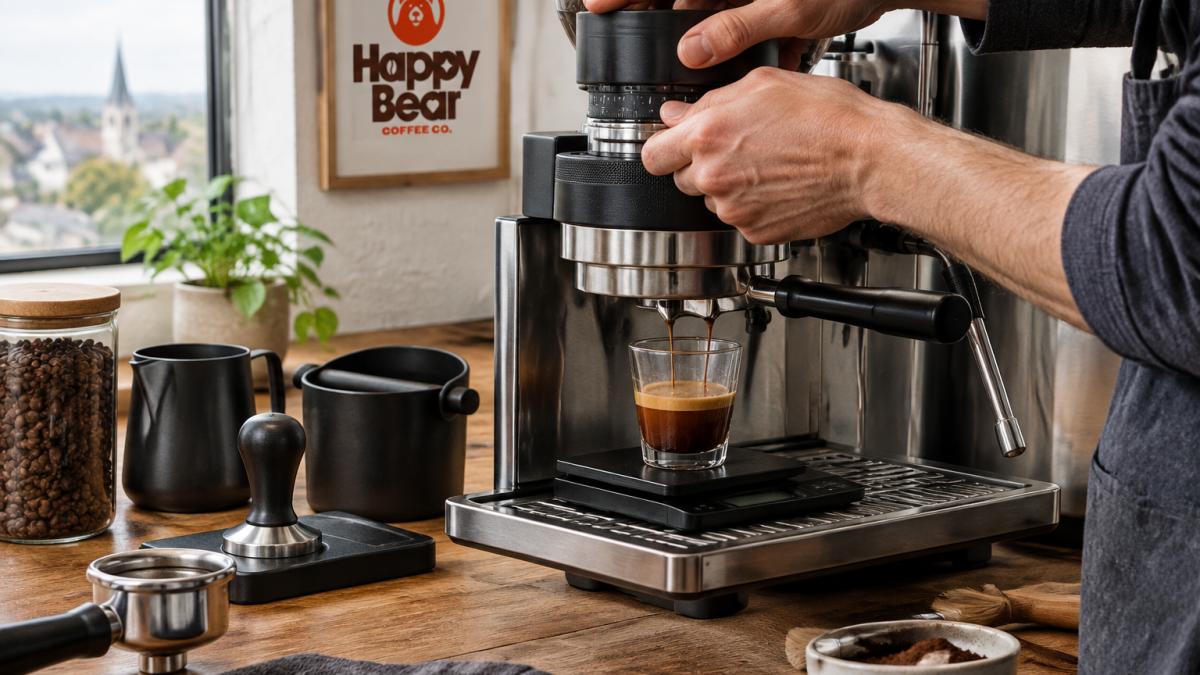
Dial in decaf by changing one variable at a time, starting with grind. Keep your dose fixed, pull a shot, taste it, then adjust. Most people change three things at once, lose track of what worked, and blame the beans. The fix is a documented starting point and a written log, so every change is attributable to one variable.
Why Decaf Pulls Differently
Decaf beans can extract differently than caffeinated beans, so a grind that works for one may not suit the other. Adjust grind and ratio from your own shot results.
A Repeatable Dialing-In Protocol
Use this sequence every time you open a new bag. The numbers below are starting points, not rules, adjust from them, but write down what you actually did.
- Fix the dose. Start at 18 grams in a double basket. Keep it identical for every shot until the grind is dialed in.
- Set a target yield. Aim for roughly 36 grams of liquid out, a 1:2 ratio, as your first reference point.
- Start coarser than you think. Begin one or two steps coarser than your regular espresso setting, then tighten. Starting too fine risks choking the machine and wasting a shot.
- Time the shot. A reasonable first target is 25 to 32 seconds from first drip to the end of the pull. Decaf often needs the longer end of that window.
- Taste before adjusting. Sour, sharp, or salty means under-extracted, grind finer or extend the yield. Harsh, dry, or ashy means over-extracted, grind coarser or shorten the yield.
- Change one variable per shot. Grind first, then dose, then yield. Never all three at once.
- Log the result. Record the grinder setting, dose, yield, and time for the shot you liked, so the next bag starts close instead of from scratch.
Reading the Shot
A well-extracted decaf espresso has a slow, syrupy pour, a crema that holds for at least a minute, and a finish that stays sweet rather than turning dry. If the crema dissipates almost immediately and the shot tastes hollow, the coffee is likely stale or the grind is too coarse. If the puck comes out soupy and the shot gushes, the grind is too coarse for the basket. If the machine struggles and drips slowly, the grind is too fine or the dose is too high for the basket size.
Adjusting for Milk Drinks
For a milk drink, pull a slightly shorter, more concentrated shot, closer to a 1:1.5 ratio, so the coffee still comes through the milk. Decaf's softer acidity can disappear under milk if the shot is too long, so taste the espresso alone first, then decide whether to shorten the yield.
Decaf Espresso Grind Settings by Brewing Method
Grind size should match the brewing method, not the bean's caffeine content. Espresso needs the finest grind of any common method because the water passes through in seconds under pressure.
| Brewing Method | Grind Size | What to Expect |
|---|---|---|
| Espresso | Fine, like powdered sugar | Slow shot, thick crema |
| Moka pot | Fine-medium | Strong, slightly gritty cup |
| Pour-over | Medium | Clean, bright cup |
| French press | Coarse | Full body, heavier mouthfeel |
| Drip | Medium | Even, familiar cup |
For espresso specifically, aim for a grind that lets a shot run slowly without choking the machine. If your grinder struggles at fine settings, our roundup of the best coffee grinders for home brewing covers options built for espresso.
Matching Decaf Beans to Your Espresso Machine Type
Different machines demand different things from a bean, and the right decaf for a manual lever machine is rarely the right decaf for a super-automatic. Match the bean to the machine's level of control, then match the grind format to what the machine can actually accept.
Manual and Lever Machines
Manual machines give you the most control and the least forgiveness. Every variable, grind, dose, tamp pressure, pre-infusion, and pull profile, is on you, so a consistent, forgiving bean matters more than complexity. A medium-dark decaf blend with chocolate and nut notes is the easiest starting point because small grind errors show up as smaller flavor penalties. Whole bean is essential here; pre-ground coffee cannot be adjusted to the machine's behavior, and manual machines expose every inconsistency in particle size. Expect to grind finer for decaf than for a comparable caffeinated blend, and expect to re-dial when the bag ages. Because decaf’s flavor still depends on how its beans balance sweetness, roast, and extraction, decaf coffee bean picks can help you compare profiles before settling on a bag to dial in.
Semi-Automatic Machines
Semi-automatics give you control over grind, dose, and yield while the machine handles pressure and temperature. This is the sweet spot for decaf espresso, because you can compensate for decaf's faster extraction with grind and ratio without fighting the machine. A medium or medium-dark decaf blend with enough body to stand up to milk works well, and a single origin can be rewarding if you are willing to dial it in. Buy whole bean and grind per shot. If you want a starting point, set an 18-gram dose, a 36-gram yield, and a 25-to-32-second window, then adjust grind first.
Super-Automatic Machines
Super-automatics do the dosing, grinding, and tamping for you, which means the bean has to fit the machine's fixed parameters rather than the other way around. Choose a medium-dark decaf roasted for espresso and avoid very light roasts, which the machine's preset grind and dose may under-extract. Whole bean is strongly preferred because the machine's grinder is calibrated for whole bean; pre-ground coffee bypasses the grinder and usually produces weak, watery shots. If your machine has a bypass chute for pre-ground coffee, reserve it for decaf when you want a single shot without emptying the hopper, and accept that the result will be less consistent than a freshly ground shot.
Pod and Capsule Machines
Pod machines remove grind and dose decisions entirely, so the only lever you control is which pod you buy and how much water you push through it. Look for decaf pods labeled for espresso rather than for lungo or drip, and pull the shortest shot the machine allows to keep the coffee from tasting thin. Whole bean and pre-ground coffee are not options here unless the machine has a separate portafilter, so treat pod choice as the whole decision.
Whole Bean vs. Pre-Ground by Machine
| Machine Type | Whole Bean or Pre-Ground | Why |
|---|---|---|
| Manual / lever | Whole bean only | Grind must be tuned to the machine and the bean |
| Semi-automatic | Whole bean | Grind is the primary dialing variable |
| Super-automatic | Whole bean preferred | Built-in grinder is calibrated for whole bean |
| Pod / capsule | Neither, sealed pods | Grind and dose are fixed by the pod |
Whatever the machine, buy fresh, store it well, and re-dial when you open a new bag. A bean that was perfect on your semi-automatic last month may need a small grind adjustment as it ages, and a super-automatic may need a slightly darker roast to compensate for its fixed settings.
Freshness, Storage, and What to Do After Opening the Bag
Freshness decides whether your decaf espresso tastes sweet or dull. Coffee releases carbon dioxide for days after roasting, then slowly stales. A bag roasted weeks ago will pull flat shots no matter how good your technique is.
Store beans in an airtight container away from light, heat, and moisture, at room temperature. Do not store coffee in the fridge. Buy whole bean, grind right before brewing, and drink the bag within a few weeks of opening. Our guide on how to store coffee beans fresh walks through the details.
Watch out: leaving the bag open on the counter pulls in moisture and stale air, and the next shot will taste papery.
Common Mistakes That Ruin Decaf Espresso
The biggest mistake is treating decaf like an afterthought. It is not a lesser coffee; it is a different bean that needs its own dialing-in. A common mistake is grinding decaf at the same setting as your regular espresso blend and expecting the same shot time.
Another: buying pre-ground decaf and wondering why the crema is thin. Espresso needs fresh-ground coffee, full stop. And many people assume all decaf is processed the same way. It is not. Swiss Water Process and solvent-based decafs behave differently in the basket, and the bag should tell you which one you are buying.
Shop Happy Bear Coffee for Your Decaf Espresso Setup
What separates a good decaf espresso from a forgettable one comes down to the bean behind it. Happy Bear Coffee roasts small batches from 100% Arabica beans in Birdsboro, PA, and our decaf uses the chemical-free Swiss Water Process. All of our coffees are certified mold-free by independent third-party lab testing, and 5% of every online purchase goes to a nonprofit you choose at checkout from a list of 30+ organizations.
Our Italian Apennine Blend is a robust blend with notes of dark chocolate and roasted nuts, and it is available as a decaffeinated option by selecting "Yes" on the option below. For travelers and office setups, single-serve coffee brew bags make a fresh cup easy anywhere, and if you run a café, restaurant, or office that pours decaf espresso daily, our wholesale coffee program supplies beans in the volumes a busy bar needs.
The challenge is simple: stop accepting bitter, hollow decaf shots. Match your grind to your machine, buy beans with a recent roast date, and start with a decaf that was processed with care. Happy Bear Coffee roasts in Birdsboro, PA, offers Italian Apennine in a Swiss Water decaf option, and ships freshly packed bags to your door. Get started with Happy Bear Coffee and pull a decaf shot worth drinking.
Frequently Asked Questions
Can decaf coffee be used in an espresso machine?
Yes. Decaf coffee works in any espresso machine, from manual to super-automatic. The key is treating it like regular espresso: use freshly roasted whole beans, grind fine enough for your machine, and adjust dose and yield to taste. Decaf beans can be slightly more brittle after the decaffeination process, so you may need to grind a touch coarser than your usual setting to avoid over-extraction and bitterness.
Does decaf espresso need a different grind setting?
Often, yes. Decaffeinated beans frequently require a slightly coarser grind than their caffeinated counterparts because the decaffeination process can make the bean structure more porous. Start one or two steps coarser on your grinder, then fine-tune based on shot time and taste. If your shot runs too fast and tastes sour, grind finer; if it runs slow and tastes bitter, grind coarser.
Is Swiss Water decaf good for espresso?
Swiss Water decaf is a strong choice for espresso because it avoids chemical solvents and tends to preserve more of the bean's natural sweetness and body. That makes it easier to pull balanced shots with good crema. Happy Bear Coffee's decaffeinated Italian Apennine blend uses a chemical-free Swiss Water Processed blend.
How do you make decaf espresso taste less sour?
Sourness usually means under-extraction. Try grinding finer, increasing your dose slightly, or raising the water temperature if your machine allows it. Also check that your beans are fresh and stored properly. If the sourness persists, extend the shot time a few seconds and taste again. Keep changes small and one at a time so you can tell what worked.


Leave a comment
This site is protected by hCaptcha and the hCaptcha Privacy Policy and Terms of Service apply.