
How to Choose a Burr vs Blade Grinder for Coffee
Last Updated: November 12, 2026
Quick Summary
The burr vs blade grinder for coffee choice comes down to consistency: a blade grinder chops beans at random, while a burr grinder pushes them between two abrasive surfaces set a fixed distance apart. Blade grinders are faster and cheaper, but burr grinders produce repeatable, even grounds that extract evenly.
- Blade grinders need 15-25 seconds for 25 grams; burr grinders take 35-55 seconds.
- Blade grinders produce fines and boulders in every batch, creating an extraction gap.
- Conical burrs suit espresso and all-round use; flat burrs favor pour-over clarity.
- Espresso is non-negotiable: a pressurized shot needs a narrow particle distribution.
- Pulse-and-shake and sifting out fines improve blade grinder results without buying anything.
Table of Contents
- Burr vs Blade Grinder for Coffee: The Core Difference
- How a Burr Grinder Works and Why Particle Size Matters
- Blade Grinder Coffee: How It Chops and What It Costs You
- Grind Consistency, Extraction, and Flavor: What Changes in the Cup
- Burr Grinder vs Conical: Flat Burrs, Conical Burrs, and What It Means for You
- Choosing the Best Blade Coffee Grinder (and When It Makes Sense)
- Matching Your Grinder to Your Brew Method: Pour-Over, Drip, and Espresso
- Total Cost of Ownership: Price, Lifespan, and Value by Budget
- Cleaning, Retention, and Maintenance for Both Grinder Types
- Practical Blade-Grinder Techniques and Manual vs Electric Burr Grinders
- Frequently Asked Questions
Burr vs Blade Grinder for Coffee: The Core Difference
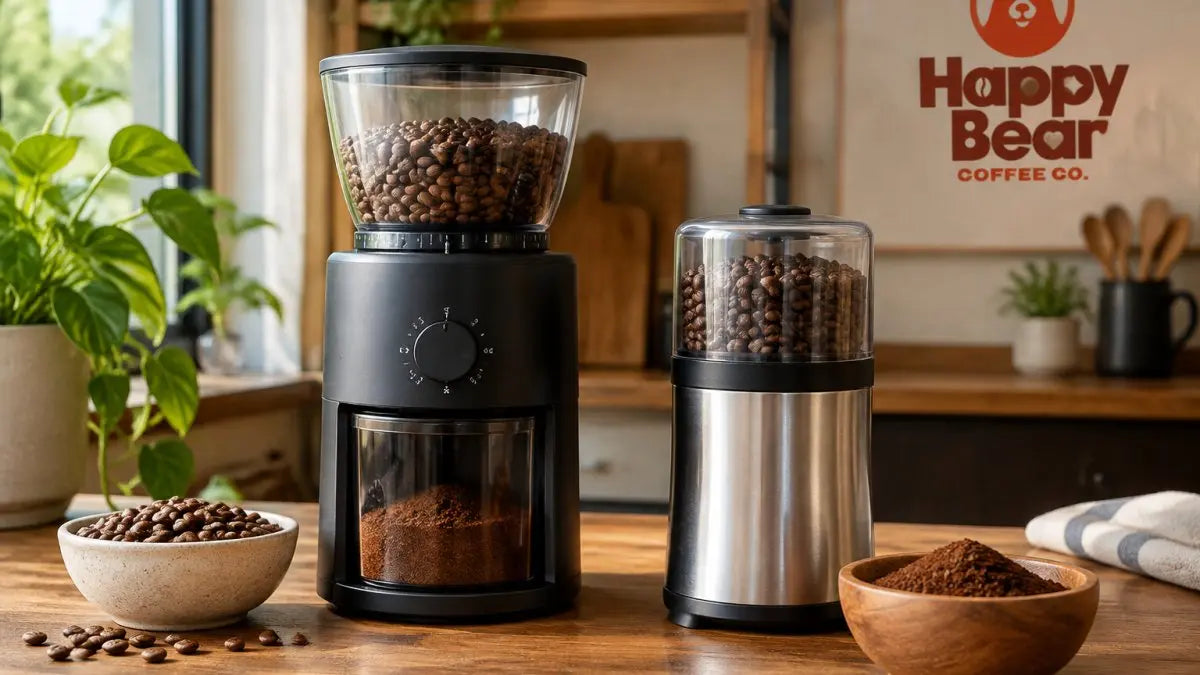
The burr vs blade grinder for coffee decision comes down to one thing: how the machine breaks the bean. A blade grinder spins a metal propeller that chops beans at random. A burr grinder pushes beans between two abrasive surfaces set a fixed distance apart, so every particle leaves at roughly the same size.
That single mechanical difference shapes everything else, from how your cup tastes to how much you spend over five years. According to Pifferia's 2026 grinder comparison, blade grinders need just 15-25 seconds for 25 grams of beans while burr grinders take 35-55 seconds. Speed favors the blade. Consistency favors the burr, and consistency is what extraction rewards.
At Happy Bear Coffee, we field this question constantly from home brewers building their first real setup. The honest answer: a blade grinder can make decent coffee, but a burr grinder makes repeatable coffee. Below, we break down how each mechanism works, what it costs you in the cup and on the counter, and which one fits your brew method and budget.
How a Burr Grinder Works and Why Particle Size Matters
A burr grinder feeds beans between two burrs, grinding them down until particles are small enough to pass through a gap you control. Turn the adjustment ring, and you change that gap, which changes grind size. Simple, mechanical, repeatable.
Particle size is the average diameter of the grounds you produce. Particle distribution describes how tightly those sizes cluster around that average. Burrs win on distribution because the gap acts as a hard limit: nothing escapes until it fits.
Why does that matter? Because extraction is a rate, not an event. Fine particles give up their flavor compounds fast. Coarse particles give them up slowly. When every particle is close to the same size, they all finish extracting at roughly the same moment. When they vary wildly, some grounds over-extract into bitterness while others under-extract into sourness, in the same cup.
For a broader foundation on building a home brewing routine, our how to brew specialty coffee at home guide walks through gear, ratios, and technique from the ground up.
Blade Grinder Coffee: How It Chops and What It Costs You
Blade grinder coffee is produced by a spinning blade in a grinding chamber, and the result is a lottery. Beans near the blade shatter into powder while beans at the top of the pile get nudged around and barely cracked. You get powder and pebbles in the same batch, every single time.
The machine also gives you almost no control. Most models run on a single button: press longer for finer, shorter for coarser. That is not grind adjustment, it is guesswork with a timer. The same five-second press produces different results depending on bean density, how full the chamber is, and how fresh the roast is.
None of this makes blade grinders useless. iDou Coffee's 2026 grinder analysis notes that blade grinders are small, powerful, and easy to use, which suits budget-focused buyers who do not need precise grind control. If you are brewing a single cup with a drip machine and you are not chasing clarity, a blade grinder gets you caffeine without ceremony.
The cost shows up in the cup, not the receipt. Uneven grounds mean uneven extraction, and uneven extraction means you taste the grinder's limitations before you taste the bean.
Grind Consistency, Extraction, and Flavor: What Changes in the Cup
Grind consistency is the single largest variable you control after the bean itself. Change it and the same coffee tastes like a different coffee.
Here is the mechanism in plain terms. Water dissolves compounds from grounds at a rate proportional to surface area. Small particles have more surface area per gram, so they extract faster. Large particles extract slower. When your bed of grounds contains both, water finds the fines first and pulls them past the sweet spot into bitter, astringent territory before the boulders have given up much of anything.
The result is a cup that tastes simultaneously hollow and harsh. You taste the roast's edges without its middle. Many brewers blame their beans or their water and never suspect the grinder, which is why this is one of the most common upgrade mistakes we see.
Fines, Boulders, and the Extraction Gap
Fines are the dust-like particles that extract almost instantly. Boulders are the oversized chunks that barely extract at all. A blade grinder produces both in every batch, and the gap between them is what we call the extraction gap.
You cannot fix an extraction gap with technique alone. Grind finer and the fines get finer, pushing them further past the bitter threshold. Grind coarser and the boulders get bigger, leaving more of the bean untouched. The gap persists because the mechanism creates it.
A burr grinder narrows that gap by design, and the payoff is a cup where sweetness, acidity, and body land in balance instead of fighting each other. If you want to understand how grind changes show up in flavor before you buy anything, our guide on how to brew better coffee covers the dialing-in process step by step.
Burr Grinder vs Conical: Flat Burrs, Conical Burrs, and What It Means for You
The burr grinder vs conical question trips up a lot of buyers, so let's settle it. Both flat and conical designs use two burr surfaces, and both produce far more uniform grounds than any blade. The difference is geometry and the flavor profile each tends to favor.
| Burr Type | Shape | Grind Profile | Best For | Typical Feel |
|---|---|---|---|---|
| Conical | Cone inside a ring | Slightly wider distribution | Espresso, drip, all-round use | Forgiving, easy to dial in |
| Flat | Two parallel discs | Tighter, more uniform | Pour-over, light roasts, clarity | Bright, separated flavors |
| Blade | Spinning propeller | Random, wide spread | Budget drip brewing | Unpredictable |
Conical burrs are the practical default for most home setups. They tolerate small dial-in errors, they handle a wide grind range, and they cost less to manufacture at a given quality level. Flat burrs push toward maximum uniformity and tend to highlight acidity and origin character, which suits pour-over brewers chasing clarity in light roasts.
Neither is objectively better. Pick conical if you brew multiple methods or make espresso. Pick flat if you brew almost exclusively pour-over and want the cleanest possible cup. What most buying guides miss is that the gap between a good conical and a good flat is far smaller than the gap between any burr and any blade.
Choosing the Best Blade Coffee Grinder (and When It Makes Sense)
The best blade coffee grinder is the one you will actually use, and for a specific kind of buyer that is a genuinely sound purchase. Market data backs this up: according to Roastworthy's 2026 market analysis, blade grinders account for a higher volume of unit sales thanks to their lower price points, even though burr grinders capture a larger share of total revenue.
A blade grinder makes sense when:
- Your budget is tight and coffee is a habit, not a hobby
- You brew automatic drip and do not plan to change methods
- Counter space is limited and you want one small device
- You need a backup grinder for travel or the office
- You are not yet sure how deep into brewing you want to go
It stops making sense the moment you buy a pour-over cone, an espresso machine, or a bag of expensive single-origin beans. Those purchases reward precision, and a blade grinder cannot deliver it. Spending good money on a prized roast and shredding it with a propeller is a false economy.
Best for: budget drip brewers and casual drinkers. Skip if: you brew pour-over, espresso, or anything where grind size is a recipe variable.
Matching Your Grinder to Your Brew Method: Pour-Over, Drip, and Espresso
Grind size should follow your brew method, not the other way around. Each method sets a contact time between water and grounds, and the grind has to match that window. The table below gives starting points, not commandments, every grinder and every bean will need small adjustments, but it shows how far apart the demands really are.
| Brew Method | Target Grind | Typical Contact Time | What Uneven Grinds Do |
|---|---|---|---|
| Pour-over | Medium-fine, like table salt | 2:30-4:00 | Channeling through the bed; sour edges with bitter finish |
| Automatic drip | Medium, like sand | 4:00-6:00 | Muddy, hollow cup; fines clog the filter |
| Espresso | Fine, like powdered sugar | 25-35 seconds | Choked puck or gushing shot; no repeatability |
| Cold brew | Coarse, like raw sugar | 12-18 hours | Cloudy concentrate; harsh, over-extracted edges |
Pour-over is the method that punishes inconsistency most visibly. A V60 or Chemex relies on water moving through the bed at a steady rate. When the bed contains both fines and boulders, water finds the fines first and channels through them, leaving the boulders barely touched. The cup tastes thin and sharp at the same time. A burr grinder set to medium-fine gives you a bed that drains evenly, which is why pour-over brewers are the most common burr converts.
Automatic drip is the most forgiving target, which is exactly why blade grinders survive in so many kitchens. The paper filter traps some fines, the brew cycle is long, and the machine does not care whether your grind is perfect. But forgiving is not the same as immune. A blade grinder on drip produces a cup that is drinkable but flat, and the difference between that cup and one from a burr grinder is the difference between coffee as a habit and coffee as something you can taste.
Espresso is where the burr argument becomes non-negotiable. A pressurized shot needs a narrow particle distribution because the puck itself is the filter. Fines migrate to the bottom of the basket and choke the flow, while boulders let water race through in thin channels. The result is a shot that pulls in 15 seconds or 45 seconds depending on which flaw dominates, and no amount of puck prep fixes a grind that was never uniform to begin with. If espresso is your target, treat a burr grinder as part of the machine, not an accessory.
Cold brew is more forgiving on consistency but still wants a coarse, even grind so the long steep extracts smoothly rather than unevenly. Boulders in a cold brew batch leave you with a concentrate that tastes weak and harsh at once, because the fines over-extract during the 12-18 hour steep while the boulders contribute almost nothing. A burr grinder set to coarse gives you a concentrate you can dilute predictably.
If cold brew is your daily driver, our cold brew coffee and equipment collection pairs well with a burr grinder set to coarse. For a side-by-side look at methods and what each demands from your gear, our home brewing methods comparison lays out the trade-offs.
Total Cost of Ownership: Price, Lifespan, and Value by Budget
Price tags mislead here, because the cheap grinder is not always the cheap option. according to Bean Box's 2026 pricing benchmarks, while blade grinders sell for a fraction of that. The gap looks enormous until you spread it across years of use.
Grinder lifespan averages two to five years depending on build quality and how hard you run it, per Pifferia's durability data. A $25 blade grinder replaced every two years costs about the same over a decade as one $100 burr grinder that lasts five. The burr grinder also makes better coffee the entire time.
| Budget | Grinder Type | Upfront Cost | Expected Lifespan | Coffee Quality |
|---|---|---|---|---|
| Under $50 | Blade | $20-40 | 2-3 years | Inconsistent |
| $50-150 | Entry burr | ~$100 | 3-5 years | Consistent, adjustable |
| $150-300 | Quality burr | $150-300 | 5+ years | Excellent, precise |
| $160 | BruTrek® Hand Grinder | $160 | Long service life | Consistent, travel-ready |
The value calculation shifts with how much you spend on beans. If you buy specialty coffee, an inconsistent grind can waste a meaningful share of every bag through uneven extraction. Over a year, that waste alone can exceed the price difference between the two grinder types.
Cleaning, Retention, and Maintenance for Both Grinder Types
Maintenance separates grinders that last from grinders that die early, and the two types demand very different routines.
Blade grinders are simple to clean and that is their quiet advantage. Wipe the chamber, brush the blade, done. No disassembly, no burr alignment, no retention to worry about because there is nowhere for grounds to hide.
Burr grinders need more attention. Grounds lodge in the chute and between the burrs, and that retained coffee goes stale, then flavors the next batch. Brush the burr chamber weekly, and run a few grams of beans through before an important brew to flush old grounds. Flat burr grinders retain more than conical models, which is worth knowing before you buy.
Watch out: never rinse a burr grinder's electric body or get water into the burr assembly. Moisture causes rust and clumping that no amount of cleaning reverses. Brush dry, or use grinder cleaning tablets made for the job.
Burrs themselves wear down. Dull burrs crush rather than cut, producing more fines and less consistency. Most home burrs last years of regular use, but if your grind suddenly turns muddy and the taste flattens, worn burrs are a likely culprit.
Practical Blade-Grinder Techniques and Manual vs Electric Burr Grinders
If you are working with a blade grinder for now, technique can narrow the extraction gap without buying anything. These methods will not match a burr grinder, but they move you meaningfully closer. The key is to treat the blade grinder as a tool with a procedure, not a button you hold down.
The pulse-and-shake method. Load no more than half the chamber, 15-20 grams in a typical 50-gram capacity is a good target. Press the button in one-second bursts, lifting and shaking the grinder gently side to side between bursts so the grounds redistribute and the blade meets fresh beans instead of the same pile. Stop when the grounds look like coarse sand for drip or slightly finer for pour-over. A full batch usually takes 8-12 pulses. The shake is not decorative: without it, the beans at the top of the chamber never reach the blade, and you get powder at the bottom and pebbles at the top.
Grind in small batches. A half-full chamber chops more evenly than a full one because the blade has room to move the grounds around. If you need 30 grams, grind in two 15-gram batches rather than one full load. It takes an extra minute and produces a noticeably tighter spread.
Sift out the fines. A simple kitchen sieve removes the dust that turns cups bitter. Sift the grounds over a bowl, discard or set aside the fines, and brew with what remains. You lose some coffee to the sieve, but the cup is cleaner and more predictable. This is the single highest-impact technique for blade-grinder users.
Grind just before brewing. Stale grounds amplify every inconsistency because the volatile compounds that make coffee taste fresh are the first to go. A blade grinder already produces an uneven bed; do not add staleness to the list of variables.
Watch out: never grind spices, nuts, or flavored coffee in the same blade grinder you use for brewing coffee. The oils and residues lodge in the plastic and flavor every subsequent batch, and no amount of wiping removes them completely.
Manual versus electric burr grinders is the other fork in the road, and it is a separate question from burr versus blade. A manual hand grinder and an electric burr grinder can use the same burr geometry and produce the same grind quality; the difference is power source, effort, and where you plan to use it.
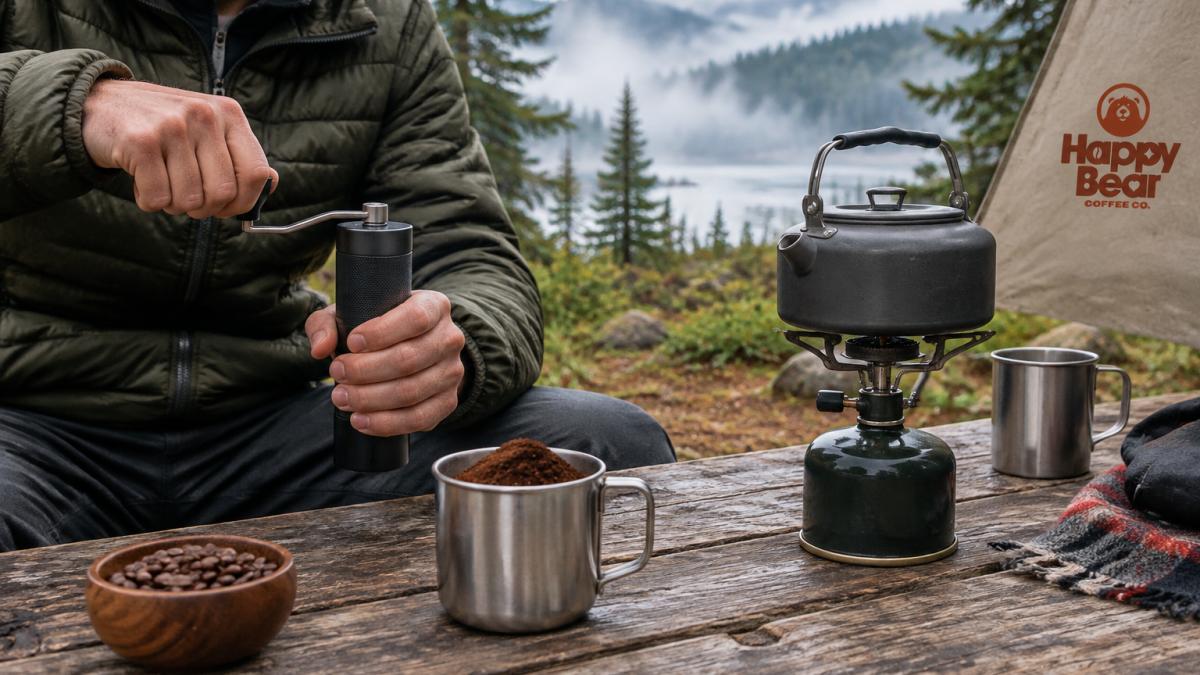
Manual burr grinders cost less than electric equivalents at similar burr quality, take up almost no space, and never need a power outlet. They are quiet, which matters in a small apartment or a shared office. The trade-off is effort: grinding 30 grams for a full pot by hand takes one to three minutes depending on the burr set and how fine you go, and doing it every morning gets old. Manual grinders shine for travel, camping, and single-cup brewers who grind 15-18 grams at a time.
Electric burr grinders remove that friction and add convenience for households brewing multiple cups daily. They are faster, they hold more beans, and they are easier to use before you have had coffee. The trade-offs are noise, counter space, and price at a given burr quality. An electric grinder also introduces retention, grounds that stay in the chute between batches, which manual grinders largely avoid because you can shake them clean.
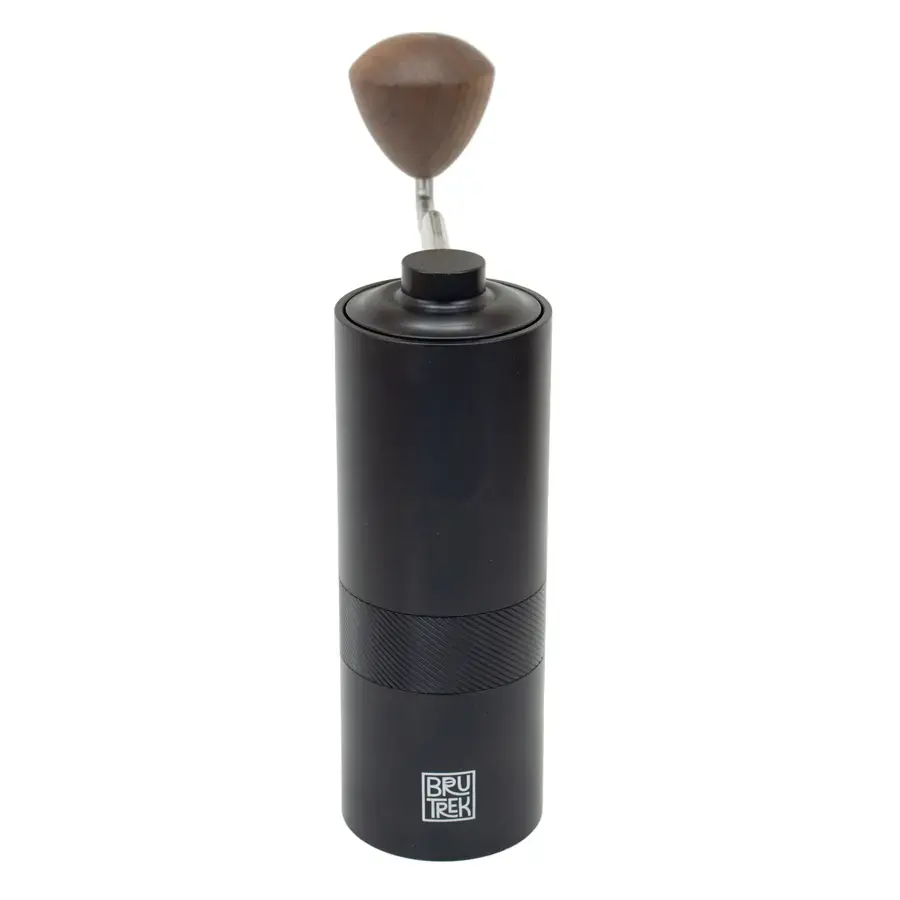
A practical rule: if you brew one or two cups a day and travel or camp regularly, a manual burr grinder is close to unbeatable. If you brew a full pot every morning and never take your gear outside, an electric burr grinder earns its counter space. Our BruTrek® Hand Coffee Grinder uses precision-engineered stainless steel burrs, holds 32-40 grams depending on bean density, and adjusts from espresso to pour-over with marked grind settings. Its rugged design is built for the outdoors, and it can work on a kitchen counter too.
Frequently Asked Questions
Is a burr or blade grinder better for coffee?
A burr grinder is better for most brew methods because it produces a uniform particle size, which leads to even extraction and a clearer flavor. A blade grinder chops beans unevenly, creating fines and boulders that extract at different rates. That said, a blade grinder can work for budget-focused drip drinkers who don't need precision. For pour-over or espresso, the burr vs blade grinder decision clearly favors burr.
Can you make good coffee with a blade grinder?
Yes, with technique. Pulse the blade in short bursts and shake the grinder between pulses to redistribute the grounds. Stop before the grounds turn to powder. Use a coarse setting for drip or French press, and grind just before brewing. A blade grinder coffee routine won't match a burr grinder for consistency, but it can produce a drinkable cup if you avoid over-grinding and use fresh beans.
What is the difference between a conical burr and a blade grinder?
A conical burr grinder uses two cone-shaped burrs to crush beans to a set distance, giving you adjustable particle size and a uniform grind. A blade grinder spins a metal blade that chops beans randomly, so particle size varies widely. The burr grinder vs conical comparison matters because conical burrs are the most common home burr type, offering precision and repeatability that a blade simply cannot match.
Is a burr grinder worth it for home coffee?
For anyone brewing pour-over, espresso, or drip with specialty beans, yes. Entry-level burr grinders are a modest investment, and a well-built grinder can serve for years, so the cost per cup stays low. A burr grinder gives you grind adjustment for different brew methods and a more consistent particle distribution. If you only drink pre-ground coffee or use a blade grinder for coarse drip, the upgrade can wait.


Leave a comment
This site is protected by hCaptcha and the hCaptcha Privacy Policy and Terms of Service apply.